
TLDR
Yes, there are many types of stickers for promotional use, and the best choice depends on where the sticker will go, how long it needs to last, and what kind of impression you want it to make.
Vinyl stickers are the safest all-around choice for most business promotions. Paper stickers work for cheap indoor campaigns. Die-cut, kiss-cut, clear, holographic, foil, bumper stickers, static cling stickers, window clings, and sticker sheets all make sense in different situations.
A sticker is not just a tiny printed thing with glue on the back. Well, technically it is. But for promotions, the format matters more than most people think. The wrong sticker can make a good brand feel cheap. The right one gets stuck on laptops, bottles, cars, notebooks, packaging, storefront windows, hard hats, coolers and whatever else people decide needs a little personality.
So yes, there are different types of stickers available for promotional use. A lot of them. The useful question is not “which sticker exists?” It is “which sticker should I actually order without creating a tiny adhesive regret pile?”
Let’s sort that out.
Why Sticker Type Matters for Promotions
Promotional stickers have a simple job: make your brand visible after the original interaction is over.
A flyer gets tossed. A business card gets buried. A sticker, if it looks good enough, gets used. That is the whole magic trick.
But different sticker formats solve different problems. A durable vinyl sticker is great for outdoor exposure, water bottles, cars and long-term brand handouts. A paper sticker is cheaper and works fine for packaging or indoor event use. A window cling is useful when you want temporary placement without adhesive. A sticker sheet can make a giveaway feel like a mini merch item instead of a single logo slapped onto backing paper.
That means the material, adhesive, finish and cut style all matter.
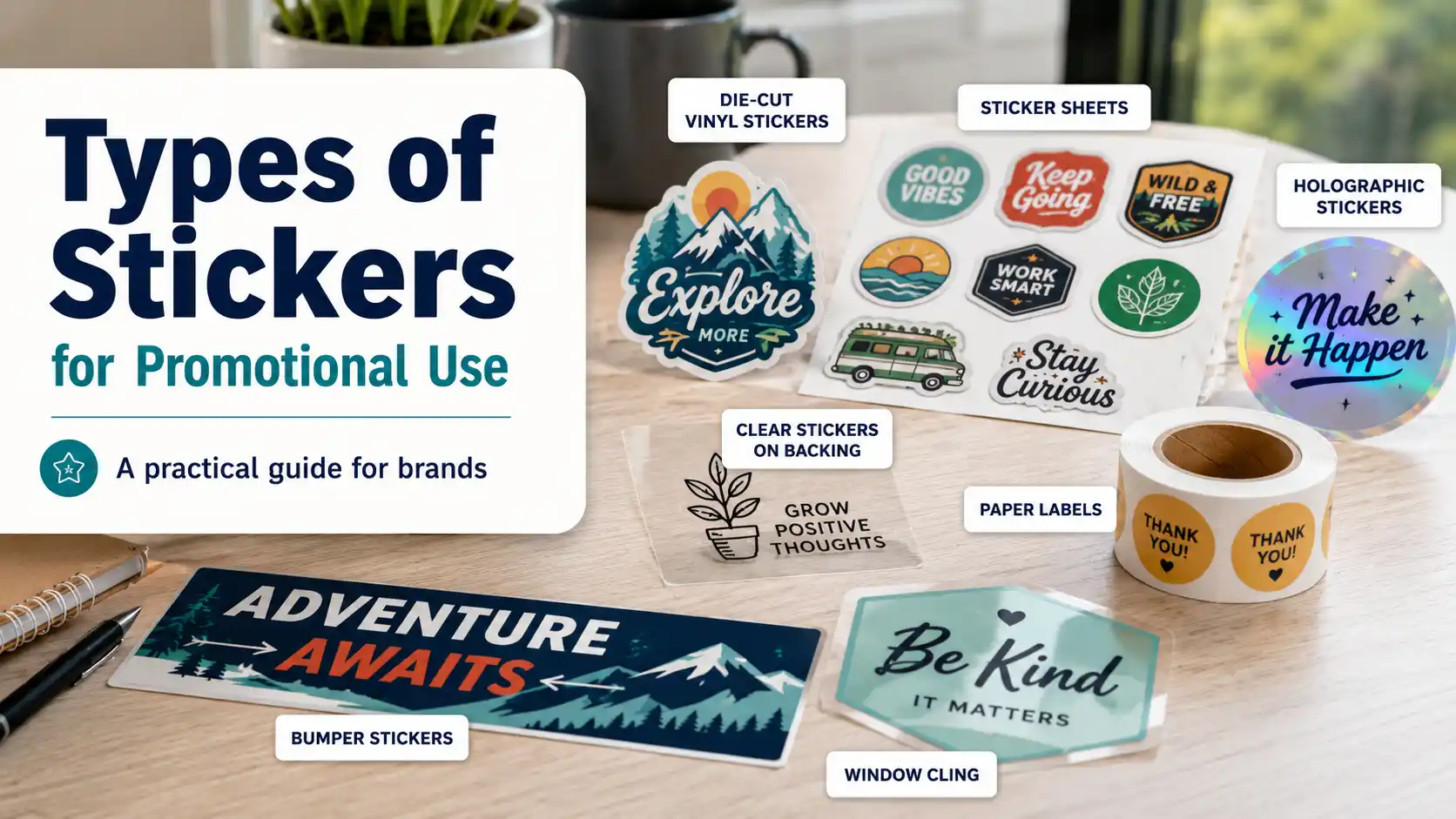
Here are the main types of promotional stickers and when each one makes sense.
Vinyl Stickers
Vinyl stickers are the default choice for most serious promotional use. They are durable, flexible, water-resistant or waterproof depending on the construction, and usually better suited for real-world surfaces than paper stickers.
Use vinyl stickers for:
- Laptops
- Water bottles
- Cars
- Coolers
- Outdoor gear
- Event handouts
- Brand merch
- Retail bag inserts
- Long-term giveaways
Vinyl is especially useful when you want people to keep the sticker. If a customer is going to put it on something they touch every day, vinyl is usually the safer bet.
For most small businesses, vinyl is the best starting point because it handles the widest range of use cases. It is not always the cheapest option, but it is often the best value because the sticker is more likely to survive and more likely to be used.
Paper Stickers
Paper stickers are the budget option. That does not make them bad. It just means they belong in the right lane.
Paper stickers work well for:
- Bakery packaging
- Retail bags
- Indoor event labels
- Short-term promotions
- Thank-you seals
- Product packaging that stays dry
- Low-cost handouts
They are not ideal for water bottles, cars, coolers, outdoor gear or anything exposed to moisture. Paper and weather have never been best friends.
If you are running a short indoor campaign, paper stickers can be perfectly sensible. If you are hoping someone sticks your logo on a laptop for the next two years, go with vinyl.
Die-Cut Stickers
Die-cut stickers are cut to the shape of the artwork. If your logo is a coffee cup, the sticker can be cut around the cup. If your brand mascot is a raccoon holding a wrench, congratulations, that can be the sticker shape too.
Die-cut stickers are best for:
- Logo stickers
- Brand mascots
- Artist merch
- Brewery stickers
- Band stickers
- Coffee shop giveaways
- Retail packaging inserts
- Premium promotional handouts
They feel more custom and more polished than a plain square or rectangle. That makes them one of the strongest types of stickers for promotional use when the sticker itself needs to feel like something people want to keep.
The tradeoff is that the cutline matters. A strange cutline can make a good design look awkward. A smooth, simple border usually works better than trying to trace every tiny detail like the sticker owes someone money.
Kiss-Cut Stickers
Kiss-cut stickers are cut through the sticker layer but not through the backing paper. The backing stays larger and intact, which makes the sticker easier to peel.
They are useful for:
- Intricate designs
- Sticker sheets
- Small promotional stickers
- Event swag
- QR code stickers
- Designs with thin details
- Easy-peel handouts
Kiss-cut stickers are especially practical when you want a clean peel experience. A tiny die-cut sticker can be annoying to remove from the backing. A kiss-cut sticker gives customers more liner to grip, which sounds boring until you watch someone fight with a sticker edge for 14 seconds.
For promotional use, kiss-cut can feel a little more practical than die-cut, especially for small or complex designs.
Clear Stickers
Clear stickers use transparent material so the surface underneath shows through. They can create a “printed directly on the object” look, especially on glass, plastic, metal and smooth packaging.
Clear stickers work well for:
- Glass bottles
- Jars
- Windows
- Minimalist packaging
- Product labels
- Sleek logo applications
- Tech brands
- Beauty and skincare packaging
The main thing to watch is contrast. A dark logo on a dark bottle will disappear. A light logo on a clear window may also vanish unless white ink or a backing layer is used.
Clear stickers look simple, but they are not always simple to design. The surface color becomes part of the design whether you planned for it or not.
Holographic Stickers
Holographic stickers use a reflective rainbow-style material that shifts in the light. They are attention-grabbing, fun and very good at making people pick up the sticker before they even know what it says.
Use holographic stickers for:
- Limited-edition giveaways
- Gaming brands
- Artists
- Music merch
- Skate brands
- Event drops
- Youth-focused promotions
- Packaging inserts that need a little shine
Holographic stickers are not subtle. That is the point.
They can be great when the promotion should feel collectible or special. They are less ideal when you need a clean corporate look or very precise color matching, because the material itself changes how the artwork feels.
Foil Stickers
Foil stickers use metallic effects, often gold, silver, rose gold or chrome. They feel more upscale than standard vinyl or paper stickers and are often used when the brand wants a premium look.
Foil stickers are best for:
- Luxury packaging
- Boutique products
- Wedding businesses
- Cosmetics
- Gift boxes
- Certificates or seals
- Premium event swag
- Limited product drops
Foil is great for accents. It can look cheap if it is overused. A small metallic logo, border or highlight usually works better than turning the entire sticker into a reflective billboard.
Use foil when the sticker needs to feel refined, not when it needs to scream from across the room.
Static Cling Stickers and Window Clings
Static cling stickers, often called window clings, stick to smooth surfaces without adhesive. They are commonly used on glass, mirrors and windows.
They are useful for:
- Storefront promotions
- Seasonal sales
- Temporary window graphics
- Car dealership decals
- Service reminders
- Event signage
- Retail hours or QR code displays
- Indoor glass doors
The big advantage is removability. Since static clings do not use adhesive, they can often be repositioned or removed without residue.
The tradeoff is that they need the right surface. Static clings are not general-purpose stickers. They want smooth glass or similar surfaces. Put one on a textured wall and it will probably give up on life.
For temporary promotional campaigns, though, window clings are excellent.
Bumper Stickers
Bumper stickers are built for outdoor exposure. They are usually made from durable vinyl with adhesive that can handle cars, weather, sunlight and road grime.
Use bumper stickers for:
- Political campaigns
- Nonprofits
- Schools
- Local businesses
- Awareness campaigns
- Clubs and teams
- Outdoor lifestyle brands
- Regional slogans
A bumper sticker needs to be readable fast. This is not the place for six lines of tiny text and a QR code that requires a co-pilot.
Keep the message short. Use strong contrast. Make the sticker durable enough to avoid becoming a sad faded rectangle by the end of the season.
Sticker Sheets
Sticker sheets place multiple stickers on one backing sheet. They are great when you want the giveaway to feel more substantial than a single sticker.
Sticker sheets work well for:
- Conventions
- Artist merch
- Influencer kits
- Kids’ promotions
- Brand mascot sets
- Product launch boxes
- Event swag bags
- Planner or journaling audiences
A sticker sheet can include logos, icons, sayings, mascots, QR codes, product illustrations and social handles. It gives people choices, which makes the giveaway more interactive.
For promotional use, sticker sheets are especially good when the brand has several visual assets. One logo is fine. A logo, mascot, icon set and funny phrase can feel like a real piece of branded merch.
Matte Stickers vs Glossy Stickers
Matte and glossy finishes change the final feel more than people expect.
Matte stickers have a softer, less reflective look. They feel modern, clean and a little more premium. Matte works well for minimalist brands, packaging, boutiques, artists and designs with muted colors.
Glossy stickers are shinier and usually make colors look brighter. Gloss works well for bold logos, colorful artwork, kids’ brands, sports teams, food brands and promotional stickers that need extra visual punch.
Neither finish is automatically better. Gloss gets attention. Matte feels more restrained. Pick the finish that matches the brand instead of treating it like a personality test.
Wall and Floor Decals
Wall and floor decals are larger promotional graphics rather than small handout stickers. They are common in retail stores, offices, trade shows, schools and events.
Use wall and floor decals for:
- Retail promotions
- Directional signage
- Event branding
- Trade show booths
- Office graphics
- Pop-up shops
- Photo backdrops
- Seasonal campaigns
The material matters a lot here. A wall decal needs to match the wall surface. A floor decal needs slip resistance and durability. A cheap sticker on the floor is not a marketing plan. It is a tiny liability with a logo on it.
For large-format promotional use, always think about the surface first.
Quick Comparison: Which Promotional Sticker Type Should You Choose?
| Sticker Type | Best For | Watch Out For |
|---|---|---|
| Vinyl stickers | Long-term giveaways, laptops, bottles, outdoor use | Costs more than paper |
| Paper stickers | Indoor packaging, budget campaigns, temporary labels | Not good for moisture or outdoor use |
| Die-cut stickers | Logos, mascots, premium handouts | Cutline quality matters |
| Kiss-cut stickers | Easy peeling, small designs, sheets | Less shaped as a standalone piece |
| Clear stickers | Glass, jars, sleek packaging | Needs strong contrast or white ink |
| Holographic stickers | Limited editions, artists, gaming, events | Not ideal for strict color matching |
| Foil stickers | Premium packaging, luxury branding | Best as an accent, not everywhere |
| Static cling stickers | Temporary glass and window promos | Only works well on smooth surfaces |
| Bumper stickers | Cars, campaigns, outdoor messages | Must be readable at a glance |
| Sticker sheets | Swag bags, conventions, merch packs | Needs multiple good designs |
| Wall and floor decals | Retail, events, signs, interiors | Must match the surface and use case |
Best Types of Stickers for Promotional Use by Goal
If you want an all-purpose promotional giveaway, choose vinyl stickers. They are durable, familiar and useful on the surfaces people actually care about.
If you want the sticker to feel more custom, choose die-cut vinyl stickers. A clean shape around your logo or artwork makes the piece feel less generic.
If you want easy peeling, choose kiss-cut stickers. They are practical for small designs and work very well for sticker sheets.
If you want a low-cost indoor option, choose paper stickers. They are not built for adventure, but they do fine on packaging, bags and short-term handouts.
If you want something flashy, choose holographic stickers. They are great for artists, gaming brands, music merch and limited-run promotions.
If you want upscale packaging, choose foil stickers or clear stickers. Foil adds shine. Clear creates a cleaner “printed on the surface” look.
If you want temporary glass placement, choose static cling stickers or window clings. They are made for short-term promotions without adhesive residue.
If you want outdoor campaign visibility, choose bumper stickers. They are built for weather and movement, and they are still one of the most recognizable promotional formats.
How to Choose the Right Sticker Without Overthinking It
There are plenty of types of stickers for promotional use, but the decision gets easier when you ask five questions.
Where will the sticker go?
If it might go outside, on a car, on a bottle or on gear, start with vinyl.
How long should it last?
A one-week event sticker does not need the same material as a car decal.
Is it a giveaway or packaging?
Giveaways need to feel worth keeping. Packaging stickers need to apply cleanly and match the product.
Does the design need a custom shape?
If yes, die-cut or kiss-cut is usually the right direction.
Does the finish matter?
Matte feels cleaner. Gloss feels brighter. Holographic and foil feel more special but can distract from fine details.
That is the whole decision tree. Not glamorous, but very useful. Most bad sticker orders happen because someone chose based on price alone, then acted surprised when the cheapest indoor material did not enjoy rain, dishwashers or being slapped on a truck window.
Common Mistakes to Avoid
The first mistake is using paper stickers outdoors. Paper is fine indoors. Outside, it loses the argument quickly.
The second mistake is putting too much text on a small sticker. If the sticker is 3 inches wide, it cannot carry your brand story, mission statement, phone number, slogan, QR code, Instagram handle and the founder’s childhood dream. Pick the important part.
The third mistake is choosing a specialty finish before checking readability. Holographic and foil effects look great, but they can compete with small text or delicate artwork.
The fourth mistake is treating every sticker as a logo sticker. Some of the best promotional stickers are not just logos. They are mascots, jokes, icons, slogans, illustrations or designs that customers actually want to use.
The fifth mistake is ignoring the surface. Glass, cardboard, plastic, metal, painted walls and car bumpers all behave differently. The sticker type should match the surface.
Final Verdict
Yes, there are many different types of stickers available for promotional use. The best one depends on the job.
For most businesses, vinyl stickers are the safest starting point because they are durable, versatile and useful for real-world surfaces. Die-cut stickers are best when you want a polished branded giveaway. Kiss-cut stickers are best for easy peeling and detailed designs. Paper stickers are best for cheap indoor use. Clear, holographic and foil stickers are better when the finish is part of the appeal. Static cling stickers and window clings work for temporary glass promotions. Bumper stickers are built for outdoor messaging. Sticker sheets are excellent for swag, merch and campaigns with multiple design elements.
The simple rule: choose the sticker based on where it will be used, not just how it looks on a product page.
That saves money. It also saves you from ordering 500 stickers that are technically correct and emotionally disappointing.
References and Internal Links
Big Print World Stickers & Labels category
https://bigprintworld.com/stickers-labels/
Big Print World: Top Affordable Poster and Sticker Suppliers for Shop Branding
https://bigprintworld.com/top-affordable-poster-and-sticker-suppliers-for-shop-branding/
Big Print World: Laminated Stickers and Laminating Sheets: What to Order and What to DIY
https://bigprintworld.com/laminated-stickers-and-laminating-sheets-what-to-order-and-what-to-diy/
Big Print World: What Are Some Common Synonyms for “Decal”?
https://bigprintworld.com/what-are-some-common-synonyms-for-decal/