
TLDR
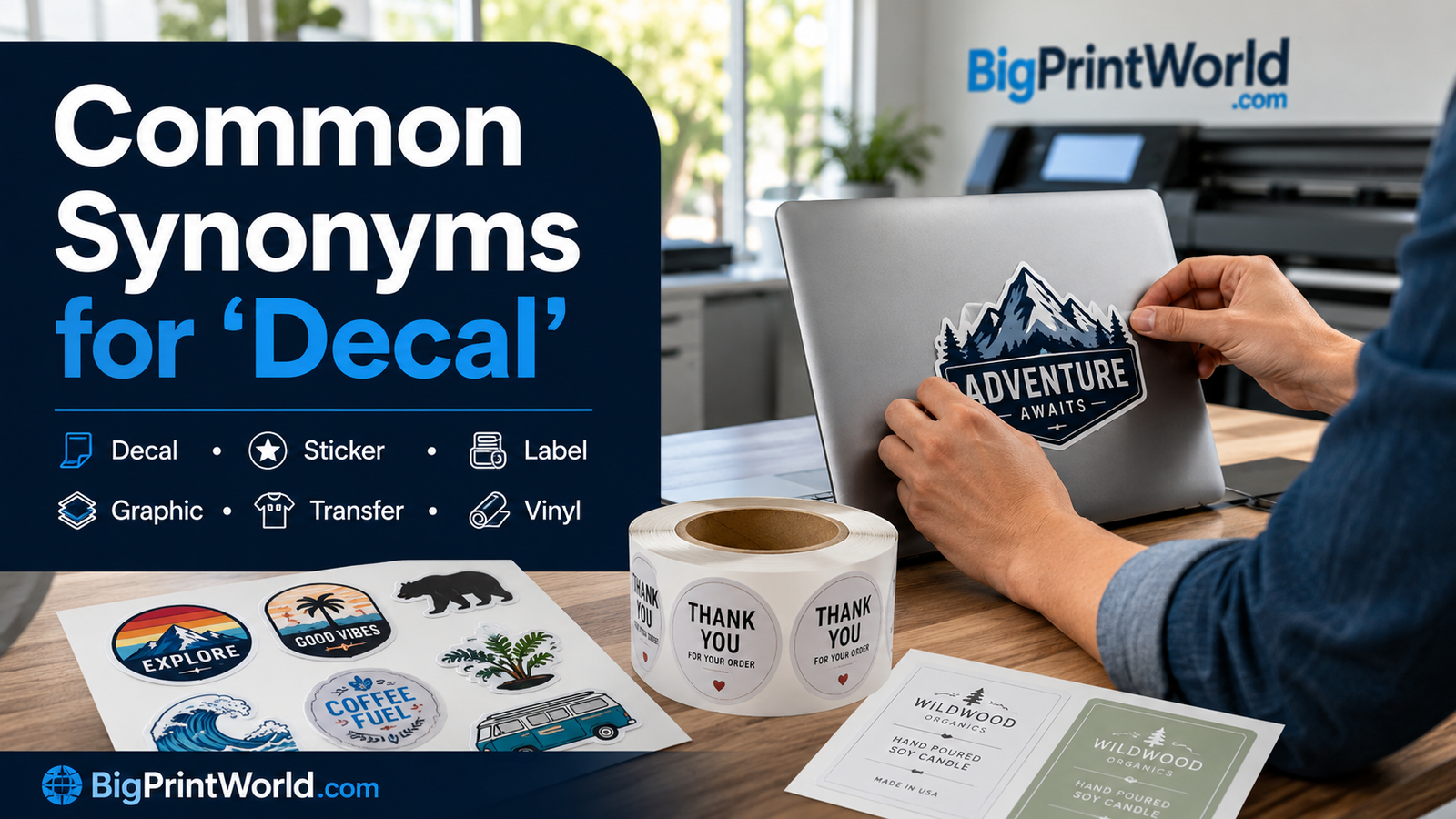
The most common synonyms for decal are sticker, transfer, label, graphic, emblem and cling. In everyday conversation, “sticker” is usually the safest replacement. In printing, signage, vehicles and product labeling, the best word depends on how the item is made and where it will be used.
“Decal” is one of those words that sounds more technical than it really is. Say “sticker” and everyone gets it. Say “decal” and suddenly someone is picturing a race car, a laptop skin, a model airplane kit or a tiny warning label on industrial equipment. All of those can be right, which is annoying but useful.
What Does “Decal” Mean?
A decal is generally a printed design, image or label that gets applied to another surface. The word comes from “decalcomania,” which refers to the process of transferring designs from prepared paper onto another material.
That origin matters because it explains why “decal” can mean slightly different things depending on who is talking. A hobbyist might think of a water-transfer decal. A sign shop might think of cut vinyl lettering. A customer ordering online might just mean a durable custom sticker.
In casual use, decal and sticker overlap a lot. In print and sign work, “decal” often sounds a little more professional or application-specific, especially when the design is going on a car, window, wall, machine, laptop or storefront.
The Most Common Synonym for Decal: Sticker
“Sticker” is the everyday winner.
If you need a simple synonym for decal, use sticker. It is familiar, clear and understood by almost everyone. A sticker usually has adhesive on the back and is peeled from a liner before being pressed onto a surface.
Use “sticker” when talking about:
Custom logo stickers
Laptop stickers
Water bottle stickers
Promotional stickers
Sticker sheets
Die-cut stickers
Kids’ stickers
Event handouts
A sticker can be decorative, informational or promotional. It can be paper, vinyl, clear, matte, glossy, waterproof or removable. The word is broad, which is exactly why people use it so much.
The only downside is that “sticker” can sound less technical than “decal.” If you are describing a vehicle installation, wall graphic or window display, “decal” or “graphic” may sound more accurate.
Transfer
“Transfer” is one of the closest technical relatives of decal.
A transfer is a design that moves from one carrier material onto another surface. This term shows up a lot in model building, craft projects, heat transfer vinyl, rub-on graphics and certain apparel or product decoration methods.
Use “transfer” when the application process matters. For example, a water-slide decal for a model car is often called a transfer. A heat-applied design for fabric may be called a heat transfer. A rub-on lettering sheet may be called a dry transfer.
In other words, “transfer” tells people the design is being moved into place, not just peeled and stuck down.
Label
“Label” is another common synonym, but it has a more informational feel.
A label usually identifies, explains or organizes something. It might show a product name, barcode, ingredient list, warning, size, flavor, shipping address or brand mark. Labels can be decorative too, but their main job is usually communication.
Use “label” when talking about:
Product labels
Jar labels
Bottle labels
Shipping labels
Barcode labels
Warning labels
Packaging labels
Name labels
Roll labels
The difference between a sticker and a label is mostly purpose. A sticker can just be fun. A label usually has a job. Nobody says, “Nice nutritional facts sticker,” unless they are trying to be difficult at a party.
Graphic
“Graphic” is common in professional print, signage and vehicle work.
This term is broader than decal. A graphic can be printed, cut, laminated, mounted, wrapped or installed in many different ways. It can refer to a single decal, a window display, a wall design, a vehicle graphic or a large-format printed piece.
Use “graphic” when the project feels more visual or commercial than casual.
Examples:
Vehicle graphics
Window graphics
Wall graphics
Floor graphics
Retail graphics
Storefront graphics
Trade show graphics
“Graphic” is often the better word when size, placement and installation matter. A small logo on a laptop might be a sticker. A full storefront window design is probably a window graphic.
Emblem
“Emblem” has a more formal or symbolic feel.
An emblem is usually a design that represents a brand, group, organization, team, club, school or identity. It can be printed as a decal, embroidered as a patch, molded as a badge or used as a logo. The word focuses more on meaning than material.
Use “emblem” for:
Car emblems
Team emblems
School emblems
Club emblems
Brand emblems
Military-style designs
Official-looking symbols
If the design feels like a mark of identity, emblem may be the right word. If it is just a funny raccoon holding a slice of pizza, sticker is probably doing fine.
Badge
“Badge” overlaps with emblem, but it often feels smaller, more official or more identifying.
In print and product design, a badge can be a small logo-style design, a certification mark, a product feature callout or a decorative icon. On vehicles, people may call small identifying decals “badges,” especially when they mark a model, trim level or brand.
Use “badge” when the design works like a small marker of identity or status.
Examples:
Model badge
Brand badge
Certification badge
Event badge sticker
Award badge
Limited-edition badge
“Badge” works especially well in design language. A round “Best Seller” sticker on packaging might also be called a badge graphic.
Logo
“Logo” is not a true synonym for decal, but people use it that way when the decal shows a brand mark.
A logo is the design itself. A decal is one possible physical form of that design. So if someone says “logo decal,” they usually mean a printed or cut adhesive version of a company logo.
Use “logo” when the brand mark is the point:
Logo sticker
Logo decal
Logo label
Logo graphic
Window logo
Vehicle logo decal
For ordering print, “logo decal” is clearer than just “logo,” because the printer needs to know what physical product you want.
Cling or Static Cling
A cling is a decal-like graphic that sticks without standard adhesive.
Static clings are commonly used on glass, windows, mirrors and smooth surfaces. They are removable and repositionable, which makes them useful for temporary promotions, seasonal displays, parking permits and window signage.
Use “cling” when you mean:
Static window cling
Removable glass graphic
Temporary window display
Non-adhesive decal
Repositionable window sign
Not every window decal is a cling. Some window decals use adhesive vinyl. Some cling to glass without traditional adhesive. That distinction matters if you plan to remove it later without residue.
Appliqué
“Appliqué” is less common in everyday printing, but it can work in certain decorative contexts.
The word is more often used in fabric, sewing and textiles. It usually means a decorative piece applied to another surface. In print or craft language, appliqué can describe an applied decorative design, though it is not the first word most customers would use when ordering decals.
Use “appliqué” when the design is decorative and applied to a material, especially fabric or craft surfaces.
For most print buyers, though, this word is a little fancy. It is accurate in some contexts, but if you say “vinyl appliqué” to a normal customer, there is a decent chance they will blink twice and order from someone else.
Skin
“Skin” is used for large, form-fitting decals that cover part or all of an object.
This term is common for electronics, gaming devices, laptops, phones, controllers, tablets and sometimes appliances or vehicles. A skin is usually decorative, protective or both. It conforms to the shape of the item and often covers a larger surface area than a normal sticker.
Use “skin” for:
Laptop skins
Phone skins
Console skins
Controller skins
Tablet skins
Device wraps
Protective decorative decals
A skin is basically a decal with ambition. It does not just sit on the object. It tries to become part of the object’s look.
Bumper Sticker
“Bumper sticker” is a specific type of decal made for vehicles.
Traditionally, bumper stickers were rectangular adhesive graphics placed on car bumpers. Now the term is used more broadly for car-friendly stickers and decals, even when they go on windows, laptops or toolboxes.
Use “bumper sticker” when the item is:
Vehicle-oriented
Outdoor durable
Message-based
Political, funny, promotional or cause-related
Usually rectangular or simple in shape
A bumper sticker is not always technically going on a bumper anymore. Language did what language does. It got lazy and somehow more useful.
Window Decal
“Window decal” is not exactly a synonym for decal, but it is one of the most common related terms.
A window decal is made for glass. It may be printed, cut vinyl, clear, opaque, perforated, adhesive-backed or static cling. The word tells the printer and buyer where the decal is going, which helps narrow down material choices.
Use “window decal” for:
Storefront hours
Business logos
Glass door graphics
Seasonal promotions
Car window designs
Safety markings
Interior office glass
For print ordering, this is more helpful than just “decal.” A printer will immediately start thinking about visibility, adhesive side, indoor versus outdoor placement, removability and whether it needs to be readable through glass.
Vinyl Lettering
“Vinyl lettering” is a more specific term for cut vinyl text or simple shapes.
Instead of printing a full-color image, vinyl lettering is usually cut from colored vinyl and transferred onto a surface. It is common on windows, doors, walls, vehicles and signs.
Use “vinyl lettering” for:
Store hours
Business names
Vehicle doors
Mailbox names
Wall quotes
Simple one-color text
Cut logos
Vinyl lettering is a decal category, but not all decals are vinyl lettering. If the design has photos, gradients or detailed full-color artwork, it is probably printed vinyl instead.
Decal Versus Sticker: Which Word Should You Use?
Use “sticker” when you want the clearest everyday word.
Use “decal” when the product sounds more durable, installed, surface-specific or professional.
A laptop design can be a sticker or decal. A car window graphic is more likely to be called a decal. A product ingredient panel is a label. A storefront design is a window graphic. A model airplane marking might be a transfer. A phone covering is a skin.
The best word depends on the buyer, the surface and the application.
Here is the simplest version:
Sticker: Best general-purpose term
Decal: Best for applied graphics on cars, windows, walls, equipment or durable surfaces
Label: Best for packaging, product info and organization
Transfer: Best when the design moves from a carrier sheet by water, heat or rubbing
Graphic: Best for professional signage, vehicle or wall applications
Cling: Best for removable non-adhesive glass applications
Skin: Best for full or partial device coverage
Emblem or Badge: Best when the design represents identity, status or branding
Best Synonyms for Decal by Use Case
For Cars and Trucks
Best terms:
Decal
Vehicle graphic
Bumper sticker
Vinyl lettering
Emblem
Badge
For vehicles, “decal” is usually better than “sticker” when you want the product to sound durable and intentional. “Sticker” can still work, especially for smaller designs, but “vehicle decal” or “vehicle graphic” feels more professional.
For Windows
Best terms:
Window decal
Window graphic
Static cling
Glass decal
Vinyl lettering
Window projects need more specific language because material choice matters. A static cling is different from adhesive vinyl. A clear window decal is different from opaque cut lettering. “Window graphic” is a nice broad term if you are not sure yet.
For Products and Packaging
Best terms:
Label
Product label
Sticker
Logo sticker
Packaging label
Badge
For packaging, “label” usually wins. It sounds more retail-ready and functional. “Sticker” works when the design is decorative, promotional or used as a seal. “Decal” is less common for normal product packaging unless the item is being applied to a durable object.
For Walls
Best terms:
Wall decal
Wall graphic
Vinyl lettering
Mural
Removable wall sticker
“Wall decal” and “wall graphic” are both common. Smaller decorative pieces are often called wall decals. Larger branded or decorative installations may be called wall graphics or murals.
For Electronics
Best terms:
Skin
Laptop sticker
Device decal
Phone skin
Protective decal
If the design covers a large part of the device, “skin” is the cleanest term. If it is a smaller design, “sticker” or “decal” works.
Final Thoughts
The best synonym for decal is usually “sticker,” but it is not always the most precise word. If you are writing casually, sticker is safe. If you are ordering print, describing a product or trying to match the right material to the right surface, words like label, transfer, graphic, cling, skin and vinyl lettering can be more useful.
The practical trick is to name the surface and the purpose. “Window decal” is better than “decal.” “Product label” is better than “sticker” when the item carries required information. “Laptop skin” is better than “big laptop decal” if it wraps the device.
Print terms are messy because real products overlap. That is not a failure of language. Well, maybe it is a little. But once you know the common synonyms for decal, it gets much easier to ask for the right thing and avoid ordering a product that almost, but not quite, matches what you meant.
References
https://www.merriam-webster.com/dictionary/decal
https://dictionary.cambridge.org/us/dictionary/english/decal