
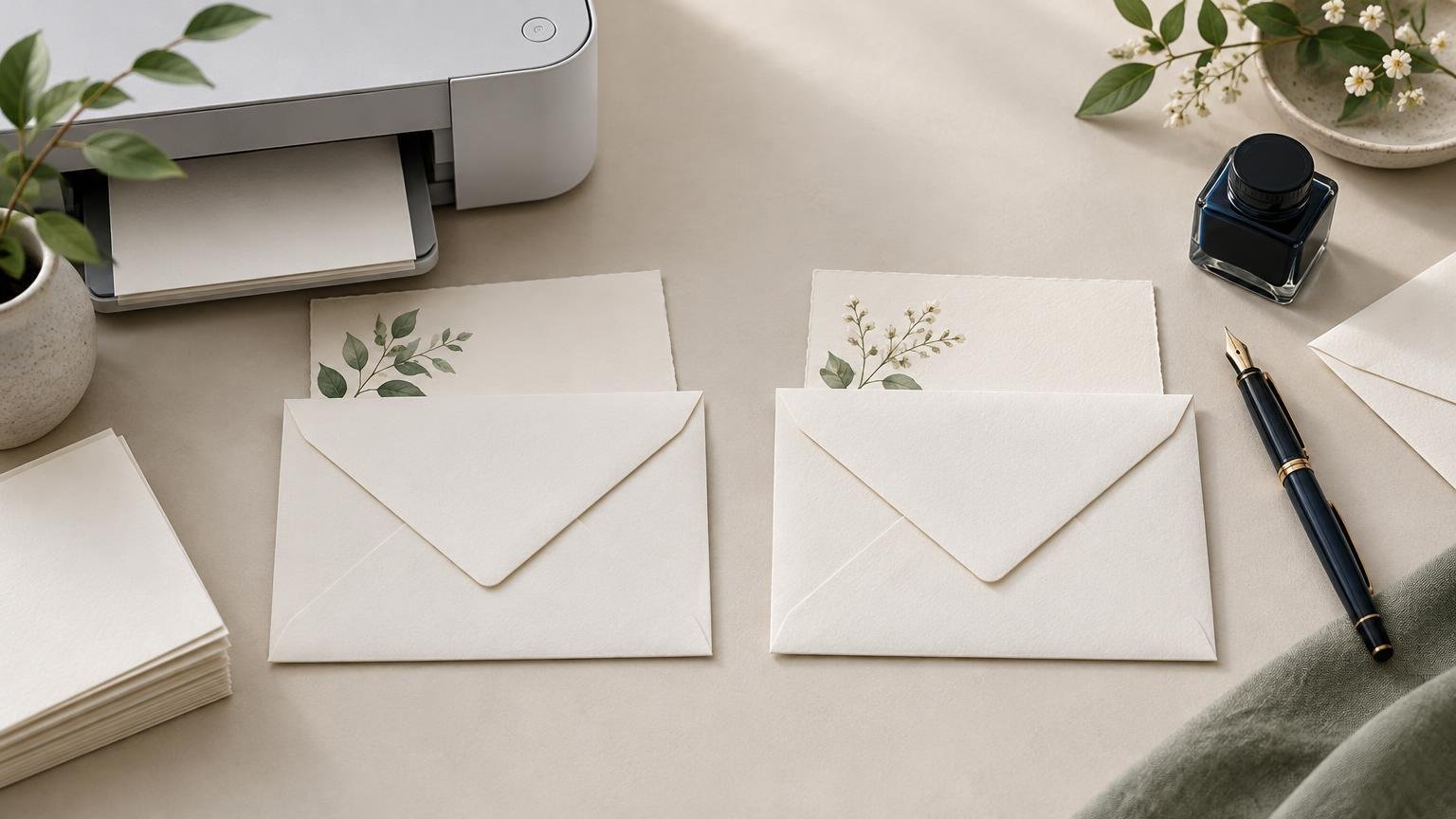
For most large or deadline-sensitive invitation lists, printed addressing is worth considering because it turns a finalized guest spreadsheet into a consistent set of envelopes. Handwritten addressing is the better fit when the list is small, the personal touch matters, and you have enough time—and sufficiently steady handwriting—to complete the job without resenting every mailbox in the country.
The choice between printed addressing vs handwritten envelopes is not really about whether a printer can make prettier letters than you can. It is a tradeoff among time, formality, guest-list accuracy, correction costs, and the appearance you want. Professional calligraphy and hybrid addressing occupy the useful middle ground. This is a research-based comparison; the final price and production schedule will depend on the printer or calligrapher you choose.
Printed addressing vs handwritten envelopes at a glance
| Factor | Printed addressing | Handwritten addressing | Professional calligraphy |
|---|---|---|---|
| Best fit | Larger lists, coordinated suites, repeatable output, tighter schedules | Small lists, personal presentation, informal or intentionally traditional events | Formal events where distinctive lettering is part of the stationery design |
| Time commitment | Requires spreadsheet cleanup and proofing, but little repetitive writing | Requires writing, checking, drying, and correcting every envelope | Requires list preparation plus vendor scheduling and review |
| Consistency | Highly consistent when the source data and proof are correct | Naturally varies from envelope to envelope | Consistent style, with handmade variation |
| Personal character | Can feel polished but less individually made | Strong personal touch, especially when written by a host or couple | Handmade and decorative without requiring your own lettering skills |
| Error correction | Easy before approval; potentially expensive or inconvenient after production | Usually costs one extra envelope and the time to rewrite it | May require another envelope, more vendor time, and an added charge |
| Cost structure | Usually a service fee, per-envelope price, package inclusion, or upgrade | Low direct cost if you already have suitable pens and spare envelopes | Typically the highest-cost option because skilled labor is involved |
| Mailing readiness | Excellent when the type is readable and conventionally placed | Excellent when the writing is dark, clear, and complete | Depends on legibility; highly decorative lettering may need a simpler postal-address treatment |
There is no universal cost winner. Printed addressing can be included by one invitation company and sold as an upgrade by another. Handwriting appears free until you count pens, extra envelopes, and several evenings of labor. Calligraphy adds professional labor and scheduling. Compare the complete order rather than assuming that one method is automatically cheaper.
When printed envelope addressing is worth the upgrade
Printed addressing becomes more attractive as the number of households rises. Notice the important word: households. A wedding with 160 guests might require 85 envelopes rather than 160, while a business announcement sent to 160 separate recipients still requires 160. Count actual mailpieces before comparing service fees or estimating your workload.
The strongest case for printing is operational. You prepare one clean data file, map its fields to the printer’s template, inspect a proof, and approve a repeatable layout. This can eliminate the physical task of writing dozens or hundreds of envelopes, although it does not eliminate the intellectual task of deciding whether the recipient should appear as “Dr. Rivera and Mr. Chen,” “Alex and Morgan,” or something else.
Printing also helps when the envelope should coordinate closely with the invitation. A restrained version of the invitation typography can make the suite feel intentional. It need not look like a utility bill. Color, spacing, hierarchy, and a well-chosen typeface can create a formal result without pretending that a font is hand calligraphy.
It is especially practical if you are already using an invitation platform with guest-list tools or comparing wedding invitation design and guest-management tools. Some services collect addresses digitally and transfer them into an envelope workflow; others require a spreadsheet in an exact format. If you are ordering invitations and coordinating the matching envelopes, check whether addressing is included, optional, or unavailable before settling on the overall design.
The catch is that a printed error is repeatable too. A misspelled surname in the master file can appear perfectly and consistently on every relevant piece. Corrections are usually easiest before approval. Once production begins, replacing an envelope may require a separate order, another proof, extra production time, or a minimum charge. The convenience pays off only if the source list is ready for it.
When handwriting is the better choice
Handwriting makes sense for a small mailing, particularly when the writer has clear lettering and wants each envelope to feel individually prepared. It also works well for casual celebrations, showers, birthday invitations, thank-you notes, and intimate weddings where a polished but visibly human presentation suits the event.
Traditional wedding etiquette commonly favors hand-addressed envelopes over adhesive address labels. Emily Post presents that as etiquette guidance, not a postal regulation. Its wedding invitation guidance recommends hand addressing, but USPS does not require wedding envelopes to be handwritten. That distinction matters: tradition can influence the atmosphere of the invitation, while mailability depends on the completed mailpiece and the readability of its address.
Handwriting also makes isolated corrections relatively painless. If one guest moves before mailing, you can discard a single envelope and write another. That flexibility is valuable when addresses are still arriving or household arrangements are changing. It is less valuable if handwriting 90 envelopes turns into an unpaid second job three nights before the mailing deadline.
Be honest about your lettering rather than comparing it with a carefully staged social-media example. Clear, ordinary handwriting is preferable to decorative lettering that is difficult to read. If your normal script becomes less legible after the tenth envelope, use neat print lettering, split the work carefully, hire a calligrapher, or choose direct printing.
Calligraphy, digital calligraphy, and hybrid options
Professional calligraphy is the premium option when the envelope itself is part of the visual experience. It can be appropriate for a formal wedding, a small luxury event, or a suite in which handmade details carry real importance. Its value is subjective: you are paying for skilled labor and presentation, not for a postal advantage.
Ask a calligrapher about lead time, accepted envelope materials, ink colors, guest-list format, revision terms, and the number of spare envelopes required. Textured, coated, dark, or unusually absorbent papers may affect the tools and ink that can be used. Do not assume your preferred metallic or pale ink will also be the easiest postal address to read.
Digital calligraphy uses a script typeface or digitized lettering printed directly on the envelope. It provides consistency and a calligraphic mood without making every envelope by hand. The risk is choosing an ornate font with elaborate swashes, tight spacing, or weak contrast. Decorative type can be used for the recipient’s name while the street address, city, state, and ZIP Code remain simple.
Hybrid approaches often provide the best balance. Practical combinations include:
- Print the complete delivery address, then add a short handwritten note or flourish away from the postal information.
- Handwrite the recipient’s name but print the street address and locality in a simple typeface.
- Print the outer envelope and hand-address an inner envelope used for presentation and household clarification.
- Use professional calligraphy for a small VIP or family group and direct printing for the rest, provided the difference will not create unnecessary social awkwardness.
- Print return addresses on every envelope while handwriting only the recipient side.
Your guest-list workflow matters more than the lettering method
A clean master list is the foundation of both printing and handwriting. Emily Post recommends maintaining the guest list in a spreadsheet or database, checking spellings, leaving sufficient time for addressing, and obtaining extra envelopes for mistakes. A spreadsheet is not glamorous, but neither is discovering that Aunt Catherine has been converted into Aunt Katherine on 70 pounds of otherwise elegant stationery.
Use one master file rather than copying addresses among email, text messages, a planning app, and a printer template. Give each household one row and separate information into consistent fields. At minimum, retain the recipient line, street address, secondary unit information, city, state, ZIP Code, country when applicable, and any preferred formal or social name.
Before submitting a printed-address file or beginning to write, complete this proofing pass:
- Resolve duplicate households and confirm which guests should share an envelope.
- Verify spelling, titles, partners’ names, apartment or unit numbers, directional abbreviations, and ZIP Codes.
- Decide on one naming style and apply it consistently, while respecting each guest’s actual title and preferred name.
- Flag long names and addresses that may wrap or require a smaller type size.
- Check international recipients separately because address structures vary by country.
- Have another person compare the final list with the source messages or address submissions.
- Freeze the approved file and date it so an older version cannot accidentally reach the printer.
If you are still deciding what information belongs in each piece, first separate the jobs of the save the date and wedding invitation. Finalize the recipients only after you know which event details and RSVP path each household needs.
How many extra envelopes should you order?
There is no single correct number supported by the available guidance. The sensible quantity depends on your addressing method, list stability, and reorder difficulty. Handwriting and calligraphy usually justify more spares because ink smears, spelling mistakes, paper variations, and late address changes are handled one envelope at a time. Printed addressing may need fewer writing-error spares, but replacements can be harder to obtain if the printer will not produce single corrected envelopes.
Instead of relying on a universal percentage, list the realistic failure points: writing mistakes, printer spoilage, guest moves, additions, damaged envelopes, and keepsakes. Then ask the printer or calligrapher how replacements work. Extra blank envelopes ordered with the suite are usually more useful than discovering later that the exact color or size is unavailable.
Mailing readiness: readability matters more than the method
USPS guidance calls for a clear, legible delivery address in the center of the address side, with postage in the upper-right area. It also places the return address in the upper-left area. These principles apply whether the letters were made by a digital press, a calligrapher, or your favorite felt-tip pen.
Use strong contrast and leave breathing room around the postal address. Avoid putting artwork, flourishes, or unrelated text where they could compete with it. USPS advises simple, readable type, and highly decorative wedding-style typography can be more difficult for processing equipment to interpret. USPS delivery-address guidance is a useful final reference when setting up the envelope.
Do not treat address printing as a postage decision. Postage depends on the assembled mailpiece’s weight and physical characteristics—not on whether the address was printed or handwritten. Square, rigid, lumpy, or unusually shaped pieces can be nonmachinable and may require additional postage. Wax seals, bulky knots, thick enclosures, and rigid embellishments can therefore matter far more than your choice of lettering.
The practical verdict
Choose printed addressing when you have many households, a stable spreadsheet, a coordinated stationery design, or a deadline that makes repetitive handwriting unrealistic. It is generally a workflow upgrade rather than an inherent quality upgrade. Compare the provider’s current fee, proofing process, correction policy, production estimate, and replacement options before ordering.
Choose handwriting when the list is manageable, personal effort is part of the message, or you need the freedom to correct individual envelopes as addresses change. Choose professional calligraphy when handcrafted presentation is important enough to justify added cost and scheduling. Choose a hybrid when you want some personal character without sacrificing consistency or postal readability.
Whichever method wins, settle it early enough to protect your wedding invitation mailing timeline. The best-looking envelope is not the one with the fanciest script. It is the one with the right guest’s name, a correct and readable address, suitable postage, and enough time to arrive before the event.
Frequently Asked Questions
When is printed envelope addressing worth the upgrade?
It is most useful for larger household lists, coordinated stationery, stable address data, or deadlines that make repetitive handwriting impractical. Confirm the provider’s current fees, proofing rules, production estimate, and correction options before ordering.
Can printed envelopes still look personal and formal?
Yes. Coordinated typography, spacing, color, and hierarchy can create a polished result. A hybrid approach—such as printing the postal address and adding a handwritten note or recipient name—can add personal character.
What should be finalized before submitting an address file?
Use one master list and verify names, titles, partners, unit numbers, cities, states, ZIP Codes, countries, duplicates, and preferred forms of address. Emily Post also recommends checking spellings, allowing enough addressing time, and obtaining extra envelopes for mistakes.
What happens if an error is found after printed envelopes are produced?
Correction terms vary by provider. A replacement may require another proof, added production time, a separate order, or a minimum charge, so resolve errors before approval and ask how corrected envelopes are handled.
Can a script font remain readable for mailing?
Yes, if it has strong contrast and uncomplicated spacing. Decorative lettering can be reserved for the recipient’s name while the street address, city, state, and ZIP Code use simpler type. USPS prioritizes a clear, legible delivery address.