
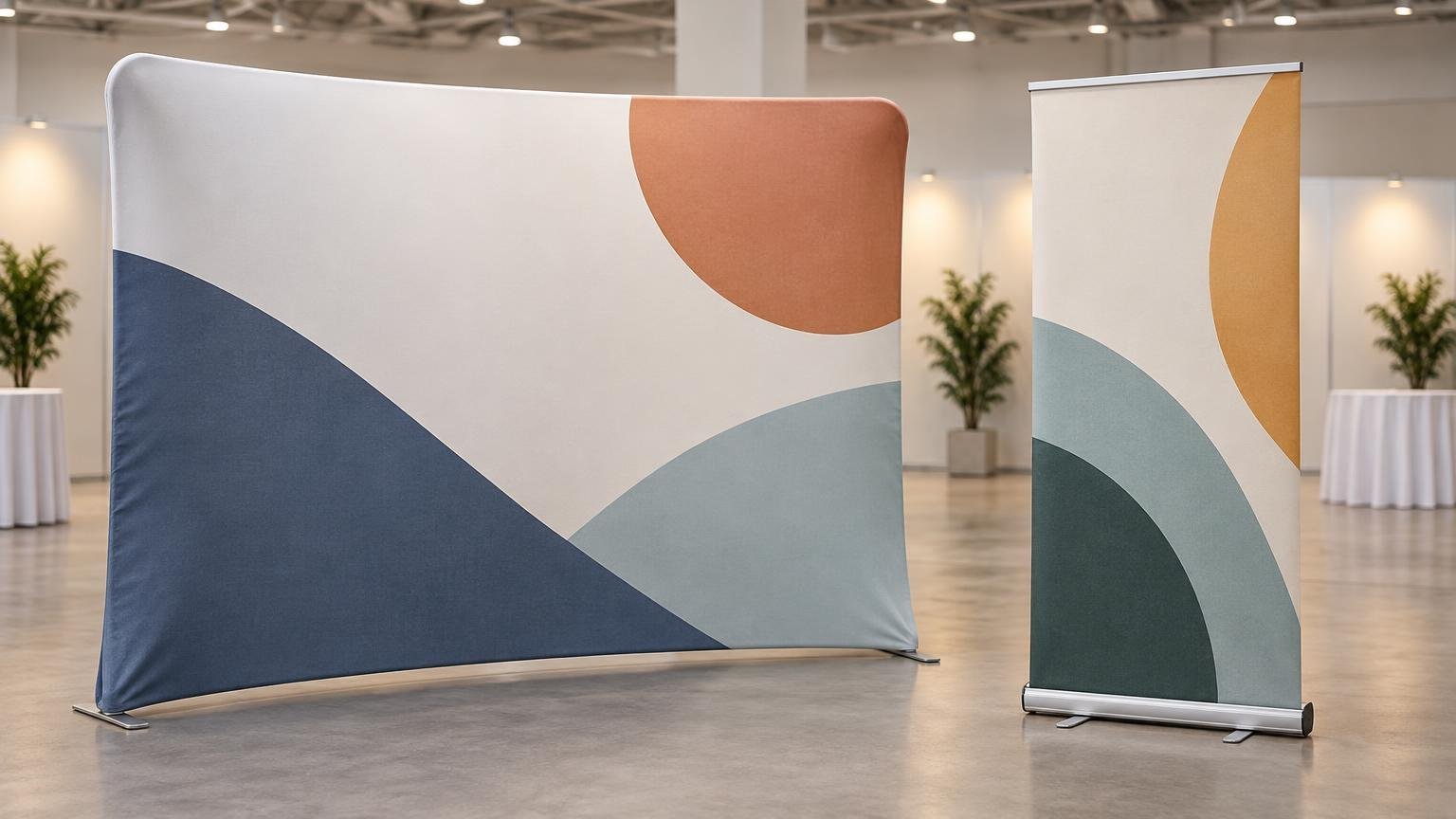
Choose a tension fabric display when the booth needs a broad, polished visual backdrop that can support interchangeable graphics. Choose a retractable banner when portability, compact placement and straightforward deployment matter more than creating one large visual surface.
That is the practical dividing line, but neither category wins every individual comparison. Retractable hardware ranges from short-term economy stands to deluxe systems designed for repeated graphic changes. Tension fabric products range from narrow towers to wide backwalls and curved frames. The model, width, case and hardware tier matter at least as much as the category name.
The differences that matter at a trade show
| Factor | Tension fabric display | Retractable banner | Practical winner |
|---|---|---|---|
| Setup | Multi-piece frame, feet and fitted fabric graphic | Base, support pole and pull-up graphic | Retractable for fewer loose parts, although model design matters |
| Transport | Frame sections, feet and folded fabric | Long base, pole and rolled graphic | Depends on packed dimensions, weight and travel method |
| Visual impact | Seamless-looking fabric surface; broad backwall formats available | Visible base and support pole; works well as a narrow sign | Tension fabric for a booth backdrop |
| Graphic replacement | Commonly available as a separate fitted graphic | Easy on some systems and awkward on others | Tension fabric for predictable campaign changes |
| Wrinkle or curl concern | Fabric may need proper packing and care; frame tension smooths the installed graphic | Graphic stays rolled in the base, but edge curl can still vary by media and use | Neither is maintenance-free |
| Storage | More separate components, usually stored together in a case | Graphic stays protected inside the base | Retractable for self-contained storage |
| Initial cost | Often higher for comparable freestanding kits | Economy options can cost less | Retractable, especially for one-off or occasional use |
Setup: retractable is simpler, but not automatically faster
A typical retractable stand uses a spring-loaded base that stores the graphic. Setup generally means positioning or rotating the stabilizing feet, assembling the pole, pulling the graphic upward and attaching its top rail. The University of Iowa retractable banner instructions show this familiar sequence.
A freestanding tension fabric display has more separate parts. A common sequence involves connecting numbered frame sections, installing the feet or base plates and pulling a fitted fabric graphic over the completed frame. This tension fabric display assembly guide illustrates the process for a wide display.
Retractable sounds like the obvious speed winner, and it often feels simpler because the graphic remains attached to the base. The available guides do not establish a universal measured setup-time advantage, however. Width, pole design, frame construction and user familiarity all affect the result. A practiced exhibitor can assemble a labeled tube frame quickly, while an unfamiliar retractable with a segmented pole can produce its own brief episode of convention-hall slapstick.
Transport and storage depend on the packed kit
Retractables travel as a long base, a pole and a case. Tension fabric kits break down into shorter frame sections, feet and folded fabric. The tension system has more pieces to track, but its package may be shorter than the assembled display width suggests. The retractable is more self-contained, but its base remains a long, rigid object.
Published examples show why the product sheet matters. One short-term retractable line lists shipping weights of 6 to 7 pounds for widths from 24 to 33 inches. A separate 7.5-foot-wide tension display lists a packed size of 33 by 11 by 6 inches and a packed weight of 8.8 pounds. These are not equivalent displays, but they demonstrate that a wide fabric system is not necessarily an enormous travel burden—and that category-level assumptions about weight are unreliable.
For air travel or frequent shipping, compare the complete case dimensions and packed weight. For local events, count the number of cases and whether one person can carry the display alongside boxes, samples and a printed trade-show tablecloth. A beautifully compact stand is less helpful when the rest of the booth requires three additional trips from the parking lot.
Footprint: check the feet, not the marketing photo
There is no universal footprint winner. Tension fabric frames may use projecting feet or broad base plates. Retractables may have fold-out or swivel feet extending from the housing. Product photos taken from the front tend to make these details disappear with suspicious efficiency. Check the actual base or foot dimensions against the booth plan.
A narrow retractable is useful beside a table, at a booth entrance or as one part of a modular display. Tension fabric works especially well when the graphic itself needs to define the back of the booth. If every inch matters, plot the display depth together with the table, chairs, literature racks and visitor standing area rather than comparing banner widths alone.
Visual impact, wrinkles and curl
Tension fabric usually has the stronger case for a unified visual presentation. FedEx Office describes its dye-sublimated fabric graphic as wrinkle-resistant and fitted over the frame for a seamless appearance, with double-sided printing available. The fabric stretches across the structure, so the hardware is less visually prominent than the base and pole of a retractable.
Retractable banners remain effective for logos, offers, schedules, directional information and focused product messages. Standard sizes commonly include narrow formats around 23 to 33 inches wide, although 47-inch and wider models also exist. Retractables are not inherently small; they simply tend to look like individual sign units rather than one continuous booth wall.
Neither format deserves a magical “always flat” label. Tension fabric is commonly marketed as wrinkle-resistant, but folded graphics still need correct packing and care. Washing, drying, steaming and ironing instructions vary by material: one guide prohibits ironing, while another permits cool ironing or steaming. Follow the instructions supplied for the exact graphic rather than applying generic fabric advice.
Retractable graphics avoid folding because they roll into the base. Some products use anti-curl or blockout media, but those claims do not guarantee that every graphic will remain perfectly flat after repeated travel and use. Hardware alignment, media choice and handling still matter.
Replacement graphics and repeat use
Graphic replacement is one of the clearest advantages of a well-supported tension fabric system. Suppliers offer replacement fabric separately, allowing the frame to serve multiple campaigns. The important catch is compatibility: the new graphic must match the frame dimensions, shape and closure design.
Retractable replacement depends heavily on hardware tier. One supplier describes an economy model intended for one graphic, a standard system with interchangeable graphics and a deluxe version designed for frequent changes. Replacement procedures may involve adhesive leaders, clamps, tension pins or removable cassettes, and poor handling can damage the graphic or mechanism.
For recurring events with a new campaign each season, price the replacement process before buying the first kit. A cheap retractable can be sensible when its message will remain current for years. It becomes less attractive if every update requires another complete stand. Conversely, premium interchangeable retractable hardware may be worthwhile when each event needs several narrow signs rather than one large backdrop.
Sidedness also affects the decision. Many standard retractables are one-sided, though double-sided systems exist. Fabric systems are commonly available with two printed faces. Pay for the second side only when attendees can approach from opposing directions; a display backed against a booth wall gains little from artwork nobody can see. The same principle applies when choosing between single-sided and double-sided banners.
Total cost is more than the first kit price
Retractables generally provide the lower entry point, particularly in economy hardware. One supplier comparison listed a 33-by-81-inch standard retractable starting at $148.96 with its graphic, while a somewhat larger 36-by-90-inch tension fabric display started at $363.96. In wider examples, a 47-by-81-inch retractable started at $309.04 and a 48-by-90-inch tension display at $453.80. The sizes and construction are not perfectly matched, so these figures illustrate the pricing pattern rather than proving a universal percentage difference. Prices should be checked again when ordering.
For the broader print package around the booth, printiverse.com covers general custom printing and related print products. Keep the display comparison itself disciplined: use matching dimensions, sidedness, hardware tier and delivered cost wherever possible.
Which display should you order?
Order a tension fabric display when the booth needs a polished backdrop, a larger uninterrupted visual field or regular graphic swaps. It is especially convincing for brand photography, product launches and repeated appearances where the frame can earn its cost across several campaigns.
Order a retractable banner when you need a portable sign for a compact space, expect to use the same message repeatedly or want several independent graphics that can be repositioned around the booth. Spend above the economy tier when frequent deployment or graphic replacement is part of the plan.
For many exhibitors, the strongest booth uses both: a tension fabric backwall for the main brand image and one or two retractables for changing offers or directional messages. If the budget allows only one, decide whether the display's primary job is to create the booth environment or communicate a movable, focused message. That answer matters more than any blanket claim that one format is faster, lighter or more durable.
References
- RETRACTABLE BANNER SET-UP INSTRUCTIONS
- # 10' Tension Fabric Displays: Assembly Guide
- Tension Fabric Displays: Tension Fabric Backdrop | FedEx Office
- Retractable Banner Stand Hardware | Tex Visions
- Compact Retractable Banner Stands | NTXPrint
- www.acedisplays.com
- Custom Banner Stands & Retractable Banners | Ardor Printing
- STP Retractable Banner Stand (Short-Term Purpose) | Hadrus Vinyl Graphics
- BRITTEN
TENSION FABRIC DISPLAYLIGHT-WEIGHT TEN
- www.xyzdisplays.com
- Custom Banner Printing for Events & Promotions | FedEx Office