
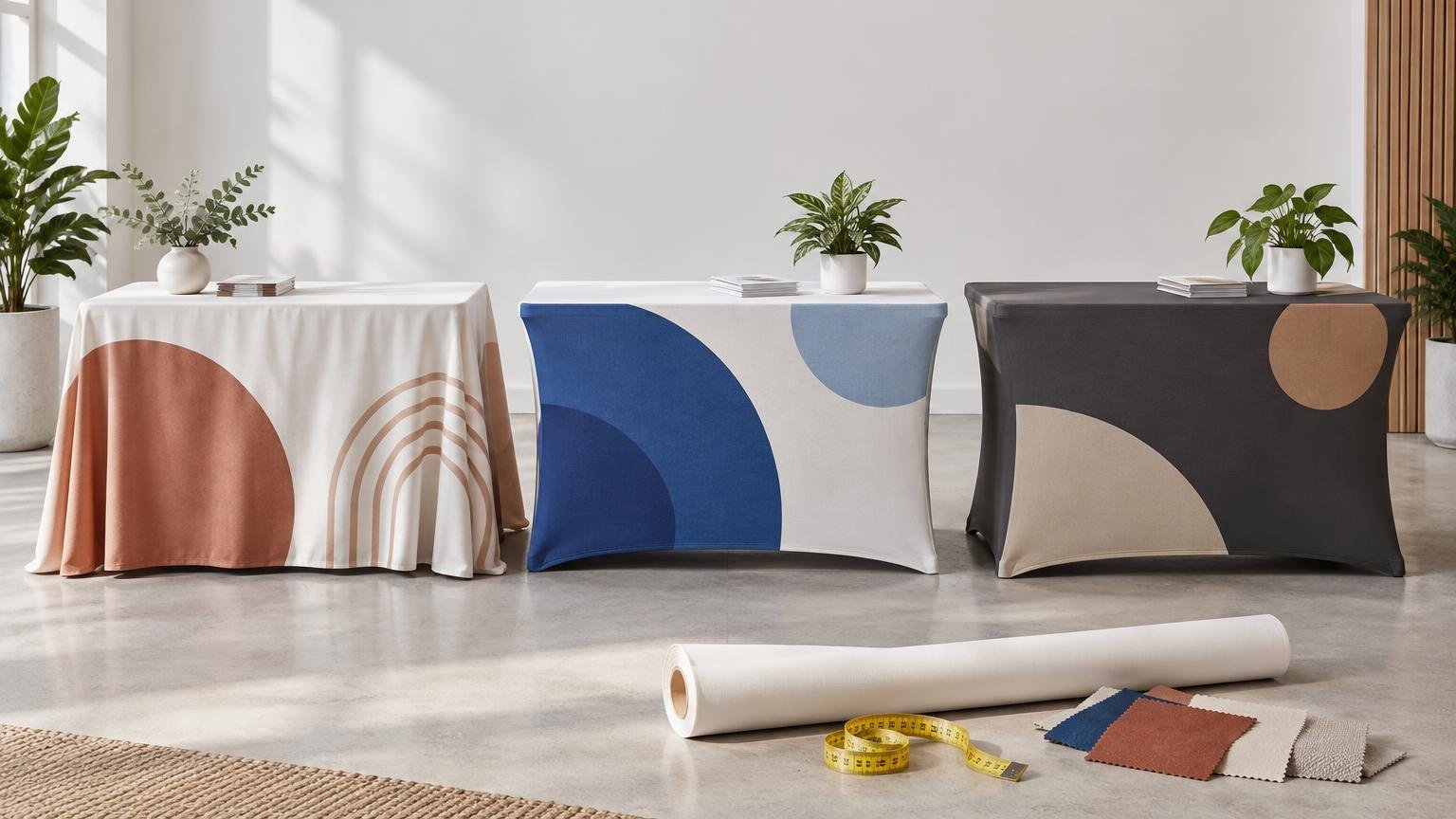
For most trade shows, markets, and registration desks, custom tablecloth printing comes down to four decisions: the correct table dimensions, the right cover style, readable artwork, and compliance with the venue’s rules. A loose throw is the flexible default. A fitted cover looks tidier, while a stretch cover creates the most tailored appearance. A runner works when you already own plain table linens or want a smaller branded piece.
Do not order by the phrase “standard table” alone. Measure the actual table, download the printer’s template, and check the finished cover’s rear access and fire-safety documentation. These details are considerably less exciting than choosing the logo color, but they are also the details that keep the finished display from looking like it borrowed the wrong trousers.
Choose the cover style before preparing artwork
Printers use several overlapping product names, including table throw, table cover, branded tablecloth, fitted cover, stretch cover, and table runner. The important distinction is how each product sits on the table, not what the product grid happens to call it.
| Style | How it fits | Best use |
|---|---|---|
| Loose throw | Drapes over the top and sides | General events, changing table sizes, and easy setup |
| Fitted cover | Sewn to match a specified table shape and size | A clean, structured booth with a known table |
| Stretch cover | Pulls taut around the table, often attaching near the legs | Modern displays where a tight silhouette matters |
| Runner | A narrow textile placed over a bare table or plain cloth | Portable branding or updating existing linens |
Open-back or three-sided covers leave the rear accessible for seating, boxes, cables, or supplies. Closed-back or four-sided versions cover the rear panel too. That creates a more complete appearance from multiple viewing angles, but it can make under-table storage less convenient. A “single-sided” print description may still mean that artwork covers the top, front, sides, and rear exterior panels while the reverse of the fabric remains unprinted. Always inspect the supplier’s printable-area diagram rather than guessing from the label.
Measure length, depth, and height
Common rectangular covers are designed around 4-foot, 6-foot, and 8-foot banquet tables. Approximate listed table dimensions include 48 by 24 by 30 inches for a 4-foot table, 72 by 30 by about 29 to 30 inches for a 6-foot table, and 96 by 30 by about 29 to 30 inches for an 8-foot table. These are useful reference points, not permission to skip the tape measure.
Measure the tabletop length and depth, then measure from the floor to the top surface. Counter-height tables, narrow folding tables, and custom display counters can differ enough to ruin the intended fit. With a loose throw, a small discrepancy may merely change the drop. With a fitted or stretch cover, it can create sagging, exposed legs, or a cover that simply will not go on. Round tables require their diameter and height rather than rectangular length and depth.
Also confirm whether the dimensions describe the table or the finished fabric. Those are not interchangeable. A full-length throw must include enough material to cross the top and reach toward the floor, while a fitted cover is constructed around the table’s three-dimensional shape.
Polyester and dye sublimation are the common pairing
Polyester is widely offered for promotional table coverings, including woven, heavier, recycled, and stretch variations. Many of these products use dye-sublimation printing. According to Epson’s explanation of sublimation printing, the process works with polyester fabric, and higher polyester content generally produces more vivid results.
That common production method does not make every table cover equivalent. Fabric weight, weave, stretch, sewing, color reproduction, wrinkle behavior, washing instructions, and durability can differ among products. Treat “polyester” as the beginning of the specification, not the entire specification.
Ask for the fabric weight or construction when appearance matters, especially for brightly lit booths where thin material may show boxes or table legs underneath. If repeated washing is likely, read the product-specific care instructions before ordering. Sellers publish different washing, drying, and outdoor-use guidance, so a general claim such as “washable” needs the actual care method attached to it.
Use the printer’s template for bleed and safe areas
A table cover is not a flat poster. Artwork may cross the tabletop, descend over panels, approach sewn edges, or distort when stretch fabric is installed. Supplier templates account for panel boundaries, seams, dimensions, bleed, and the portions most likely to be visible.
Bleed extends artwork beyond a finished edge so small cutting or sewing variations do not leave an unintended unprinted line. Adobe’s guide to print bleed explains the general principle, but the printer’s own template must determine the required amount and safe zones for a specific cover.
Keep the logo and essential text inside the designated safe area. Avoid placing phone numbers, QR codes, or small type directly across seams and folds. On a conventional booth table, the front panel carries the main message because it faces the aisle. The tabletop can hold secondary graphics, but brochures, products, laptops, and elbows have a remarkable ability to cover whatever seemed important in the design file.
- Download the template for the exact size and cover style.
- Build the artwork at the template’s specified scale.
- Extend backgrounds and images through the required bleed.
- Keep logos, text, and QR codes inside the safe area.
- Check which template panel becomes the front of the finished cover.
- Outline or package fonts if the supplier requests it.
- Export in an accepted format and review the proof at high magnification.
Design for the aisle, not the computer screen
The front panel should communicate one clear identity from several feet away. A logo, short descriptor, and high-contrast background usually outperform a miniature catalog of services. Fine details can disappear in fabric texture and folds, while low-contrast colors become harder to read under uneven exhibition lighting.
If the table is part of a larger booth, coordinate its colors and message with the banner, mounted sign, or poster rather than treating every item as a separate design project. Our guide to foam board versus poster paper for event displays can help with the sign above or beside the table, while the large-format printing guide covers broader display planning.
When the cover is one item in a wider event kit, Printiverse custom printing and print products can also provide a starting point for considering related pieces. Keep one master color reference and one approved logo file across the set; otherwise, “close enough” shades have a habit of becoming noticeably unrelated once they share a booth.
Check venue rules before approving the order
Some exhibition venues require table coverings and booth fabrics to be flame-resistant or flame-retardant, and inspectors may request supporting documentation. The exact rule can vary by building and event. Materials accepted at one show are not automatically accepted at the next. Guidance collected in GES event work rules includes venue-specific requirements, while other event manuals may reference standards such as NFPA 701.
Ask the printer for the applicable test report, certificate, or product documentation before ordering. A seller’s statement that a fabric was tested under a named standard does not by itself confirm that the finished product meets every venue’s rule. Send the documentation to the show organizer when the requirement is unclear rather than arriving with a tablecloth and a developing interest in fire codes.
Plan for care, weather, and turnaround
Printed fabric may be described as suitable for events, but outdoor suitability varies. Current seller guidance ranges from limited use in mild outdoor conditions to recommendations for indoor use because extreme weather can damage the fabric. Wind is also a practical problem: even if the print survives, a loose throw can become an unwanted sail.
For outdoor work, ask about water exposure, UV exposure, attachment points, and wind management. For indoor events, prioritize wrinkle recovery, opacity, rear access, and simple packing. A fitted or stretch cover can look polished, but a loose throw is usually easier to reuse when event organizers provide tables with inconsistent dimensions.
Treat custom table covers as made-to-order products rather than presumed same-day purchases. Published production estimates can conflict even within one seller’s page, and general same-day signage language does not necessarily include fabric tablecloths. Confirm the ready date, delivery method, proofing time, and event deadline at checkout.
What should you order?
Before paying, verify the measured table dimensions, front and rear coverage, fabric specification, care instructions, artwork template, proof, production date, and venue documentation. Those checks matter more than the product name. The best printed tablecloth is the one that fits the actual table, presents the message clearly, and gets through the event entrance without an argument.
References
- Fabric Table Throws: Custom Tablecloths | FedEx Office
- Custom Table Coverings: Design & Print | VistaPrint
- Custom Table Covers & Throws | Signs.com
- Sublimation Printers for Beginners & Small Business | Epson US
- Adobe Learn – Learn InDesign – Set a print bleed
- EXHIBITOR DISPLAY RULES & REGULATIONS
- Expresso by GES
- Custom Tablecloths & Table Covers | VistaPrint
- Comprehensive Print Products for Successful Trade Show Participation