
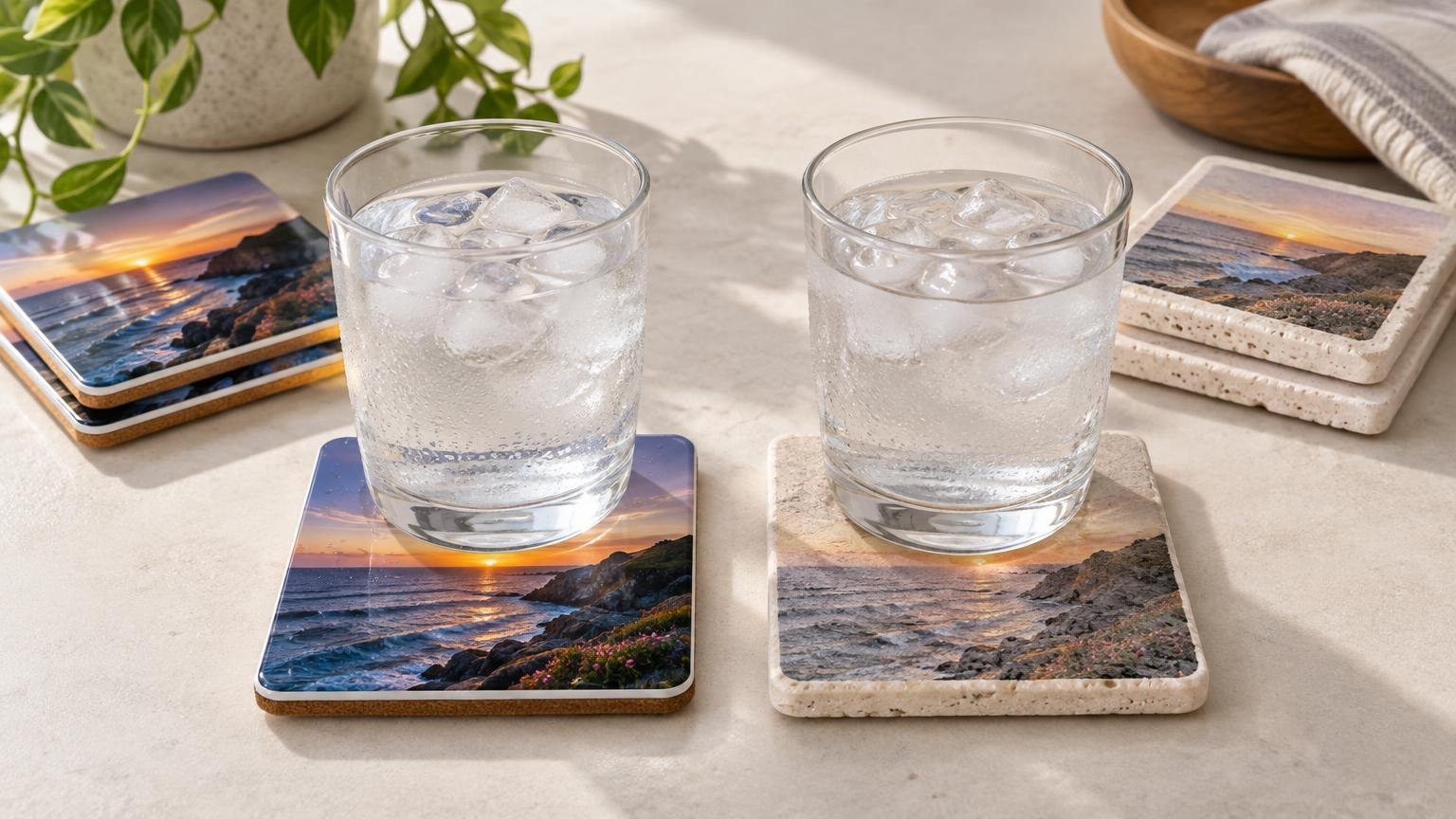
Choose glossy cork-backed hardboard when photo clarity, consistent edges and easy cleanup matter most. Choose unsealed absorbent stone when the priority is pulling condensation away from a cold glass and you like a matte, tactile appearance. Just do not treat “cork-backed” and “stone” as true opposites: cork describes the underside, while the printable face and its coating determine how the coaster handles moisture and displays an image.
That distinction saves a surprising amount of confusion. A stone coaster can also have cork underneath, and a cork-backed coaster may have a glossy hardboard face that absorbs essentially no condensation. When browsing custom print products, look past the headline material name and check the face material, surface treatment and backing separately.
The practical differences at a glance
| Feature | Glossy cork-backed hardboard | Unsealed absorbent stone |
|---|---|---|
| Condensation | Water stays on the protected surface until wiped away | Porous face takes in condensation and releases moisture as it dries |
| Photo appearance | Glossy, smooth and photograph-like | Usually more matte, with texture that may affect fine detail and color |
| Edges | Often uniform, with clean corners or rounded corners | Varies from precisely cut sandstone to visibly irregular tumbled stone |
| Cleaning | Generally suited to wiping with a soft damp cloth | Usually requires gentle hand-cleaning and careful treatment of stains |
| Best fit | Bright photos, easy maintenance and consistent sets | Cold drinks, condensation control and a natural appearance |
Condensation is decided by the face, not the cork
Mpix describes its photo coasters as glossy waterproof hardboard with non-slip cork backing. Shutterfly similarly lists a gloss hardboard coaster with a water- and chemical-resistant surface. Those descriptions support treating this format as wipe-clean rather than absorbent: the coating protects the print while moisture remains on top. Mpix’s photo coaster specifications show why “cork-backed” says little about what happens when a cold glass starts sweating.
Unsealed sandstone behaves differently. Custom Stone Coasters says its porous sandstone takes in condensation and releases it while drying; it also notes that sealing the surface removes that absorbency. That makes an unsealed stone face the more useful choice for iced drinks that regularly produce puddles. The manufacturer’s sandstone description also warns that wine, coffee and oil can permanently stain the porous surface, so absorption comes with a housekeeping bill.
The word “stone” still requires inspection. One seller identifies its absorbent product as sandstone, while another markets an absorbent-stone coaster but lists ceramic as the material. The product title alone does not establish the exact substrate, porosity or performance. Check both the specification and any mention of sealing before ordering.
Gloss favors photo punch; stone favors character
Glossy hardboard is the safer choice for saturated family photos, sharp graphics and designs with small details. Its smooth face gives the image a more conventional photographic presentation. Mpix specifies a glossy finish, while Shutterfly describes its hardboard surface as fade- and scratch-resistant. Those are seller specifications rather than a side-by-side durability test, but they explain how the products are positioned.
Stone can produce a quieter, more tactile result. Zazzle describes its sandstone option as matte and suggests it for black-and-white photos, vintage illustrations and text. Personalization Mall notes that the natural color, texture, cracks, graining and crystallization of its tumbled travertine may remain visible and affect image color. In other words, the stone participates in the design whether invited or not.
That variability can look charming with landscapes, old photographs, botanical artwork or simple monograms. It is less appealing when accurate skin tones, tiny lettering or perfectly even backgrounds are essential. For a broader personalized-gift strategy, the same restraint that improves coasters also applies to making a photo gift people actually keep: select a few images that suit the object instead of treating every printable surface as a family archive.
Edge finish changes the feel of the set
Manufactured hardboard coasters commonly offer a regular silhouette. Fujifilm’s catalog describes high-gloss photo coasters with rounded corners and cork backing, while Shutterfly lists a square hardboard coaster. The exact shape varies, but the general appeal is consistency from piece to piece.
Stone needs a product-by-product check. Cut sandstone can have an orderly shape, while tumbled travertine may retain visible texture and irregularity. That is not automatically a defect; it is part of the rustic presentation. Buyers who want four coasters to align like a tiny stack of tiles should inspect product photos and edge descriptions carefully. Buyers who enjoy variation may consider the irregularity the point.
Cleaning guidance favors the glossy option
A protected hardboard face is usually the lower-maintenance choice for everyday tables because spills can be wiped from the surface. Follow the seller’s care instructions and avoid soaking the coaster, especially where the face meets the backing.
Absorbent stone calls for gentler treatment. YouCustomizeIt advises hand-washing its product with cold water, gentle soap and a soft cloth while avoiding abrasives. For natural stone more broadly, the Natural Stone Institute’s care guidance recommends neutral cleaner, stone soap or mild dish detergent and cautions against acidic and abrasive products. The coaster maker’s instructions should take priority because printed surfaces, coatings and stone types differ.
For an unsealed porous coaster, blot colored spills promptly. A surface designed to absorb water may also accept coffee, wine or oil, and enthusiasm is not a recognized stain-removal method.
Can every coaster use a different photo?
Sometimes, but the material does not decide this. Mixed-image ordering is a template and production feature. Printique says its four-piece set can use one repeated image or four different images; Mpix allows four photos in a four-piece set; and Fujifilm lists both single- and multiple-image coaster options.
Stone sets can offer the same flexibility. YouCustomizeIt says its set defaults to one repeated design but can be changed so each coaster uses a different image. If a listing merely says “set of four,” do not assume it accepts four files. Check the editor, personalization fields or proof before paying.
Which photo coaster should you order?
Order glossy cork-backed hardboard for a busy household, a desk set or a gift where crisp photography and uncomplicated wiping matter most. It is also the safer aesthetic choice when every coaster should look uniform.
Order unsealed absorbent stone for iced drinks, frequent condensation and a more natural matte presentation. Choose images that tolerate texture, and accept that porous stone requires quicker attention when dark or oily liquids spill.
References
- Custom Photo Coasters | Mpix
- Absorbent Sandstone Coasters | Custom Printed in Bulk — Custom Stone Coasters – Custom Stone Coasters
- Custom Photo Absorbent Stone Coasters – Set of 4 | YouCustomizeIt
- Custom Photo Coasters | Personalized Photo Gifts
- Photo Gallery Coaster
- Custom Personalized Photo Sandstone Coaster | Zazzle
- Photo Personalized Tumbled Stone Coaster Set for Family
- HOME & OFFICE
- Natural Stone Institute – Learn About Cleaning Products for Natural Stone