
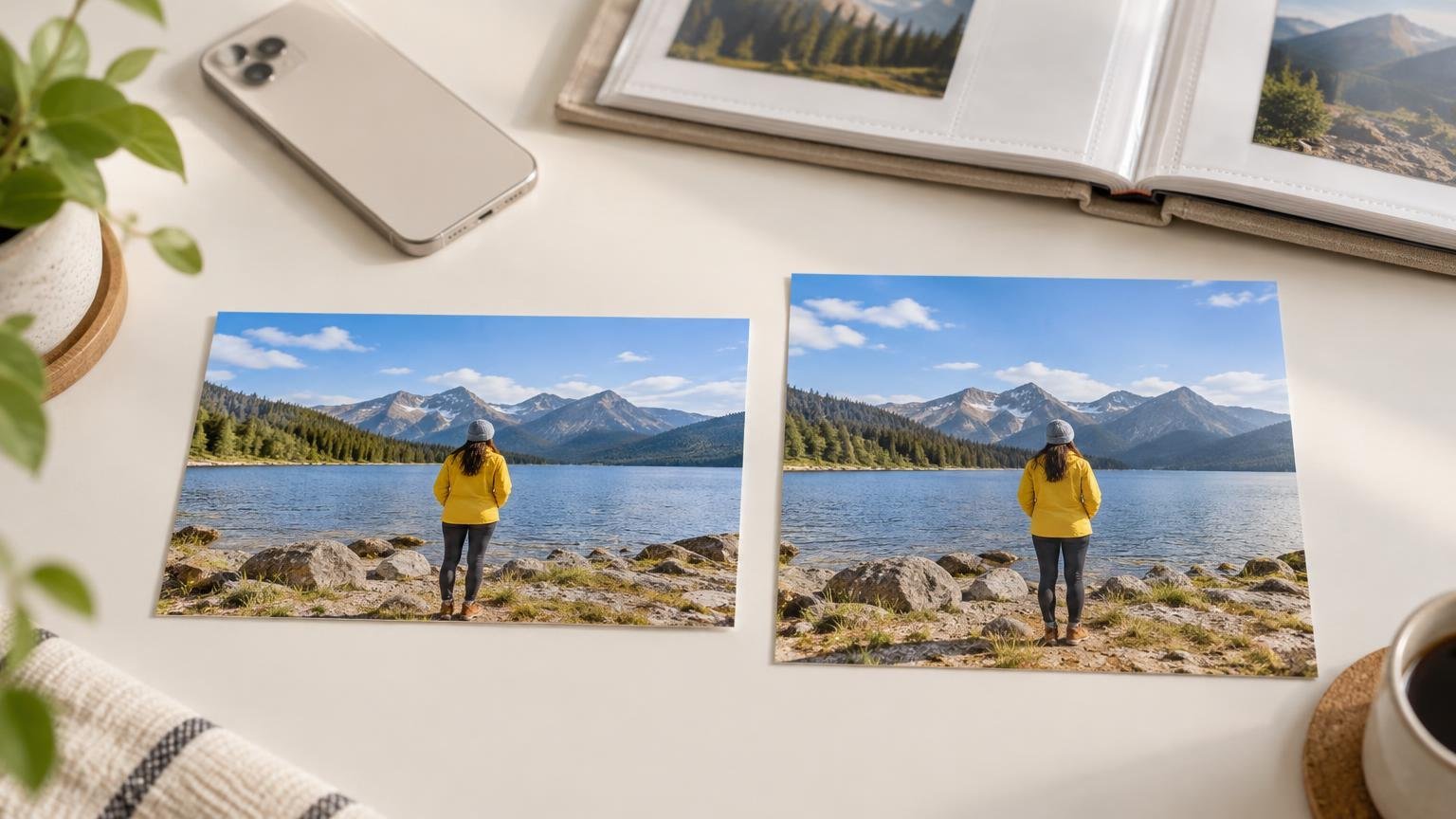
Choose 4×5.3 when preserving the full composition of a 4:3 phone photo matters more than receiving the familiar 4×6 format. Choose 4×6 when you need a standard print for frames or album pockets, but inspect the crop preview carefully. A 4:3 image does not naturally fill 4×6 paper: you must either crop part of the picture or accept blank space.
The practical dividing line is simple. A 4×6 print has a 3:2 aspect ratio, while a 4×5.3 “True Digital” print closely matches 4:3. Walgreens identifies these as separate print formats, not two names for the same sheet of paper.
What happens to a 4:3 phone photo?
Consider a landscape photo measuring 4032 × 3024 pixels. That file has a 4:3 aspect ratio. It is large enough for either of these small print sizes; the immediate problem is shape, not pixel count. For a broader discussion of resolution, see our guide to how large you can print a phone photo.
There are three common ways to turn that file into a print: fill a 4×6, fit it within a 4×6, or order a separate 4×5.3 print.
| Print choice | Physical result | What happens to the 4:3 image |
|---|---|---|
| 4×6 with fill | Borderless 6-by-4-inch print | About 11.1% of the image height is removed |
| 4×6 with fit | 4×5⅓-inch image centered on 4×6 paper | The full image remains, with about ⅓ inch of blank space at each side |
| 4×5.3 True Digital | Smaller print closely matching 4:3 | Nearly the full composition fills the print without substantial borders |
Fill: borderless, but cropped
Filling 4×6 paper means enlarging the 4:3 image until it covers the entire 3:2 rectangle. The 4032-pixel width remains, but the printable height falls from 3024 to 2688 pixels. A centered crop removes 336 pixels in total: about 168 pixels from both the top and bottom.
That leaves roughly 88.9% of the original image height. Snapfish rounds this to about 11% cropped and notes that landscape images lose content from the top and bottom; portrait images lose it from the left and right. Its Best Fit and True Digital explanation illustrates why a mismatch that looks minor on an ordering screen can remove a forehead, shoes or the top of a landmark.
Fit: complete image, visible borders
The fit setting scales the whole 4:3 image down until it fits inside 4×6 paper. At four inches high, the image becomes 5⅓ inches wide. That leaves roughly two-thirds of an inch unused across the sheet, or one-third inch on each side when centered.
Fit is the safest 4×6 choice when every edge matters and white bars are acceptable. It also preserves the standard outer dimensions for an album sleeve. The tradeoff is aesthetic: the print no longer looks borderless unless you trim it, and trimming turns it into approximately the same size as a True Digital print anyway.
4×5.3: a different physical print
A 4×5.3 print is not a 4×6 with white bars. It is a smaller sheet, 0.7 inch shorter on the long edge, with proportions that closely follow a 4:3 file. Snapfish describes this format as Best Fit or True Digital and says it avoids the crop caused by forcing mismatched images into 4×6.
The mathematically exact long edge for a four-inch-high 4:3 image is 5⅓ inches, so the advertised 5.3-inch dimension is a rounded commercial size. Check the lab’s preview before ordering, especially when text, faces or graphic borders sit close to an edge. Even a tiny adjustment matters when the composition has no breathing room.
Which format should you order?
Order 4×5.3 for uncropped 4:3 snapshots, group photos with people close to the sides, carefully composed images, screenshots or pictures containing text near an edge. It is the cleanest choice when you want the photograph to reach the paper edges without sacrificing meaningful content.
Order 4×6 fit when you need a standard physical size but cannot crop anything. This works well for storage and casual albums, though the white side borders may look unfinished in a borderless display.
Will 4×5.3 prints fit a 4×6 photo album?
A 4×5.3 print is physically smaller than a 4×6, so it may slide into a straightforward 4×6 pocket. That does not guarantee a tidy presentation. It can shift sideways, sit off-center or move behind another print if the pocket is loose.
Album listings usually specify their maximum intended photo size rather than promising a snug fit for every smaller format. For example, Gallery Leather’s pocket refill specifications describe pockets for 4×6 photographs, with two prints per page. Another supplied album listing similarly describes pockets for photos up to 4×6 rather than identifying a dedicated 4×5.3 pocket.
Before ordering a large batch, check the pocket opening, orientation and backing color. A dark or patterned backing makes uneven spacing more obvious. If you already own a pocket album, print a small test order first. For albums with fixed 4×6 windows, 4×6 fit may be the more predictable compromise because the paper fills the pocket even though the image has side borders.
Which photo labs offer 4×5.3 prints?
Current product information identifies three widely available options:
- Walgreens lists 4×5.3 True Digital alongside its 4×6 photo-print format. View Walgreens print sizes.
- Snapfish offers a 4×5.3 Best Fit or True Digital print. It currently states that this format is priced the same as 4×6, although prices should be checked in the cart before ordering.
- Walmart Photo lists 4×5.3 for one-hour pickup and ship-to-home, alongside 4×6. Its published table currently shows the same starting price for both formats. View Walmart Photo print options.
Availability can vary by fulfillment method and location, particularly for pickup orders. Confirm that the selected store, paper finish and delivery method still support 4×5.3 before building a large cart. If lab choice matters as much as print dimensions, our photo print service comparison covers the broader buying decision.
The verdict
For a 4:3 phone photo, 4×5.3 is the better borderless format because it preserves almost the entire composition. A 4×6 remains the better organizational format when standard frames and album pockets are the priority.
If you must use 4×6, choose deliberately between fill and fit. Fill gives you edge-to-edge paper at the cost of roughly 11% of the image in this 4:3 example. Fit keeps the whole picture but adds side borders. The ordering preview is not a decorative step; it is where you decide whether the print keeps the scene you photographed or quietly edits it for you.
References
- 4×6 Photo Prints and Photo Enlargements – Walgreens Photo
- Best Fit print size for True Digital prints with no cropping – Snapfish Help
- Gallery Photo Pocket Refill (4×6) | Gallery Leather
- Pioneer 200-Pocket Leatherette Photo Album, 4×6-Inch, Black with Picture Frame Cover – Walmart Business Supplies
- Photo Prints | Order Prints Online | Walmart Photo