
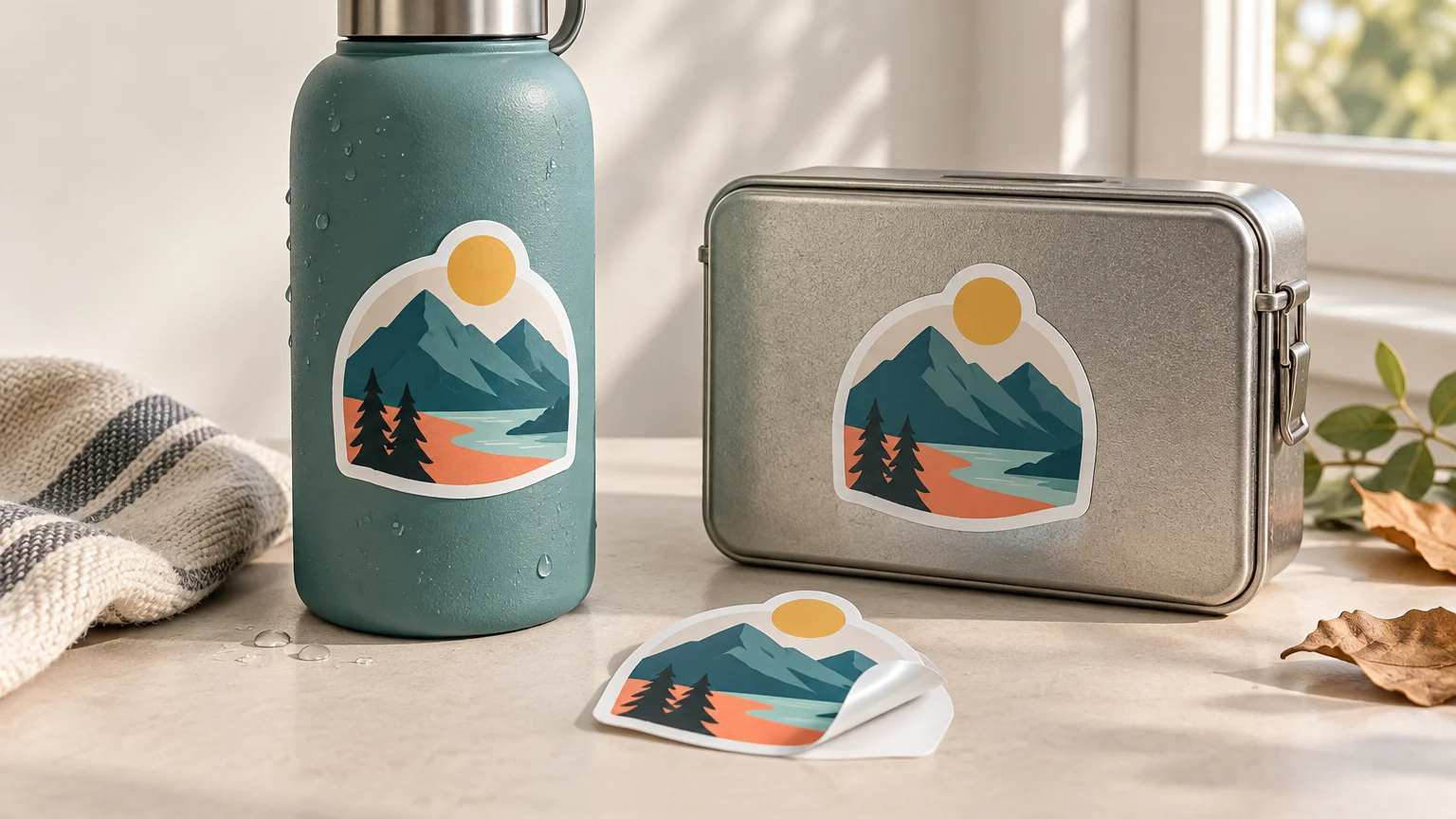
TLDR: Choose a waterproof sticker when water is the main concern, such as splashes, condensation, or careful hand-washing. Choose a documented weather-resistant construction when the sticker will also face sunlight, temperature changes, abrasion, and repeated outdoor exposure. Neither term automatically means dishwasher-safe, suitable for immersion, or guaranteed to remain attached to every surface.
The frustrating part of comparing waterproof vs weather resistant stickers is that these words are not interchangeable universal grades. One supplier may use “waterproof” for a film sticker that tolerates splashes, while another reserves it for a finished construction with a protective laminate. Unless the seller publishes test conditions, the durability word is only the beginning of the specification.
The practical answer is to buy for the actual exposure. A sticker for a refrigerated bottle has a different job from one placed on a toolbox, kayak, storefront window, or dishwasher-bound lunch container. Material matters, but so do the printed image, protective layer, adhesive, application surface, temperature, chemicals, and care routine.
Waterproof vs weather resistant stickers in plain English
There is no single supplied standard establishing universal consumer definitions for these three marketing terms. The following distinctions are therefore useful buying guidance rather than formal grades:
- Water-resistant usually means the sticker can tolerate limited moisture, such as brief splashes, damp handling, or condensation. It does not necessarily mean prolonged soaking.
- Waterproof generally indicates that the sticker face and printed design are intended to withstand more direct water exposure under the seller’s stated conditions. It does not automatically cover the adhesive, exposed edges, detergents, heat, or abrasion.
- Weather-resistant usually describes broader environmental durability. Depending on the product, that may include rain, sunlight, humidity, temperature changes, and general outdoor exposure. The exact combination must still be verified.
- Dishwasher-safe is a narrower use claim involving repeated water, heat, detergent, spray pressure, and abrasion. A waterproof label is not dishwasher-safe merely because the word “waterproof” appears in its name.
Technical label specifications illustrate why test conditions matter. ASTM D7932 covers printed pressure-sensitive labels intended for extreme distribution environments using defined tests and acceptance criteria. It does not create a universal consumer definition of waterproof, but it shows the value of evaluating a label against specific conditions rather than relying on one broad adjective. Readers who need specification-level context can review the ASTM D7932 label specification.
Evaluate the whole sticker, not just the face material
A pressure-sensitive sticker is a small system of layers. Its performance is limited by whichever part is least suited to the job. A moisture-tolerant film cannot compensate for ink that rubs away, an adhesive that releases from the chosen surface, or exposed edges that allow water to work between layers.
| Part of the construction | What it affects | What to verify |
|---|---|---|
| Face stock | Tearing, dimensional stability, and how the sticker reacts to moisture or heat | Exact material, thickness if relevant, and intended environment |
| Printed image | Whether colors or fine details remain intact | Print method and whether a protective layer is included |
| Laminate or coating | Resistance to surface moisture, scratching, handling, and sometimes UV exposure | Type of protection, coverage, finish, and stated limitations |
| Adhesive | Whether the sticker stays attached | Permanent or removable formula, compatible surfaces, temperature, and moisture conditions |
| Application surface | How well the adhesive can make contact | Cleanliness, texture, curvature, coatings, and surface energy |
| Edges and shape | Potential routes for lifting or moisture entry | Application technique, edge exposure, and whether the design has vulnerable points |
This is why “vinyl sticker” is not a complete durability specification. Two stickers can both use vinyl while differing in adhesive, ink, laminate, thickness, and intended exposure. If you are choosing a decal specifically for outdoor equipment or signage, our guide to outdoor vinyl and decals explains how format and installation affect the decision.
Vinyl, polypropylene, and polyester can all have a role
Vinyl, often used as a broad name for PVC-based sticker film, is common for wet and outdoor applications because it does not behave like ordinary unprotected paper. That makes it a sensible starting point, not an automatic durability guarantee. The finished construction still determines whether it is appropriate for rain, sunlight, frequent handling, or washing.
Polypropylene and polyester films are also used in label constructions. For example, 3M describes one polyester label material as offering thermal stability and moisture resistance. It separately describes a polypropylene label material with a removable acrylic adhesive and stated moisture and UV resistance. These examples show two important points: vinyl is not the only film option, and moisture performance does not tell you whether an adhesive is permanent or removable.
Material selection should follow the use case. A squeezable container may need conformability. A rigid product label may prioritize dimensional stability. A temporary window or equipment label may need clean removal. A paper sticker can still be perfectly sensible for dry indoor packaging where low cost, writing ability, or recyclability considerations matter more than outdoor durability.
What a laminate can and cannot do
A laminate or overlaminate adds a transparent protective layer over the printed graphics. Depending on the exact product, it can improve resistance to moisture, rubbing, scratches, sunlight, and general weathering. For example, 3M describes its FV02490N vinyl overlaminate as providing moisture, abrasion, UV, and weathering resistance in relevant label constructions.
That does not mean every laminate provides the same protection. A thin DIY laminating sheet, a liquid coating, and a commercial pressure-sensitive overlaminate are different products. Coverage and application quality also matter. A laminate may protect the image while leaving the adhesive, edges, or underlying surface as the weak point.
Nor can laminate fix a poor material match. It cannot make an adhesive bond reliably to an oily, dusty, heavily textured, or incompatible surface. It cannot turn a general outdoor sticker into a documented marine label. It also cannot guarantee that a container will survive repeated dishwasher cycles. For a closer look at finished laminated products versus DIY supplies, see our guide to laminated stickers and laminating sheets.
Water, UV, heat, detergent, and abrasion are separate questions
A sticker may perform well against one stress and poorly against another. Water exposure asks whether moisture damages the face, print, layers, or adhesive. UV exposure concerns fading and material degradation. Heat can soften an adhesive or affect a film. Detergent introduces chemicals. Abrasion tests whether rubbing removes the surface or printed image.
Avery Dennison’s technical documentation for one premium film evaluates humidity, water immersion, detergent immersion, elevated-temperature detergent exposure, and accelerated UV ageing separately. Its outdoor-durability language is also qualified by color, exposure conditions, substrate preparation, and maintenance. That is a useful model for buyers: one successful moisture test does not answer every outdoor or cleaning question.
When a seller says a sticker is weather-resistant, look for the environmental details behind that claim. Rain resistance does not prove saltwater suitability. UV resistance does not establish chemical resistance. A stated outdoor estimate may depend heavily on climate, orientation, color, surface preparation, and maintenance. Avoid treating any lifespan estimate as a promise unless the supplier clearly defines the finished product and its conditions.
Why a waterproof sticker can still peel
The face of a sticker can resist water while its adhesive bond fails. Adhesion depends on intimate contact between the adhesive and the surface. Dust, oil, wax, silicone, condensation, rough texture, sharp curves, and immediate exposure after application can all interfere with that contact.
Apply stickers to a clean, dry surface using the supplier’s instructions. Pay attention to minimum application temperature and any recommended dwell time before wetting or washing. On bottles and curved containers, keep small protruding corners away from grip areas where fingers repeatedly catch them. Rounded shapes often have fewer vulnerable points than designs with long, sharp tips.
Adhesive requirements also depend on the task. A removable adhesive can be a feature rather than a weakness when temporary labeling is the goal. USPS, for example, publishes adhesion requirements for pressure-sensitive labels applied to mailpieces, but those rules concern mail processing rather than rain, outdoor life, or dishwasher performance.
Waterproof does not automatically mean dishwasher-safe
A dishwasher combines several stresses: hot water, detergent, spray pressure, repeated temperature changes, long wet periods, and contact with racks or other items. A sticker that survives rain or hand-washing may still fade, lift, wrinkle, or wear faster in that environment.
The product instructions should settle the question. Cricut, for example, calls its Printable Waterproof Sticker Set waterproof while recommending hand-washing because dishwasher heat and detergents can reduce product life. That is a clear example of a legitimate waterproof claim accompanied by a dishwasher limitation.
For a reusable bottle, mug, lunch container, or food-storage tub, look for an explicit dishwasher-use statement for the complete sticker construction. Check whether it applies to a particular rack, temperature, cure time, wash setting, or number of cycles. If the documentation merely says waterproof, assume careful hand-washing is the lower-risk approach.
Which construction fits your use case?
| Use case | Sensible starting point | What could change the choice |
|---|---|---|
| Dry indoor packaging | Paper or basic film label | Condensation, refrigeration, oil, or frequent handling |
| Chilled bottle or condensation-prone package | Moisture-resistant film with a suitable adhesive | Cold application, curved surfaces, immersion, and recycling requirements |
| Hand-washed water bottle | Protected film sticker with documented water resistance | Hot soaking, detergent, aggressive scrubbing, and edge placement |
| Outdoor equipment or window | Weather-resistant film, protective layer, and outdoor-rated adhesive | Sun intensity, temperature range, abrasion, surface texture, and expected service period |
| Boat, kayak, or marine equipment | Construction documented for the relevant marine or saltwater exposure | Immersion, fuel, cleaners, high UV exposure, and safety-critical labeling |
| Dishwasher-bound container | Product explicitly documented for dishwasher use | Rack position, cure time, wash temperature, detergent, and repeated cycles |
Promotional stickers handed out at an indoor event do not need the same construction as equipment decals. Paying for maximum durability can be unnecessary when the sticker will live on a notebook, gift box, or dry package. Our guide to promotional sticker formats can help separate low-cost giveaway needs from longer-term branding applications.
Questions to ask before ordering custom stickers
A useful supplier answer should describe the product, not merely repeat the durability word in larger type. Ask these questions before placing a large order:
- What is the exact face material: paper, vinyl or PVC, polypropylene, polyester, or another film?
- Is the printed image protected by a laminate or coating? What type?
- Does the durability statement apply to the complete printed sticker or only the unprinted material?
- Is the adhesive permanent, removable, repositionable, or intended for a specific surface?
- Which surfaces were considered when stating the moisture or outdoor performance?
- Does “waterproof” cover splashing, hand-washing, temporary immersion, or continuous immersion?
- Does “weather-resistant” specifically include UV exposure, temperature changes, and rain?
- Are there exclusions for saltwater, oils, cleaners, alcohol, fuel, or other chemicals?
- Is dishwasher use explicitly supported, and what care or application instructions apply?
- Is there a recommended application temperature or waiting period before exposure?
- Can the supplier provide a technical data sheet, test method, sample, or small proof order?
For expensive, safety-related, chemical, marine, or long-term outdoor applications, general consumer wording is not enough. Request documentation for the exact material, print, protective layer, adhesive, surface, and exposure. A small real-world trial on the intended object is also more informative than assuming a marketing term covers conditions the supplier never mentioned.
The bottom line
Do not pay extra for the word “waterproof” or “weather-resistant” by itself. Pay for a construction that matches the job and comes with useful conditions: the right film, a suitable protective layer, an adhesive compatible with the surface, and documentation covering the exposure that matters.
For condensation and careful hand-washing, a moisture-tolerant protected film may be enough. For outdoor equipment, prioritize documented resistance to rain, UV, temperature changes, and abrasion. For dishwashers, marine environments, chemicals, or prolonged immersion, require a specific statement covering that use. The more demanding the environment, the less useful a one-word durability promise becomes.
References
- D7932 Standard Specification for Printed, Pressure-Sensitive Adhesive Labels for Use in Extreme Distribution Environments
- 3M™ Sheet Label Material 7909L, Brushed Silver Polyester, 508 mm x 686 mm, 100 Sheet/Case | 3M United States
- 3M™ Removable Label Material FP56N, Clear Polypropylene, Roll, Config | 3M United States
- 3M™ Overlaminate Label Material FV02490N, Clear Textured Vinyl, Roll, Config | 3M United States
- 700 Premium Film Technical Data Sheet EN
- 2-3.2 Pressure-sensitive Label
- Printable Waterproof Sticker Set Instructions – Help Center