
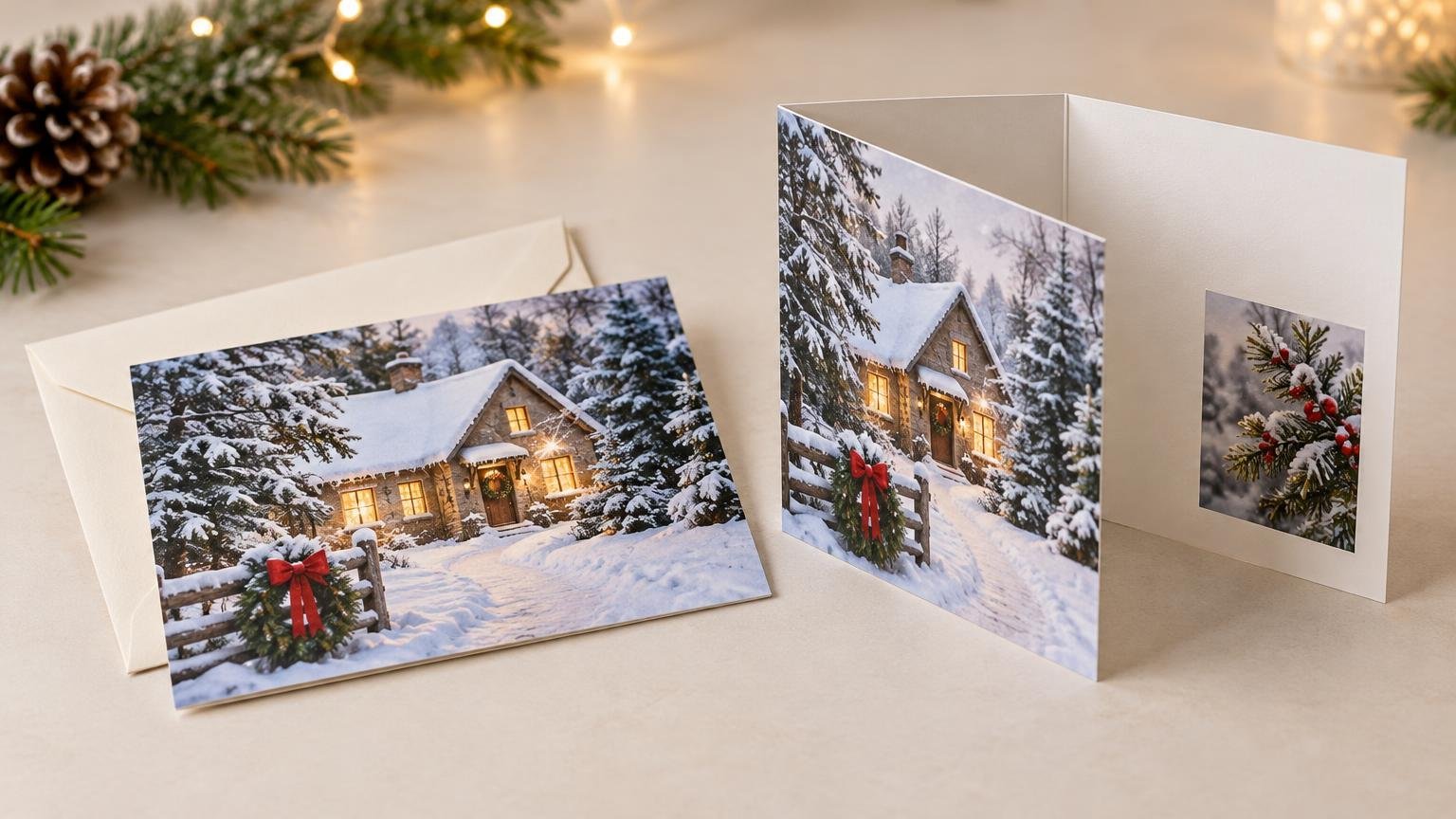
For most families, flat holiday cards are the better value. They handle a photo, greeting, names, and short update without charging you for paper and panels you may struggle to fill. Folded cards become worth the upgrade when you want to write a substantial message, include several photos without crowding them, or send something designed to stand on a mantel.
The choice is less about which format is universally more premium and more about whether you will use the extra space. A blank interior is not luxury. It is just very expensive white space.
The practical differences at a glance
| Decision factor | Flat card | Folded card |
|---|---|---|
| Message space | Best for a greeting, names, and brief update | Better for longer messages or distinct sections |
| Photo layout | Strong for one main image or a compact collage | More room to separate cover and interior photos |
| Presentation | Simple, modern, and easy to scan | More traditional and reveal-oriented |
| Display value | Usually needs a holder or support | Can stand open on a desk or mantel |
| Production | No fold to plan around | Requires fold-aware artwork and finishing |
| Mailing | Often lighter, but the completed mailpiece decides postage | May weigh more, but folding alone does not determine postage |
| Best value for | Short, photo-led greetings and larger mailing lists | Long updates, multiple photos, and keepsake-style cards |
Folded cards give you more space—but only if you use it
A typical flat card provides a front and back, while a folded card provides a front, back, and two interior panels. Templates can restrict how much of that theoretical space is actually usable, but folded cards still provide more opportunities to separate content. You might place a cover photo on the front, a family update inside, supporting photos on the opposite panel, and names or a date on the back. A flat card generally has to combine those jobs across two surfaces.
Choose folded if your annual update is part of the point. Choose flat if your message is closer to “Happy holidays from all of us” than a season finale recap. For a flat card, the front can carry the strongest photo and greeting while the reverse holds a short note or second image. That is enough for many households and usually produces a cleaner design.
More panels do not automatically create a better photo card. Four small images squeezed around decorative borders can look busier than one strong photograph given room to breathe. If the long-term value of the image matters most, our comparison of photo and non-photo holiday cards as keepsakes can help settle the design direction before you choose the format.
Paper and envelopes do not automatically improve with a fold
A folded card may feel more substantial because the recipient opens it, but format alone does not guarantee better paper or envelopes. Stock, finish, printing method, embellishments, envelope quality, and addressing options vary by printer and product line. A thick flat card with a well-matched envelope can feel more polished than a lightweight folded card.
Compare the actual stock description and sample options rather than assuming “folded” means “premium.” Look for the finished card size, paper type, coating, envelope inclusion, return-address printing, recipient addressing, and whether the printer offers a proof. If you want to explore paper and format choices outside standard photo-card templates, a service focused on custom invitation and card printing may offer a more stationery-oriented starting point.
The fold adds production considerations
Folded cards require artwork that respects the fold line. Important faces, text, and small details should not sit where the paper bends; Shutterfly gives this warning specifically for gatefold photo cards. The risk is not merely aesthetic. Folded pieces must be scored or folded during production, and heavier stock, paper grain, coatings, heavy ink coverage, or inadequate scoring can contribute to cracking along the fold. The Sappi technical guide to folding and scoring explains how grain direction and scoring affect the result.
Also check whether the cards arrive fully folded. Some products are delivered flat and scored for the buyer to fold, including the folded holiday cards described by Staples. Folding a few cards is harmless. Folding 150 while trying to remember which relatives moved this year is less festive.
Mailing cost depends on the finished envelope
A folded card may use more paper than a flat card with the same closed dimensions, but USPS does not price an envelope according to whether the card inside is folded. Postage depends on the sealed mailpiece’s dimensions, thickness, weight, shape, and machinability.
Under the current letter-size standards described in the USPS First-Class Mail guidance, a letter must be at least 3.5 by 5 inches, no larger than 6.125 by 11.5 inches, no thicker than 0.25 inch, and no heavier than 3.5 ounces. A piece outside the letter limits may be treated as a large envelope or another mail class. Square, rigid, or unevenly thick envelopes can also trigger nonmachinable pricing.
Do not estimate postage from the product thumbnail. Order a sample or assemble one complete card with its envelope, inserts, address label, and any decorative extras, then weigh and measure that finished piece. Check the current USPS price tools before buying postage, especially if you selected square envelopes, thick stock, liners, foil elements, or extra inserts. Those upgrades can matter more than the basic flat-versus-folded choice.
Folded cards win for display and keepsake value
A folded card can stand open on a desk, shelf, or mantel, which gives it a practical display advantage over a single flat sheet. That makes the upgrade easier to justify for grandparents, close friends, and relatives likely to keep the card visible through the season.
Price the whole order, not the format label
Folded cards involve extra paper and finishing, but there is no reliable rule that every folded product costs more than every flat one. Finished size, paper, printed surfaces, finish, envelope choices, quantity, addressing, promotion, and delivery speed all affect the total. Compare carts using the same quantity and similar stock, then include envelopes, addressing, shipping, and postage.
Production timing deserves attention too. A folded design can require more layout work and another physical finishing step. That does not mean it will always ship more slowly, but it gives you one more specification to verify when the deadline is tight. Our guide to when to order and send holiday cards can help you build in enough time for proofing, printing, addressing, and mailing.
Which holiday card should you order?
Order flat holiday cards if you want one strong photo, a concise greeting, straightforward mailing, and the best chance of keeping a large list affordable. They are especially sensible when the design itself already does the emotional heavy lifting.
Upgrade to folded cards if you have a real plan for the interior: a longer family update, several well-spaced photographs, a handwritten note, or a presentation that recipients can stand on display. In that case, the extra panels are functional rather than decorative.
Before checking out, compare the actual stock and envelope specifications, confirm whether folded cards arrive pre-folded, and test the completed mailpiece against current USPS requirements. The best choice is the format that carries your message cleanly without making you pay for space, weight, or production flourishes you do not need. For most short holiday greetings, that means flat. For a message meant to be opened, read, and displayed, folded earns its upgrade.
Frequently Asked Questions
Do folded holiday cards automatically require extra postage?
No. USPS postage depends on the sealed mailpiece’s dimensions, thickness, weight, shape, and machinability—not simply whether the card folds.
Are folded cards made with better paper than flat cards?
Not necessarily. Paper stock, finish, printing method, envelopes, and embellishments vary by printer and product line. Compare the actual specifications rather than treating “folded” as shorthand for “premium.”
Can folded holiday cards arrive unfolded?
Yes. Some folded-card products arrive flat and scored for you to fold, so verify the finishing details before ordering a large quantity.
What USPS letter limits should a holiday card stay within?
Current letter-size standards require a mailpiece to be at least 3.5 by 5 inches, no larger than 6.125 by 11.5 inches, no thicker than 0.25 inch, and no heavier than 3.5 ounces.
Which format is easier to design and produce?
Flat cards are simpler because there is no fold to plan around. Folded designs require fold-aware artwork, and scoring, paper grain, coatings, or heavy ink coverage can affect how cleanly the card folds.
References
- Holiday Cards – Artifact Uprising
- faq.usps.com
- Notice 123 | Postal Explorer
- Cards | Motif Studio
- Gatefold Holiday Photo Cards | Shutterfly
- Folding and Scoring
- Paper Scoring | Smartpress Support
- Custom Holiday Cards | Staples®
- First-Class Mail & Postage | USPS
- Create Your Own Holiday Cards | Custom Holiday Cards | Staples