
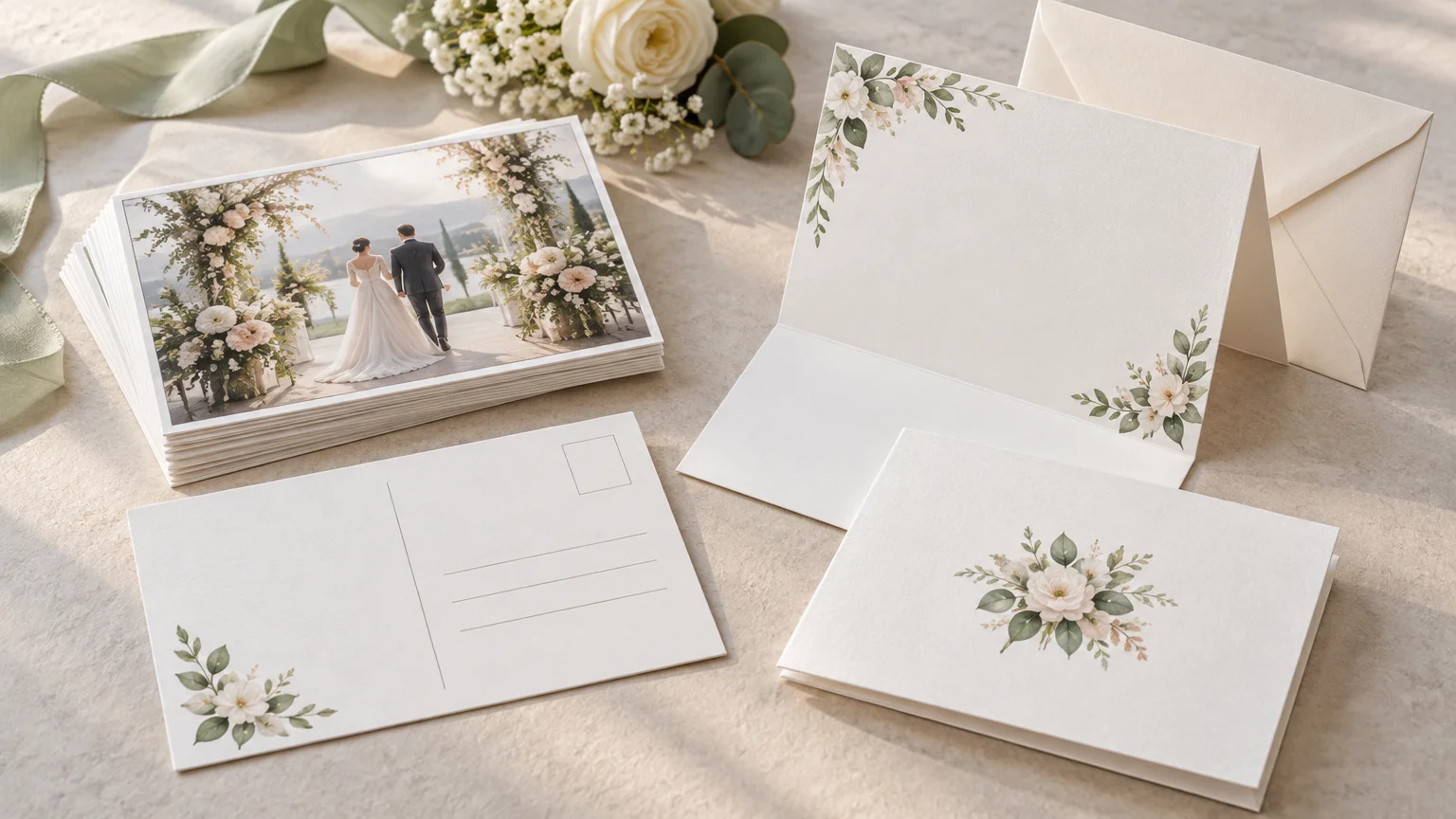
TLDR
The postcard vs folded thank you cards decision comes down to the message before it comes down to price. Choose a postcard for a short, shareable note, especially when a photo is the main feature or you have a large batch to send. Choose a folded card with an envelope when you need more writing room, greater privacy, or a presentation that feels more personal and formal. If postage savings matter, confirm that the finished postcard qualifies for the current USPS postcard rate; calling a product a “postcard” does not automatically make it eligible.
Neither format is universally better after a wedding or event. A postcard can turn one strong photograph and two sincere sentences into an efficient thank-you. A folded card gives you room to mention the gift, the guest’s contribution, or a specific memory without writing in a font size normally reserved for medicine bottles.
Postcard vs folded thank-you cards at a glance
| Decision factor | Postcard | Folded card with envelope |
|---|---|---|
| Writing space | Best for a concise note; the address and postage area restrict one side | More interior room for a longer or more individualized message |
| Privacy | Message remains visible during handling and delivery | Envelope keeps the message enclosed |
| Envelope | Usually unnecessary | Normally needed for mailing |
| Postage | May qualify for the USPS postcard price if it meets all applicable specifications | Usually mailed at the applicable letter price, subject to size, weight and machinability |
| Photo use | Strong for one dominant image or a simple collage | Supports a cover photo plus interior text or additional images |
| Presentation | Direct, casual and visually immediate | More traditional and ceremonial |
| Large quantities | Efficient when the same short message suits many recipients | Better when messages need meaningful personalization |
| Total cost | Potentially lower, but only after comparing printing and postage | May include extra printing, envelope and addressing costs |
This table describes the practical differences between the formats, not guaranteed printer pricing. Paper, finish, quantity, included envelopes, addressing services, shipping and promotions can move the final total in either direction.
Choose a postcard when the message can stay short and visible
A postcard is strongest when brevity is a feature rather than a compromise. It works well for a general event thank-you, a casual celebration, a charity gathering, a company event, or a wedding follow-up built around a favorite photograph. The format gives the image immediate impact because the recipient does not have to open anything to see it.
The best postcard messages tend to have a simple structure: thank the person, mention the occasion or contribution, and close warmly. For example: “Thank you for celebrating with us. We loved seeing you on the dance floor, and we are grateful you made the trip.” That fits comfortably. A detailed note about a specific gift, travel help and three memorable moments probably does not.
Postcards can also simplify a large mailing. There are no envelopes to stuff or seal, and the recipient address can be printed directly on the mailpiece. That convenience becomes meaningful when you are sending 150 notes instead of 15. However, printed addressing does not replace the need to proof every address, and the format does not include standard USPS Tracking when sent as ordinary First-Class Mail.
The privacy limitation is straightforward: anyone handling the postcard can see its message. Avoid account details, sensitive family news, private jokes that need context, or detailed references to the value of a gift. First-Class Mail letters are treated as sealed against inspection, making a folded card in an envelope the more sensible choice when discretion matters.
Choose a folded card for writing space, privacy and presentation
A folded card is the safer default for traditional wedding thank-yous and any note that needs to feel distinctly personal. The front can carry a photograph, names, date or restrained design, while the inside is reserved for the message. The recipient’s address goes on the envelope instead of competing with the note for space.
That extra room is useful when you want to name a gift and explain how you plan to use it. It also accommodates different messages for guests, vendors, hosts and people who could not attend. You can still use a printed opening or closing, but leaving enough blank space for handwriting usually makes the card feel more individual.
Folded cards are also more flexible when the recipient list spans several relationships. The same exterior design can hold a warm three-line message for a colleague and a longer note for a close relative. With a postcard, those two notes must fit essentially the same exposed layout.
The tradeoff is additional handling and potentially higher all-in cost. Envelopes have to be included or purchased, addressed, stuffed and sealed. A heavier card, unusual envelope, rigid decoration or nonstandard shape can also affect mailing charges. The presentation upgrade may be worthwhile, but it is not free merely because the printer bundles envelopes into the product listing.
USPS postcard rules can change the cost comparison
For USPS retail postcard pricing, a mailpiece must be rectangular, at least 3.5 by 5 inches and no larger than 4.25 by 6 inches. Its thickness must fall from 0.007 through 0.016 inch. A larger card can still be mailed, but USPS charges it at the applicable letter price rather than the postcard price. Review the current USPS postcard-size rules before approving a custom size.
This distinction matters because many printers use “postcard” as a product category covering several sizes. A 5-by-7-inch photo card may look and behave like a postcard to the buyer, yet it exceeds the maximum dimensions for the retail postcard price. If postage is central to the budget, choose the mailing class first and design within its limits—not the other way around.
USPS publishes postcard and letter prices in Notice 123. Rates change, so calculate the mailing total using the schedule in effect when the cards will actually enter the mail. Multiply the current per-piece difference by the number of recipients, then compare that result with any differences in printing, envelopes, addressing and shipping. A small postage difference can matter across hundreds of pieces, but it may be minor for a list of 20.
Machinability matters too. USPS advises that letters and postcards need enough flexibility for processing equipment. Rigid inserts and exposed additions such as wax seals, string or ribbon can require different packaging and may result in nonmachinable charges. Decorative touches look lovely on a screen; sorting equipment is less sentimental.
Can a folded card be mailed without an envelope?
Do not assume an ordinary folded greeting card is ready to mail by itself. USPS treats folded self-mailers as a distinct format with design and construction standards. A printer offering a purpose-built self-mailer should provide specifications for its finished size, fold, closure and address placement. Otherwise, use an appropriate envelope and confirm the assembled mailpiece’s size, thickness, weight and flexibility.
Photo layouts favor different kinds of storytelling
A postcard is naturally image-led. One full-bleed wedding portrait, a candid event photograph or a restrained two-image layout can work well on the front. The reverse then has to accommodate the recipient address, postage and message, so every extra design element competes with usable writing space.
A folded card offers more surfaces: front, back and interior panels. That does not mean every panel needs a photograph. A strong cover image with a clean interior usually provides more usable space than a busy collage. Additional photographs are most useful when they add a different part of the story, such as one ceremony image and one reception image, rather than six nearly identical poses.
Before ordering either format, inspect the printer’s crop preview and keep faces, text and other important details away from trim and fold areas. If the source is a phone image, check whether it has enough resolution for the chosen print dimensions rather than assuming a larger file is automatically suitable. Our guide to printing phone photos at larger sizes explains why physical size and image resolution have to be considered together.
For related design choices, the comparison of photo and non-photo holiday cards offers a useful parallel: photography often creates the stronger personal keepsake, while typography or illustration may produce a design that dates more slowly. The occasion is different, but the visual tradeoff is similar.
Compare total cost at your actual quantity
It is reasonable to expect a simple postcard order to have fewer components than folded cards with envelopes, but that does not prove it will be cheaper from every printer. Quantity breaks, card stock, printing on one or both sides, foil or specialty finishes, envelope inclusion, return-address printing and shipping can overturn the expected result.
Build two comparable carts using the same recipient count and a similar paper level. Then record the complete cost rather than the headline unit price.
- Printed cards at the required quantity
- Envelopes, if they are not included
- Return-address and recipient-address printing
- Proof or sample charges, when applicable
- Premium paper, finish or foil upgrades
- Shipping from the printer
- Current postage for the finished mailpiece
- Any rush production or expedited-delivery charges
If you are ordering invitations and matching event stationery, check whether the chosen design has both postcard and folded thank-you formats. Reusing the same visual system can reduce design work, but it should not force you into a format that cannot hold the message.
Publisher note: PrintInvitations.com is part of the publisher’s network. That relationship is separate from this format recommendation; the better card remains the one that fits your message and mailing requirements.
Which format is better after a wedding?
For individualized wedding gift acknowledgments, a folded card is usually the better choice. It provides room to name the gift, thank the guest for attending or acknowledge their absence, and add a specific personal detail. The envelope also keeps those details private and supports the traditional presentation many couples want.
A postcard can still be appropriate after a casual wedding, destination gathering or reception where the primary purpose is sharing a photograph and sending a concise thank-you. It also works for a general note to vendors, volunteers or a broader community when the message is not sensitive. Etiquette depends on the relationship and occasion; sincerity and specificity matter more than the presence of a fold.
For coordinated seasonal or wedding-related card planning, the holiday card guides cover adjacent decisions involving photographs, envelopes, addressing and deadlines.
A practical decision checklist
- Choose a postcard if the complete message fits comfortably without tiny type or cramped handwriting.
- Choose a folded card if individual recipients need substantially different messages.
- Use an envelope when the note includes private family details, gift information or anything you would not place on an exposed mailpiece.
- Confirm whether the postcard’s finished dimensions and thickness qualify for the intended USPS price.
- Treat a folded self-mailer as a specialized mailing product, not as an ordinary greeting card without an envelope.
- Compare delivered printing cost and current postage at the actual quantity.
- Order early enough to review names, addresses, cropping, trim areas and fold placement.
- Skip rigid embellishments unless you have confirmed the packaging and potential postal charge.
Common questions
Do folded thank-you cards need envelopes?
Ordinary folded thank-you cards should generally be mailed in envelopes. A purpose-designed folded self-mailer is different and must meet the applicable postal standards. Do not remove the envelope simply to save money without checking the construction requirements.
Are postcard thank-you notes private enough?
They are suitable only when the message can be public. Use a folded card and envelope for sensitive information, gift details, personal family news or any note that could embarrass the sender or recipient if read during handling.
Are postcards always cheaper to mail?
No. The lower postcard price applies only to pieces meeting USPS postcard specifications. Oversized, unusually thick or otherwise nonqualifying cards may be charged at letter rates or incur other charges. Check current prices and standards before ordering.
Is a postcard good for a large batch of thank-you notes?
Yes, when the message is brief and largely consistent across recipients. It reduces envelope handling and can use space efficiently. A folded card remains better when a large list still requires meaningful personalization; quantity does not make a cramped message more gracious.
The final choice
Pick the format around the note you need to send. Use a postcard for a concise, image-led and nonprivate thank-you, particularly when mailing efficiency matters. Use a folded card with an envelope for longer writing, recipient-specific details, privacy and a more traditional presentation.
Before placing the order, write one realistic message, put it into the proposed layout and build a complete cost comparison at your actual quantity. Then verify the finished mailpiece against current USPS dimensions and rates. That short exercise will tell you more than any blanket claim that one format is always cheaper, classier or better.