
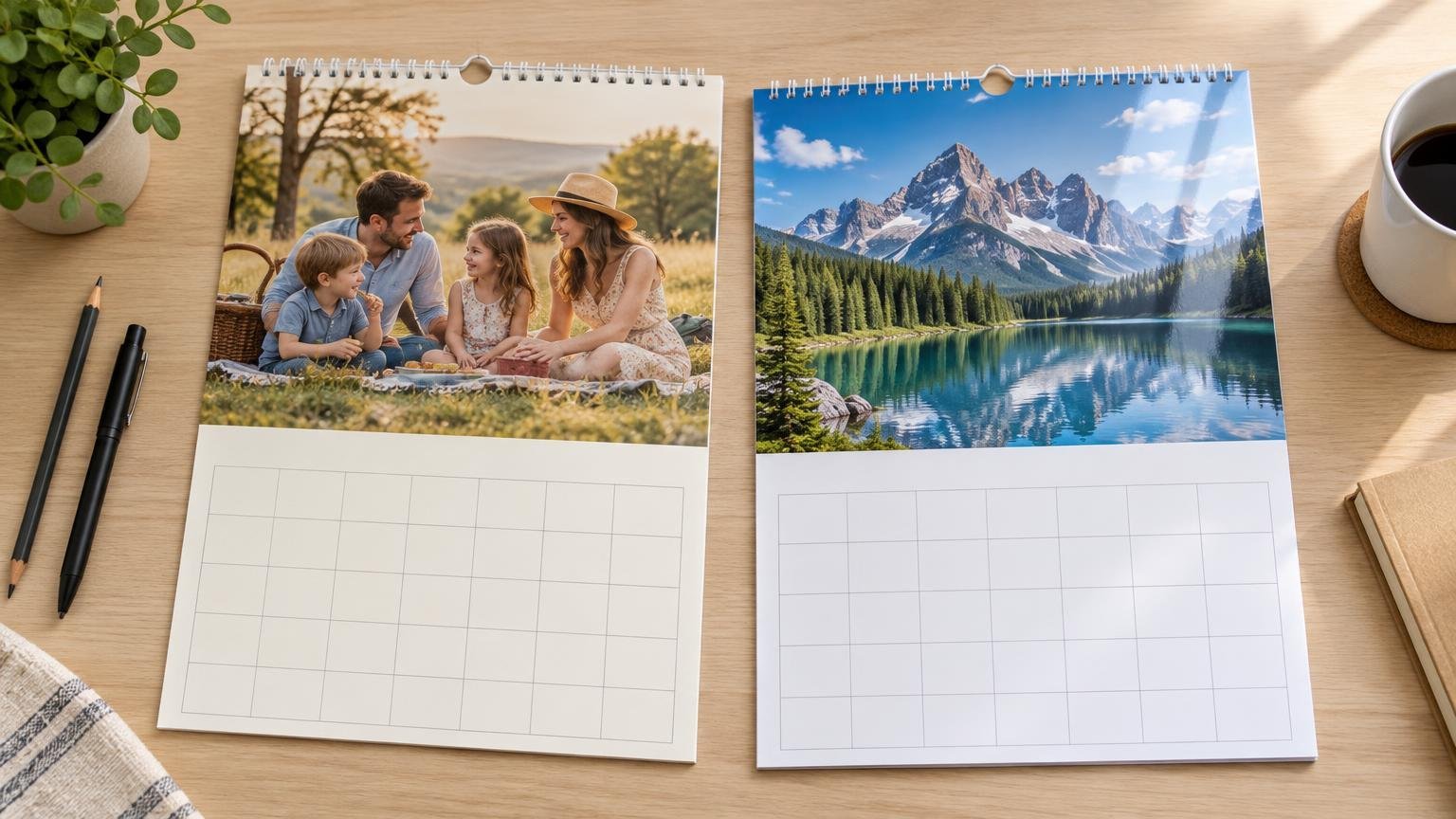
For a calendar that will collect appointments, reminders, school dates, and the occasional mysterious arrow, choose a matte or uncoated writing grid that the seller explicitly describes as writable. For a photo-first calendar that will mostly be displayed, gloss can deliver more visual punch.
The important catch is that “matte” does not automatically mean writable, and “glossy” does not automatically mean impossible to write on. Matte and gloss describe surface appearance, not a universal writing standard. The coating on the grid, the calendar’s construction, and the writing instrument all matter. Before ordering, look for product-specific confirmation that the date grid accepts your preferred pen or pencil.
Matte vs glossy photo calendars at a glance
| Decision factor | Matte or low sheen | Glossy | Practical winner |
|---|---|---|---|
| Everyday writing | Potentially convenient, but coated matte may still resist ink | Often requires a compatible pen or permanent marker | Verified writable or uncoated grid |
| Photo presentation | Subdued appearance with less reflected light | Higher perceived contrast, saturation, and visual punch | Glossy |
| Glare | Diffuses more reflected light | More reflective under bright or changing light | Matte |
| Fingerprints and handling | Usually hides handling marks better | More likely to show fingerprints, scratches, and stains | Matte |
| Kitchen or office use | Easier to view and handle in busy, bright spaces | Best when display impact matters more than frequent notation | Matte |
| Gift presentation | Soft, restrained, practical look | Shiny, photo-forward presentation | Depends on the recipient |
Writability depends on the exact calendar, not just the finish
A matte calendar can still use coated paper. The Fujifilm paper guide distinguishes matte from uncoated stock and describes matte as a coated, low-sheen surface. Its general guidance also says coated matte and glossy papers are usually unsuitable for ordinary pen or marker writing because their coatings can resist ink adhesion.
That does not mean every glossy calendar grid is unwritable. Some calendars use coated pages for the photos and an uncoated area for the dates. VistaPrint says certain middle-bound wall calendars use that split construction, while its top-bound formats have no coating; it states that its calendar writing areas can accept a pen or marker. That is a product-specific feature, not permission to assume the same about every glossy calendar.
Other sellers attach different writing guidance to different papers. Saal Digital says its Premium Matte and Art Line Smooth calendar options work with most pens, while ordinary pens and pencils do not adhere well to its glossy and premium-glossy surfaces; it recommends a permanent marker for those glossy options. Photobox similarly describes its matte and extra-matte calendars as pen-friendly while recommending permanent marker for glossy calendars to reduce smudging.
Finish names also vary between sellers. “Satin,” “silk,” “dull,” and even some products labeled “matte” can indicate low-sheen coated papers rather than fully uncoated writing stock. Nations Photo Lab, for example, describes its calendar paper as satin/dull/matte with a subtle semi-gloss sheen, yet says it accepts a standard ballpoint pen or permanent marker.
Check pencil separately from pen
Do not treat “writable” as a promise that every instrument will behave identically. The ASTM practice for evaluating print-media writeability examines legibility, skipping, and smearing with several instruments, including ballpoint pens and a No. 2 pencil. Saal Digital’s guidance is more specific still: it says ordinary pencils do not adhere well to its glossy calendar surfaces.
If you plan appointments in pencil so they can be moved later, look for an explicit pencil claim. If the product page only says “writable,” ask the seller which instruments were intended. A permanent marker may work on a glossy coating, but that is not much help to someone who expects to erase next Tuesday’s dentist appointment.
Gloss makes photos pop, but it also reflects the room
Glossy paper has a smooth, reflective surface that can make photographs appear more saturated, higher in contrast, and more vivid. That makes it appealing for travel pictures, colorful family photos, and gift calendars intended to feel like a rotating photo display.
The same reflective surface can produce glare under bright or changing light. Matte paper diffuses more reflected light, making it easier to view from different angles in a kitchen, hallway, or office. The tradeoff resembles the one involved in choosing matte or glossy photo prints for framing: gloss supplies punch when the lighting cooperates, while matte is more forgiving when it does not.
Gloss also tends to reveal fingerprints, scratches, stains, and handling marks more readily. That matters less for a calendar hung out of reach and more for one that gets flipped, carried to a desk, or handled by several family members. Matte is not immune to grime, but it generally does a better job of keeping ordinary handling from becoming part of the design.
Which finish works better in a kitchen?
Matte is the safer default for a kitchen calendar. Kitchens commonly combine bright overhead lighting, changing daylight, frequent handling, and an urgent need to read the grid from an angle. Lower glare and less visible fingerprinting are useful advantages rather than decorative preferences.
The best construction is an explicitly writable grid—preferably uncoated if pencil use matters—with the photo area finished separately if available. That split gives the pictures some visual polish without turning “buy milk” into a surface-adhesion experiment. Confirm the binding position and grid coating before ordering, because sellers may apply different finishes to different calendar formats.
Which finish works better in an office?
For a working office calendar, prioritize the grid over the photographs. A calendar used for deadlines, shift notes, project milestones, or shared scheduling should accept the instruments people already use. An explicitly writable matte surface or uncoated grid is generally the most practical choice.
Gloss can still work for a reception area, private office, or promotional calendar that functions mainly as a visual display. If notes will be occasional, a compatible permanent marker may be acceptable. If entries change frequently or several people will use the calendar, requiring a special marker creates needless friction.
Which finish makes the better gift?
Glossy paper often creates the more immediately photo-forward presentation. Bright colors and contrast can feel lively when the recipient first opens the calendar. Matte produces a quieter look, reduces distracting reflections, and is usually better suited to a gift that will become a working household planner. Neither style is universally more premium; it depends on whether the recipient values photographic impact or daily usability.
Think about the recipient before paying for an upgraded finish. A grandparent who writes birthdays and appointments on the grid may get more value from easy notation and legibility than extra shine. Someone who displays calendars as photo collections may prefer gloss. Our guide to making a custom photo calendar gift for grandparents covers the broader choices involving image selection, layout, readability, and family dates.
What to verify before ordering
- Is the calendar described as writable, and does that claim cover the grid specifically?
- Is the writing area coated, uncoated, or made from a different stock than the photo area?
- Does the seller confirm compatibility with ballpoint pen, pencil, marker, or only permanent marker?
- Are the product photos and date grid given different finishes?
- Do the finish options change between top-bound, middle-bound, desk, and poster-style calendars?
- Will the calendar hang beneath bright lights or near a window where glare could affect readability?
- Will it be handled and written on daily, or mostly viewed as a photo display?
If the listing does not answer those questions, ask the seller or order a sample when available. Test the exact pen or pencil you intend to use, then check for skipping and smearing before committing to a larger order or a gift deadline.
The practical verdict
Choose matte for a kitchen, shared office, family-planning station, or any calendar likely to be handled and annotated frequently—but only after confirming that its grid is genuinely writable. Choose gloss when the photographs are the main attraction, the lighting is controlled, and writing will be limited or done with a seller-approved marker.
If you can choose a calendar with glossy or polished photo pages and an uncoated writing grid, that is often the best compromise. Otherwise, trust the product’s material and instrument guidance over the finish label. “Matte” sounds practical and “glossy” sounds difficult, but the calendar’s actual construction gets the final vote.
Frequently Asked Questions
Are all matte photo calendars writable?
No. Matte can still mean coated paper, and that coating may resist ordinary ink. Confirm that the calendar grid accepts your preferred pen or pencil.
Can you write on a glossy photo calendar?
Sometimes. Certain sellers approve pens or markers for specific glossy calendars, while others recommend permanent marker to reduce poor adhesion or smudging. Check the exact product guidance.
Which calendar finish is best for pencil?
An explicitly pencil-compatible or uncoated grid is the safer choice. Pencil performance differs from pen performance, and ordinary pencils may not adhere well to glossy coatings.
Is matte or glossy better for a kitchen calendar?
Matte or low sheen is usually more practical because it reduces glare and makes handling marks less obvious. The grid should still be verified as writable.
Which finish makes a better photo-calendar gift?
Choose gloss for a vivid, photo-forward presentation. Choose matte for lower glare and easier daily use—especially when the recipient will treat the gift as a household planner.
References
- Uncoated Paper vs. Matte, Dull and Glossy Paper – Fujifilm
- F2294 Standard Practice for Determining the Writeability of Print Media
- Design a Photo Calendar for 2027 with your own photos
- Custom Wall Calendars 2027| VistaPrint
- Personalised Calendar 2027 | Make your own Photo Calendar
- What Makes an Ink “Archival”? | Canon U.S.A., Inc.
- Flip Calendars | Custom Wall Calendars | Nations Photo Lab