
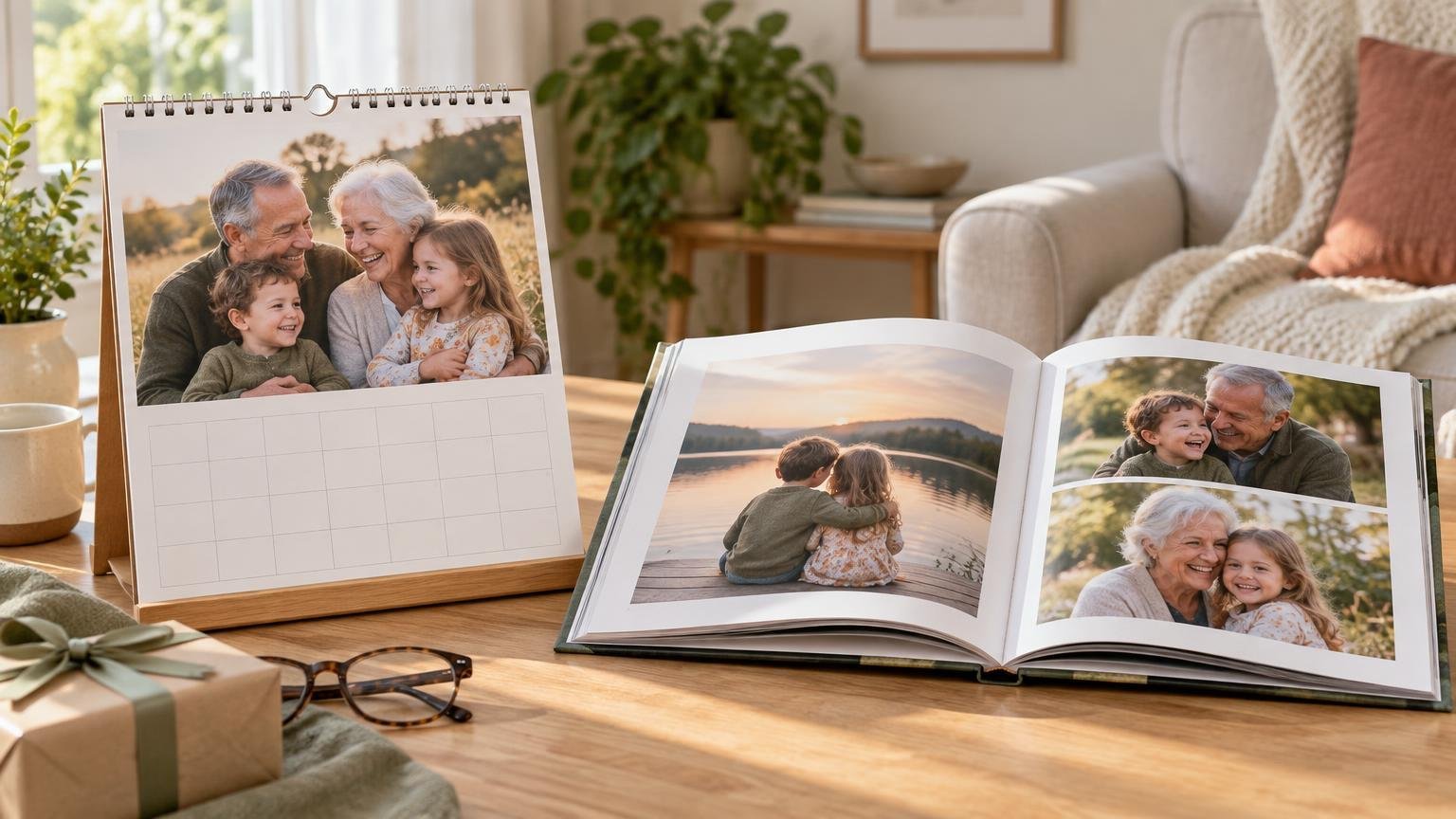
TLDR: In the photo calendar vs photo book gift decision, choose a calendar when your grandparents use a date grid and would enjoy seeing family photos in everyday life. Choose a photo book when the photos form a larger story, such as a family year, major trip, wedding, reunion, or grandchild’s milestones. The calendar wins on recurring visibility; the book wins on storytelling depth.
Neither format is automatically more personal. The better photo calendar vs photo book gift depends on what the recipient will actually do with it. A calendar can remain visible near a desk, kitchen, or family noticeboard for months. A photo book can hold many moments in an intentional sequence, but it must be picked up and opened. That simple difference should guide the order.
This is a research-based category comparison, not a new hands-on test of specific calendar and photo-book products. Big Print World’s methodology distinguishes research-led coverage from physical product testing, and the recommendations here are based on format, workflow, provider information, and recipient fit rather than a side-by-side sample order.
The quick decision
| Decision factor | Photo calendar | Photo book |
|---|---|---|
| Everyday visibility | Usually displayed where dates are checked | Usually stored on a shelf or table and opened intentionally |
| Storytelling depth | Best for monthly highlights and short captions | Best for chronology, captions, themes, and varied layouts |
| Photo collection | Works well with a small, carefully edited set | Better suited to a larger collection that benefits from sequencing |
| Editing effort | Potentially simpler, but custom dates and monthly layouts add decisions | Usually involves more choices about order, pages, captions, and pacing |
| Useful lifespan | Date grid is tied to a defined period | Not tied to a calendar year |
| Gift presentation | Practical and immediately understandable | Can feel more like an album or keepsake |
| Best recipient fit | Someone who uses a calendar and likes visible family photos | Someone who enjoys revisiting trips, milestones, or family history |
For many grandparents, the deciding question is not “Which looks more impressive?” It is “Where will this live?” If the answer is a kitchen wall or desk where it will be noticed frequently, the calendar has a strong practical advantage. If the answer is a coffee table where family members will sit together and revisit a particular year, the book is the better container.
Choose a photo calendar for recurring visibility
A photo calendar works best when the gift should become part of the recipient’s routine. Big Print World’s calendar guidance treats calendars as functional products, while its photo-book guidance emphasizes projects in which sequence and narrative matter. That makes a calendar especially suitable for grandparents who already write appointments, birthdays, or reminders on a printed date grid.
The format also imposes useful restraint. Rather than attempting to include every decent phone photo from the year, you can choose one strong image for each month and a cover image. Colorland, for example, presents 13 photos—one cover plus 12 monthly images—as a starting point for one of its calendars, while allowing customers to add more. That is a provider-specific example, not a rule for every calendar.
Restraint matters because a calendar still needs to function as a calendar. Packing every page with tiny photographs can reduce both the impact of the pictures and the usability of the date grid. One strong photograph, or a deliberately simple collage, is usually easier to appreciate from normal viewing distance. For a step-by-step approach, see this guide to making a custom photo calendar gift for grandparents.
Some providers add useful personalization beyond photographs. Colorland says customers can select a starting month, add custom events, and choose a gift-box option, while Lulu lists customer events and both 12- and 18-month templates. These features can make the calendar more relevant to the family, but they are not universal. Check the exact product page before building your plan around an October start date or a preprinted list of birthdays.
The main tradeoff is that the practical part of the gift expires. Once the displayed months have passed, the recipient may keep the calendar for its photographs, but it no longer performs its original job. That does not make it less meaningful. It simply means its value comes from repeated use during a particular period rather than permanent, undated reference.
Choose a photo book when the sequence is the gift
A photo book is the stronger choice when individual images gain meaning from their order. A family trip can move from departure to destination. A baby-year book can progress from early days to a first birthday. A reunion book can introduce each family branch before ending with the group photograph. Big Print World’s photo-book guidance identifies trips, weddings, year recaps, and baby milestones as projects in which sequencing adds value.
Books also give captions somewhere sensible to live. Names, locations, dates, family recipes, short stories, and remembered remarks can sit beside the relevant image instead of competing with a calendar grid. This is particularly useful when the gift is meant to preserve family context, not merely display attractive photographs.
The freedom comes with more decisions. You may need to choose a book size, organize photos, decide which images deserve a full page, balance horizontal and vertical shots, write captions, and check every spread. If the available choices are becoming a small administrative crisis, start by choosing an appropriate photo book size and then estimate how many photo book pages the project needs.
Design assistance varies by seller. Shutterfly describes manual design, an Autofill option, and a designer service, and it lists gift boxes among its photo-book options. Automated layout can reduce the initial workload, but it does not remove the need to inspect crops, duplicate images, page order, and text. Automation is helpful; it is not a substitute for noticing that Grandpa’s head has disappeared into the binding.
How many photos do you need?
For a simple calendar, start by asking whether you have roughly one excellent image per month plus a cover. The 13-image model is easy to plan, even though individual products may support many more images. If your collection contains only eight or nine genuinely good photographs, forcing the weaker ones into monthly starring roles will not improve the gift. Look for a layout that allows selective collages, reuse a meaningful image where appropriate, or choose a photo book with a short, focused theme instead.
A photo book does not have one responsible universal photo-count target. Capacity changes with page count, book dimensions, and whether you use full-page images or multi-photo layouts. More capacity is not the same as a better result. A concise book with a clear beginning, middle, and end can feel more intentional than a long book containing every burst-mode variation of the same group portrait.
Use this practical sorting method before opening an editor:
- Create a “must include” folder for the photographs central to the gift.
- Create a second folder for supporting images that add context but are not essential.
- Remove obvious duplicates, screenshots, blurred files, and near-identical frames.
- Check that important family members appear in a balanced way appropriate to the project.
- Decide whether the collection forms a sequence or a set of independent monthly highlights.
That final step usually answers the format question. A sequence wants a book. Independent highlights often work naturally in a calendar.
Which format takes more effort?
A basic calendar often requires fewer layout decisions because the months provide a ready-made structure. Choose a cover, assign pictures to months, inspect the grid, and proof the result. The work increases if you add multiple images per page, enter birthdays, change backgrounds, or match photographs to seasons.
A book usually demands more editorial judgment. Even when software places the pictures automatically, someone must decide whether the order makes sense and whether the layout gives important moments enough space. Captions add value but also introduce spelling, date, and name checks. If several relatives have nearly identical names, this is where confidence turns into a group-text investigation.
A realistic rule is to choose a calendar when time is limited and the photo set is already small and polished. Choose a book when you can devote time to sorting and sequencing, or when the story is important enough to justify that work. Either format can become complicated if you keep adding pages, collages, embellishments, and upgrades.
Timing, shipping, and gift presentation
There is no universal production or shipping winner. Published timelines differ among providers: Colorland states a usual calendar production time of one working day plus delivery, while Lulu lists three to five business days of production across its network. Those examples demonstrate variation rather than guaranteeing when a particular order will arrive.
For a deadline-sensitive gift, compare the actual configuration in the cart. Size, binding, paper, gift packaging, destination, shipping method, and seasonal demand can all affect the estimate shown by the seller. Leave time to review the preview before ordering; a faster checkout does not compensate for a birthday assigned to the wrong month.
Presentation depends more on execution than category. A photo book can feel substantial with a well-chosen cover, restrained title, and optional presentation box. A calendar can feel equally thoughtful when its first visible image is strong and it is wrapped without crushing the binding or bending the corners. Provider-specific gift-box options exist for both categories, but availability should be checked for the selected product.
Do not assume either product qualifies for USPS Media Mail. The official USPS Media Mail standards define eligibility by content category. Calendars are not included in the listed eligible categories, and a photo-heavy book may not meet the standard that qualifying books consist wholly of reading matter or scholarly bibliography. If low-cost mailing is central to the plan, check the finished item against current USPS rules or choose a clearly applicable package service instead of relying on the word “book.”
Which works better for different grandparent gifts?
For grandparents who track appointments on paper
Choose the calendar. Its date grid gives the photographs a practical reason to remain visible. Add family birthdays only if you can verify every date, and keep enough blank space for handwriting.
For a grandparent who loves family history
Choose the photo book. Use captions to identify people, places, and approximate dates, especially when younger family members may later inherit the book. The context can be as valuable as the pictures.
For a new grandchild’s first year
Choose a book if the goal is to preserve development in sequence. Choose a calendar if the goal is to provide one cheerful image each month during the coming year. The same photo collection can support either gift, but the intended use is different.
For grandparents with limited display or storage space
First determine what space is genuinely available. A wall calendar needs a suitable hanging location; a book needs shelf or table space. Matching a photo gift to the recipient’s habits and home is more useful than selecting the largest format available. Big Print World’s broader guide to making a photo gift people keep explains why recipient fit, careful cropping, and readable text matter.
For a reunion, wedding, or major trip
Choose the photo book unless you specifically want a practical calendar for the following year. These events normally benefit from chronology, varied page layouts, and captions that a calendar cannot accommodate as comfortably.
A final checklist before ordering
- Where will the gift live: wall, desk, coffee table, or bookshelf?
- Does the recipient currently use a printed date grid?
- Do you have a small set of standout images or a larger connected story?
- Would names, places, dates, and captions improve the collection?
- How much time can you realistically spend sorting and proofing?
- Are important faces safely inside the crop boundaries shown in the preview?
- Is text large enough and sufficiently contrasted to read comfortably?
- Have you checked the current production estimate and delivered date for the exact configuration?
- Does the seller offer the desired starting month, custom events, wrapping, or gift box?
- Have you compared the complete cart rather than an advertised starting price?
Common questions
Is a photo calendar less meaningful because it lasts one year?
No. Its dated function ends, but its strength is frequent visibility during that period. A calendar that is noticed and used can be more successful than a keepsake that stays closed. Choose based on the recipient’s habits, not an assumed hierarchy of sentimental value.
Can a photo calendar start outside January?
Some can. Colorland states that customers can select a starting month, but this feature is provider- and product-specific. Verify it before designing, particularly if the calendar is intended for a birthday, school year, or anniversary rather than a winter holiday.
Does a photo book take longer to make?
It often requires more sorting, sequencing, and page-level review, but the answer depends on the project and software. A simple automated book may be faster than a calendar filled with custom events and elaborate collages. Production and delivery times also vary by seller and configuration.
Which is easier to send directly as a gift?
Either can be shipped directly if the seller supports recipient delivery. Check whether prices or packing slips are included, whether a gift message is available, and how the item will be packaged. Do not assume gift packaging is included merely because it appears as an optional product upgrade.
The better choice for most grandparents
Choose a photo calendar when the recipient uses printed calendars, has a good display location, and would enjoy a tightly edited set of family images throughout the year. Choose a photo book when the photographs need chronology, captions, or enough room to preserve a fuller family story.
Before ordering, identify where the gift will live and sort the photos into “essential” and “optional” groups. If the essentials fit naturally into monthly highlights, make the calendar. If removing images breaks the story, make the book. That dividing line is more reliable than choosing whichever product currently has the louder discount banner.
References
- How We Test – bigprintworld.com
- Calendars – bigprintworld.com
- Photo Books & Prints – bigprintworld.com
- Photo Calendar | Colorland US
- Make a Custom Art or Photo Wall Calendar | Lulu
- Shutterfly Photo Books Guide: Common FAQs | Shutterfly
- 170 Retail Mail Media Mail and Library Mail | Postal Explorer
- How to Make a Photo Gift People Actually Keep – bigprintworld.com