
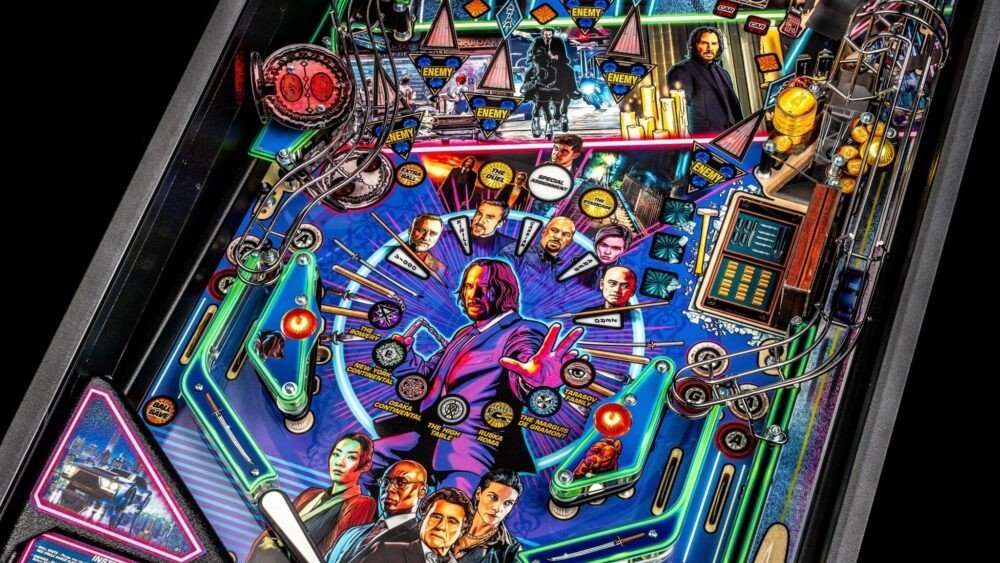
Pinball playfields are one of the more interesting examples of specialty printing because the graphics have to look sharp, hold up under physical play, and work as part of a manufactured object. This guide looks at how pinball playfield graphics are printed, finished, and protected.
If you have ever wondered how pinball playfield graphics are printed, the short answer is this: usually not with a giant sticker, and not in one simple pass. On a commercial playfield, the artwork is typically printed directly onto the prepared playfield surface after the wood is routed, the inserts are installed, and everything is leveled for printing.
It Starts Before Any Ink Touches the Playfield
The printing part only works because of everything that happens first. A playfield blank gets routed for holes, features, and hardware locations, then inspected for flaws. After that, the inserts are glued in by hand and the surface is sanded flat so the art can cross wood and inserts cleanly instead of stepping over little ridges. Reproduction makers using old-school methods describe the same general order: machine the field, glue and sand the inserts, prep the surface, then send it to printing.
The Art Is Usually Screen Printed Directly Onto The Surface
This is the part most people are asking about. In the traditional factory method, the art is screen printed directly onto the playfield, one ink at a time. Churchill’s playfield process shows the inks being applied by hand one by one, while the artwork itself is built from a four-color process with additional layers for white or other spot colors when CMYK alone is not enough. Each ink needs its own screen. So no, it is not one giant print button and a prayer.
Why Screen Printing Works So Well For Pinball
Pinball art asks a lot from a printing process. It has to land accurately on a rigid surface with cutouts, inserts, and odd geometry, and it often mixes smooth blends with sharp comic-book edges. Screen printing handles that well. Colors are generally laid down from light to dark, and a black keyline is often printed last to trap the colors together and hide tiny registration errors. It also supports specialty inks such as fluorescent, metallic, and UV-reactive colors that help give some playfields that extra punch.
Some playfield areas are also built from halftone dots rather than solid blocks of color. Up close, four-color process work can show the same kind of cyan, magenta, yellow, and black dot structure you see in other printed graphics, but from normal playing distance the eye blends it into full-color art.
Clear Coat Is Part Of The Look, Not Just The Protection
After the ink passes are done, the playfields go onto drying racks, and once the inks are cured they move on to clear coat. That clear layer is doing two jobs. It protects the art from the abuse of normal play, and it changes the look dramatically. Churchill noted that before clear coat, a playfield looks dull and lifeless. After clear, the colors look richer and more saturated, which is a big part of why a finished playfield has that glossy, alive look under the glass.
The Protective Top Layer Changed Over Time
Older pinball games did not all use the same protective approach. Williams adopted Sun Process’s Diamond Plate hardcoat around 1990, a modified automotive urethane system developed to make playfields more durable, and other manufacturers followed with their own hardcoats later. Gottlieb generally stayed with lacquer longer, and even tried an odd exception called Vitrigraph, where the art was printed onto a mylar sheet applied to the playfield instead of being screened directly onto the wood. That tells you something useful: direct printing onto the playfield was the norm, and the mylar-first approach was unusual enough to stand out.
Is This Still How It’s Done?
The old-school process is not dead. Chicago Gaming said in a 2025 post that its playfields are still silk screened by hand, and Buthamburg says its licensed reproduction playfields are produced only with silk screen printing, color by color. So screen printing is not just something collectors talk about nostalgically while staring at a Funhouse under bright shop lights. It is still a real production method when the goal is a traditional playfield look.
What About Digital Printing, Overlays, And Hardtops?
For homebrew games, one-off restorations, and some repair products, digital methods are more common because they are cheaper and more practical at low volume. Pinball Makers notes that home builders often use direct digital printing or printed vinyl/mylar overlays, while products like Outside Edge’s Hardtop print the art on the underside of a rigid clear sheet so the ball never touches the ink. Those methods can work very well, but they are different from a factory-style printed playfield.
The Short Version
So, how are pinball playfield graphics printed? In the classic commercial method, the playfield is machined, inserts are glued and leveled, the art is screen printed directly onto the surface one ink layer at a time, and the whole thing is sealed under clear coat. It is a slower and fussier process than most people expect, which is probably why great playfields look great, and why bad printing or weak clear coat gets noticed for a very long time.
Learn more at printreviewer.