
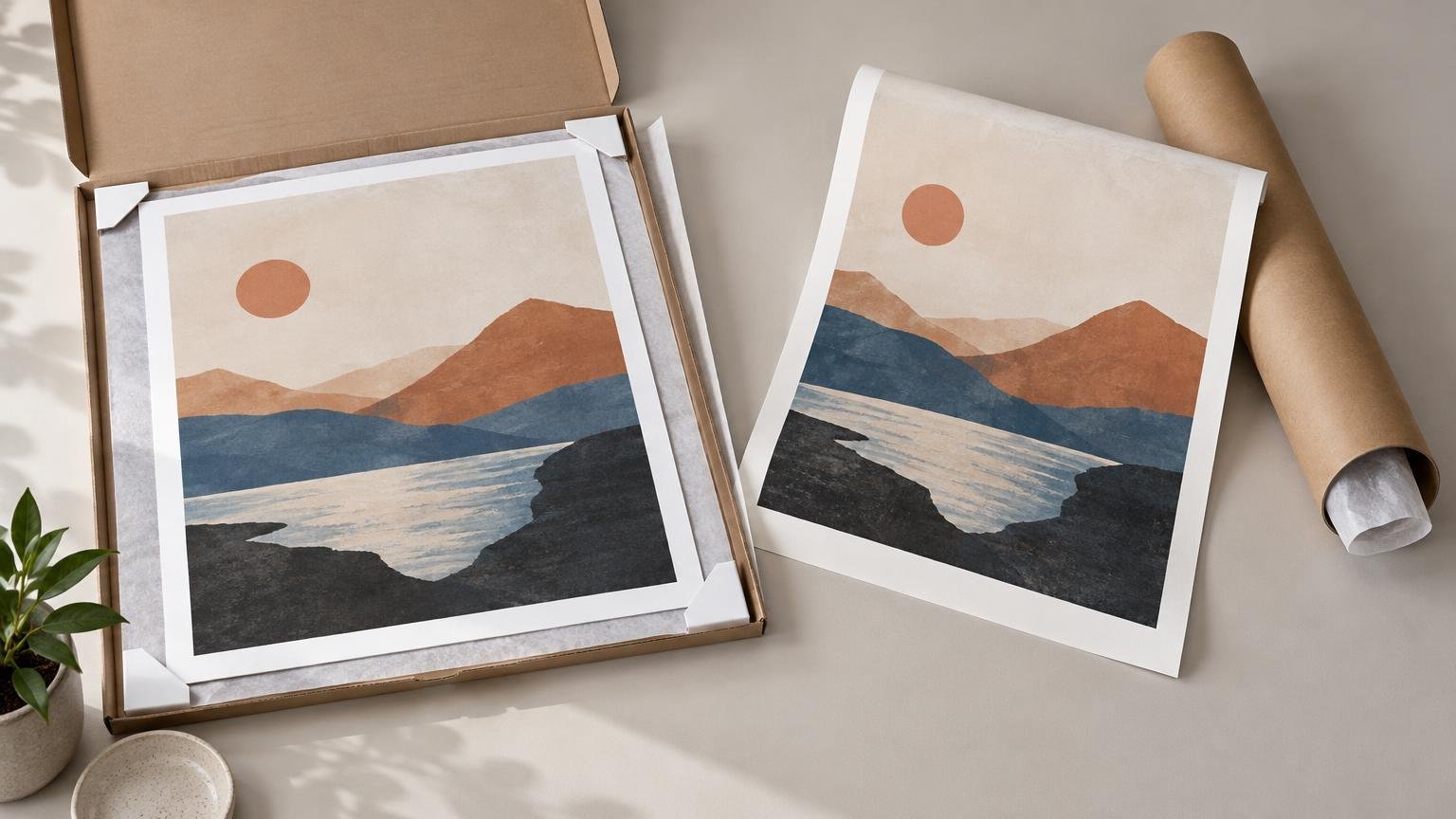
For a large art print offered at the same size, choose flat shipping when the seller uses genuinely rigid support and you want the print ready for framing with minimal flattening. Choose rolled shipping when the paper is flexible, the flat package would be unwieldy, or the seller’s tube packaging is clearly more protective.
Neither format is automatically safer. Flat packages can bend or suffer crushed corners; tubes can be dented, lose an end cap, or allow the print to shift. The decisive question is not “tube or mailer?” It is “what protects the paper inside?”
The practical differences at the same print size
| Factor | Rolled shipping | Flat shipping |
|---|---|---|
| Arrival condition | Usually arrives with some curl | Arrives without intentional curl if the package stays flat |
| Package shape | Long, comparatively compact tube | Wide rigid mailer or flat box |
| Typical vulnerability | Tube dents, crushed ends, shifting, surface abrasion and stubborn curl | Bending, corner impacts, punctures and edge compression |
| Before framing | May need time and careful flattening | Often needs less preparation, though it may still require inspection or flattening |
| Best fit | Flexible papers and very large dimensions | Stiffer papers and prints you want to frame promptly |
Those are format tendencies, not guarantees. A strong tube with secure end protection can beat a flimsy flat mailer, and a properly supported flat box can beat a thin tube that gets used as an accidental drumstick by the delivery network.
Paper weight matters, but GSM does not settle the choice
GSM measures paper mass per square meter. It does not directly measure thickness, stiffness or resistance to bending. Papers with similar GSM ratings can have different bulk, surfaces, coatings and textures, as explained in Hahnemühle’s paper-quality guide.
At the same dimensions, a higher-GSM print contains more paper mass, but that number alone does not reveal whether it will tolerate rolling well or whether a flat package will protect it adequately. Ask for the exact paper name, GSM, thickness and finish. If the choice of stock is still open, our guide to photo paper versus fine art paper explains how surface and texture affect the finished print.
Stiff or heavily textured paper deserves particular attention. Rolling places the sheet into a curved position, while flat shipping asks the package to resist bending across a much larger area. Environmental conditions can also contribute to curl, so paper weight is only one part of the story.
Judge the complete packaging system
The Postal Service says packaging should protect its contents and avoid bulging, while FedEx’s artwork guidance recommends appropriate protective packaging and cushioning. In other words, the shipping format is only the outer geometry; the supports inside do the actual work.
For a rolled print, look for a sturdy tube, protected ends, secure caps and an internal method that keeps the print from sliding or rubbing. For a flat shipment, look for rigid support larger than the artwork, protected corners or edges, a clean protective layer over the print, and enough restraint to prevent movement.
If the product page merely says “ships flat” or “ships rolled,” ask what that means. A print floating in an oversized box is not premium packaging. It is a very expensive passenger without a seat belt. Buyers comparing other presentation and mounting options can also browse our wall art and poster guides.
Why the flat-packaging charge may be higher
Flat shipping can carry an extra charge because the package occupies more space and may require rigid boards, corner protection or a larger box. That does not mean every flat shipment costs more, and an added packaging fee does not prove that the packaging is better.
Carriers may calculate charges using package dimensions as well as actual weight. UPS states that billable weight can be the greater of actual weight or dimensional weight, while USPS also applies dimensional-weight rules in applicable circumstances. A broad, shallow flat box may therefore price differently from a long tube even when both contain the same print.
Compare the final delivered totals at checkout, not just a line labeled “packaging.” That total can combine postage, dimensional charges, materials, handling and the seller’s own pricing. If flat shipping costs more, ask what protection the upgrade adds. Paying extra for rigid support is easier to justify than paying extra for a different box label.
How to flatten a rolled print safely
Start with the seller’s instructions for the exact paper and printing process. Unroll the print slowly on a clean, dry surface and stop if the sheet feels brittle, unusually stiff or tightly set. Keep hands and rough materials away from the printed surface.
Avoid improvising with heat, moisture or aggressive reverse rolling. Guidance from the National Archives warns that opening or flattening weak, brittle, creased or tightly curled paper can cause tears, breaks or permanent creases. Other conservation guidance also cautions that humidification and reverse bending can introduce risks when the paper and image materials are unknown.
A newly produced commercial art print is not necessarily as fragile as an old document, but its coating, ink and paper surface still matter. If gentle relaxation does not work, contact the printer before applying pressure or attempting a more involved method. A framer can handle valuable, heavily curled or unfamiliar media with fewer experiments and fewer opportunities to turn one curve into three creases.
Document shipping damage before discarding anything
Inspect the package before opening it. USPS and FedEx both advise keeping the original packaging for a potential damage claim, and their claims guidance identifies photographs and supporting documents as useful or potentially required.
- The unopened exterior, including the shipping label and tracking number.
- Every visible dent, puncture, crushed corner, open seam, missing cap or wet area.
- The package immediately after opening, before moving the print or internal supports.
- All cushioning, boards, sleeves, tissue, corner protectors or tube components.
- The complete front and back of the print in even light.
- Close-ups of creases, dents, edge damage, scuffs, abrasions, ink loss or moisture effects.
Do not photograph only the artwork. Carrier guidance distinguishes among damage to the exterior package, the internal cushioning and the artwork itself, so your record should show all three. Keep the box or tube, internal materials, receipt, order confirmation and tracking information until the seller or carrier closes the issue.
Which option should you order?
Choose flat shipping when the printer describes substantial rigid support, the paper is relatively stiff, or you need to frame the print soon after delivery. Choose rolled shipping when the stock is flexible, the size makes a flat package awkward, and the tube includes secure end and surface protection.
If the seller provides no packaging details, ask before paying an upgrade charge. For rolled versus flat shipping, the winning option is the one with the better package system for that specific paper—not the one that sounds more careful on the checkout page.
Frequently Asked Questions
Is flat shipping always safer for a large art print?
No. A rigid, well-supported flat box can work well, but a flimsy mailer can bend or crush. A sturdy tube with secure ends and internal restraint may provide better protection; the complete packaging system is what matters.
Does a higher GSM mean the print should ship flat?
Not by itself. GSM measures paper mass per square meter, while thickness, stiffness, texture and coating are separate characteristics. Ask for the exact paper specifications rather than treating one number as the verdict.
Why can flat shipping cost more than rolled shipping?
A flat package may need larger rigid boards, corner protection or a broad box. Carriers can also use package dimensions when calculating billable weight, so compare the final delivered totals and ask what protection the surcharge adds.
How should I flatten a rolled art print?
Follow the printer’s instructions, unroll it slowly on a clean, dry surface and stop if it feels brittle, stiff or tightly set. Avoid heat, moisture and forceful reverse rolling when the paper and image materials are uncertain.
What shipping damage should I photograph?
Document the unopened exterior and label, dents or moisture, the print’s position inside, every protective component, both sides of the artwork and close-ups of creases, scuffs, abrasions, edge damage or moisture effects. Keep all packaging and order records until the issue is closed.
References
- How to Prepare & Send a Package | USPS
- How to Ship Artwork | FedEx
- Paper Quality Parameters – Traditional FineArt
- Paper Quality Parameters – Digital FineArt
- Shipping Package Dimensions and Weight Limits | UPS – United States
- How to Prepare & Send a Package | USPS
- File a Claim | USPS
- How Do I File a Claim for a Missing or Damaged Package? | FedEx – FAQs
- Frequently Asked Questions
- Paper-Based Records | National Archives
- Flatten Carefully – Division of Library and Information Services – Florida Department of State
- Flattening Folded or Rolled Documents | National Postal Museum
- Conserve O Gram 13/2: How to Flatten Folded or Rolled Paper Collections (U.S. National Park Service)