
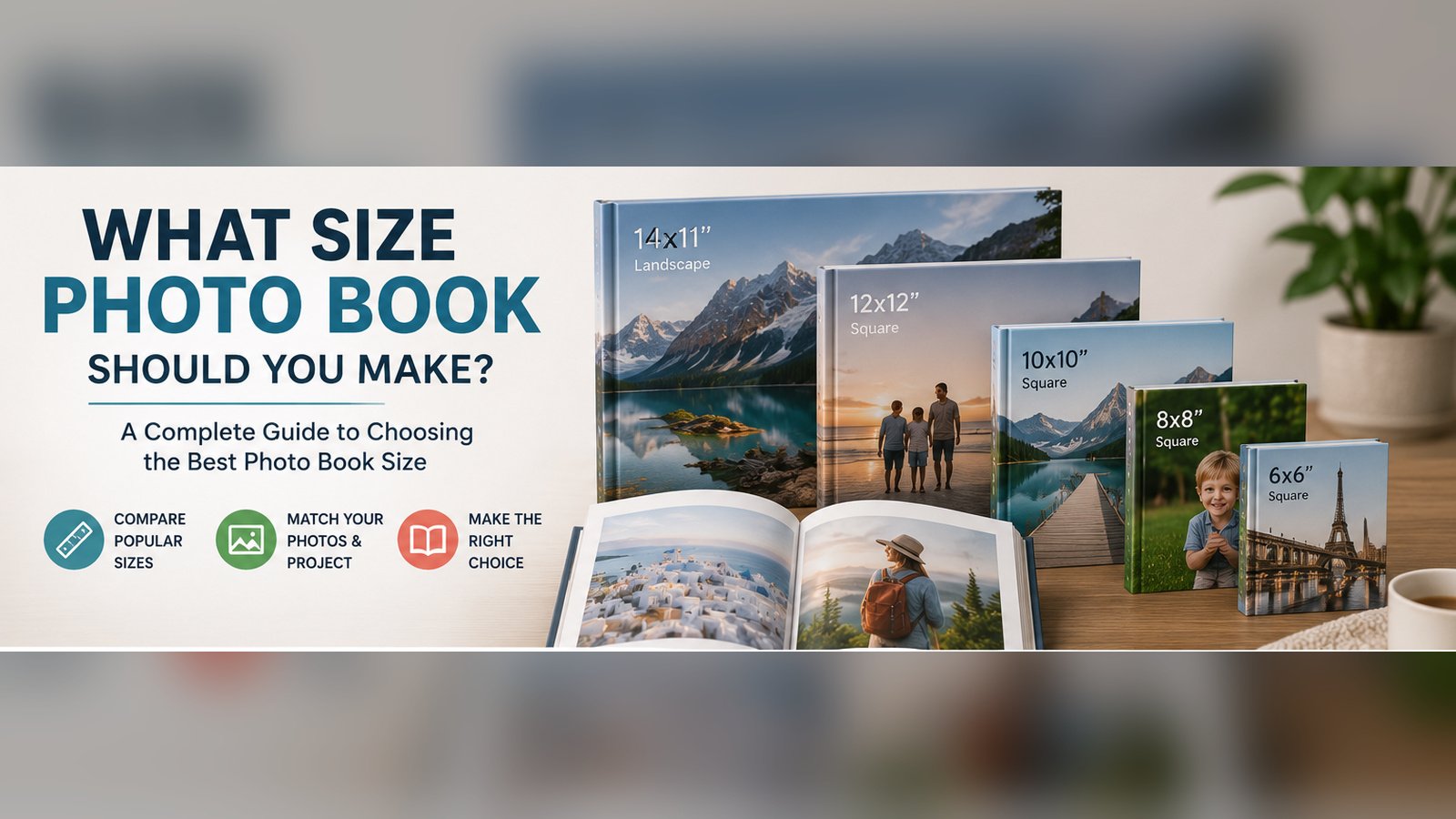
Choosing a photo book size sounds simple until the editor presents a wall of squares, rectangles, orientations, and premium upgrades. So, what size photo book should you make? For most family, travel, and year-in-review projects, an 8-by-8-inch or 10-by-10-inch book is the safest choice. Larger 12-by-12-inch books work better for weddings and display pieces, while landscape formats are ideal for travel photography and panoramic images.
The best size depends on your photographs, how many images you want to include, where the finished book will be stored, and how much you want to spend.
Quick Photo Book Size Recommendations
| Photo Book Size | Best For | Main Tradeoff |
|---|---|---|
| 6×6 inches | Small gifts, children, short trips | Limited room for captions and collages |
| 8×8 or 8.5×8.5 inches | Everyday albums, gifts, family highlights | Large group photos may feel cramped |
| 10×10 inches | Family yearbooks, travel books, premium gifts | Costs more than an 8×8 book |
| 12×12 inches | Weddings, milestone albums, coffee-table books | Heavy, expensive, and harder to store |
| 8.5×11 inches, portrait | Cookbooks, school books, family histories | Landscape photos may require cropping |
| 11×8.5 inches, landscape | Travel, scenery, events, panoramic photos | Less natural for vertical phone photos |
| 14×11 inches, landscape | Portfolios and dramatic display books | High price and demanding image resolution |
Our default recommendation is an 8-by-8-inch book for a casual project and a 10-by-10-inch book for an important keepsake.
Is an 8×8 Photo Book Big Enough?
An 8-by-8-inch photo book is big enough for most everyday projects.
It works particularly well for:
- Family highlights
- Short vacations
- Baby books
- Birthday albums
- Pet photo books
- Gifts for parents and grandparents
- Small year-in-review projects
An 8×8 book is easy to hold, easy to store, and normally one of the more affordable hardcover options. The square format also handles a mixture of portrait and landscape photos reasonably well.
You can place one large photograph on a page or create simple two-photo and three-photo layouts without making everything microscopic.
The weakness appears when you try to include large group photographs, lengthy captions, or dense collages. Eight inches sounds generous until you place six photos, a title, two decorative elements, and a paragraph on the same page. At that point, the people in the pictures begin to resemble witnesses in distant security footage.
Choose an 8×8 book when you want something compact and approachable rather than dramatic.
When Should You Choose a 10×10 Photo Book?
A 10-by-10-inch photo book is the best all-around size for a substantial family album.
It provides noticeably more room than an 8×8 book without becoming as bulky or expensive as a 12×12 album. The extra space allows you to use:
- Larger photographs
- More comfortable white space
- Two-page chapter openings
- Longer captions
- Four-photo and five-photo layouts
- Full-page portraits
- Group photographs with recognizable faces
A 10×10 book is particularly suitable for an annual family yearbook. It gives ordinary phone photographs enough room to look important without making the finished book feel like ceremonial furniture.
It is also a good choice for travel books, anniversary gifts, graduation albums, and substantial baby books.
Choose 10×10 when the book is intended to last, be displayed, and be looked through repeatedly.
Is a 12×12 Photo Book Too Big?
A 12-by-12-inch photo book is large, but it is not too big for the right project.
This format works best for:
- Wedding albums
- Professional event photography
- Milestone anniversaries
- Large family histories
- High-end travel books
- Photography portfolios
- Coffee-table books
The larger page gives important photographs room to breathe. A single wedding portrait can fill the page without feeling cropped or compromised, while panoramic spreads become much more impressive.
A 12×12 layflat album can be especially effective because the open spread measures approximately 24 inches across. That gives you enough room for a wide landscape, a full wedding party, or a carefully paced sequence of images.
But there are real tradeoffs.
A large book costs more, and extra pages can become expensive quickly. It is heavier to hold and may not fit comfortably on a normal bookshelf. Low-resolution photos are also more obvious when enlarged.
Choose a 12×12 book because the photographs deserve the space, not merely because the size sounds premium.
Square vs Landscape vs Portrait Photo Books
The shape of the book can matter just as much as its dimensions.
Square Photo Books
Square books are the most flexible option.
They work with a mixed collection containing:
- Vertical phone photos
- Horizontal camera photos
- Square social-media images
- Collages
- Text pages
- Scanned photographs
A square book does not perfectly match every image, but it rarely fights the collection. That makes it the best default format for family albums and year-in-review books.
Popular square sizes include 6×6, 8×8, 8.5×8.5, 10×10, and 12×12 inches.
Landscape Photo Books
Landscape books are wider than they are tall.
They are best for:
- Travel photography
- Landscapes
- Road trips
- Sporting events
- Weddings
- Group photographs
- Panoramic scenes
- Professional camera images
A landscape book makes wide photographs easier to display without aggressive cropping. It also creates long two-page spreads that work well with scenery and event sequences.
Common landscape sizes include 8×6, 11×8.5, and 14×11 inches.
Portrait Photo Books
Portrait books are taller than they are wide.
They work well for:
- Phone photography
- Portrait sessions
- Cookbooks
- Family histories
- School projects
- Yearbooks
- Written stories with photographs
- Professional headshots
An 8.5×11-inch portrait book feels familiar because it resembles a standard magazine or document. It is also convenient when the project contains substantial text.
The weakness is that wide photographs may need to be cropped, reduced, or placed across two pages.
Match the Book to Your Photos
Before choosing a format, look at the photographs you plan to use.
Do not rely on a vague impression of your camera roll. Put the selected images in one folder and review them as a group.
Ask:
- Are most photographs vertical or horizontal?
- Are there many panoramic scenes?
- Do you have large group photographs?
- Are the images mostly close-ups?
- Will you include scanned prints?
- Do you want captions or longer stories?
- Are the photographs high enough in resolution for large pages?
If most of your photographs were taken vertically on a phone, a portrait or square book will be easier to design. If the collection comes from a DSLR or mirrorless camera and contains landscapes, a landscape book may require less cropping.
Mixed family collections usually work best in a square format.
Consider Photo Resolution Before Ordering a Large Book
A larger photo book does not improve a weak image. It simply makes the weaknesses easier to inspect.
One current printer recommends approximately:
| Full-Page Book Size | Suggested Minimum Image Resolution |
|---|---|
| 8×8 inches | 2400×2400 pixels |
| 8×11 inches | 2400×3300 pixels |
| 10×10 inches | 3000×3000 pixels |
| 11×14 inches | 3300×4200 pixels |
| 12×12 inches | 3600×3600 pixels |
These are useful targets rather than universal rules. Different printers, paper types, image-processing systems, and viewing distances can affect the final result.
A modern phone photograph will often have enough pixels for a full page. Problems are more likely when the image is:
- A screenshot
- Downloaded from social media
- Sent through a messaging app
- Heavily cropped
- Digitally zoomed
- Scanned at low resolution
- Pulled from an old website
- Already compressed several times
Pay attention to the printer’s low-resolution warning. It is not merely the editor being dramatic.
Choose the Size Based on Photo Count
The number of photographs also affects the best photo book size.
A small book can contain many pages, but dense layouts become harder to read. A larger format gives you more freedom to use several photographs without shrinking them excessively.
As a general guide:
| Number of Selected Photos | Suggested Book Size |
|---|---|
| 20 to 50 | 6×6 or 8×8 |
| 50 to 100 | 8×8 or 10×10 |
| 100 to 200 | 10×10 or 11×8.5 |
| 200 to 350 | 10×10, 12×12, or large landscape |
| More than 350 | Split into volumes or use a long standard-page book |
Do not automatically choose the largest format because you have many photos. A 400-photo book can still feel exhausting if every page is crowded.
Sometimes the better solution is two focused books instead of one enormous visual storage unit.
Best Photo Book Size by Project
Family Yearbook
Best choice: 10×10 square
The format handles mixed photo orientations, school pictures, holidays, vacations, and everyday phone photographs. It also gives you enough room for monthly dividers and captions.
An 8×8 book can work for a shorter yearbook, while 12×12 is better if professional family photography is a major part of the project.
Wedding Album
Best choice: 12×12 square layflat
A large layflat book gives portraits, ceremony photographs, and group shots room to breathe. It also supports dramatic two-page spreads.
A 10×10 layflat book is a good compromise when budget or storage space matters.
Travel Photo Book
Best choice: 11×8.5 landscape
Travel collections often contain scenery, architecture, group photos, and panoramic images. A landscape book matches these photographs naturally.
Choose 14×11 only when the images are high resolution and the book is intended as a major display piece.
Baby Book
Best choice: 8.5×8.5 or 10×10 square
Square formats make it easy to mix phone photos, monthly milestone pictures, hospital photos, and written notes.
A smaller book feels intimate, while 10×10 leaves more room for text and keepsakes.
Photo Book Gift
Best choice: 8×8 square
An 8×8 book is affordable, portable, and large enough to feel meaningful. It is a good size for grandparents, friends, teachers, and relatives.
Family History
Best choice: 8.5×11 portrait
Family-history books often contain more text, captions, documents, certificates, letters, and scanned photographs. A portrait format supports this material better than a decorative square album.
Photography Portfolio
Best choice: 12×12 square or 14×11 landscape
Match the orientation to the work. Portrait photographers may prefer a tall format, while landscape and architectural photographers will usually benefit from a wide book.
For professional work, paper quality and color accuracy matter at least as much as the dimensions.
Custom Cookbook
Best choice: 8.5×11 portrait
A standard portrait format works well for ingredients, instructions, food photographs, and section dividers. It is also easier to use on a kitchen counter than a large square album.
Think About Where the Book Will Live
It is easy to choose a photo book on a bright computer screen without considering where the physical object will go.
Before ordering, measure:
- Bookshelf height
- Shelf depth
- Coffee-table space
- Storage boxes
- Display stands
- Existing album sizes
A 12×12 album may not fit on a shallow shelf. A 14×11 landscape book can require substantial horizontal space. Thick layflat books also occupy more shelf width than standard-page books with the same number of pages.
Smaller books are easier to pass around. Larger books create more impact. Neither is automatically better.
How Size Changes the Price
Photo book pricing usually increases in three ways:
- Larger covers cost more.
- Larger pages cost more.
- Additional pages cost more in larger formats.
Premium paper and layflat construction can widen the difference considerably.
A modest upgrade from 8×8 to 10×10 may be worthwhile. Moving from an 8×8 standard hardcover to a 12×12 layflat album is a different financial decision entirely.
Always compare the final cart price after adding:
- Your actual page count
- Paper upgrades
- Cover upgrades
- Logo removal
- Gift boxes
- Shipping
- Tax
The inviting starting price rarely survives every checkbox.
Common Photo Book Size Mistakes
Choosing a Format Before Selecting Photos
Your photographs should guide the orientation. Selecting a portrait book and then discovering that nearly every favorite image is horizontal creates unnecessary cropping.
Going Too Large for the Image Quality
Large pages expose blur, compression, and digital noise. Check old and downloaded photographs carefully before committing to a display-sized book.
Going Too Small for the Layout
A small book can work beautifully, but not when every page contains five photos and a short memoir.
Ignoring Storage
Measure your shelf before ordering a giant album. Furniture is strangely unsympathetic to sentimental reasoning.
Assuming Every Company Offers the Same Sizes
Photo-book sizes vary by company, book type, cover, paper, and binding. A service may offer a size as a hardcover but not as a layflat album.
Confirm the exact configuration before designing the entire project.
Final Recommendation
What size photo book should you make?
Choose an 8×8 square book for a casual, affordable album or gift. Choose a 10×10 square book for the best balance of presentation, usability, and price. Choose a 12×12 layflat book for a wedding or major milestone.
Use landscape formats for scenery and wide event photography. Use portrait formats when the project contains vertical phone images, written stories, recipes, or documents.
And when you are stuck between two sizes, the middle option is usually the sensible one. A 10×10 book is large enough to feel special without requiring its own piece of furniture.