
TLDR
- The best label sticker size for small business packaging depends on the package shape, available flat space, and amount of information.
- Small labels work well for logos, lids, seals, and simple branding.
- Larger labels are better for ingredients, product names, scent names, instructions, barcodes, and compliance-style information.
- Before ordering, measure the actual package and test a paper mockup at real size.
- Shape matters: circle, square, rectangle, and wrap labels all solve different packaging problems.
A label can make small business packaging feel clean and intentional, but only when the size makes sense. Too small, and the important details become hard to read. Too large, and the label wrinkles, wraps awkwardly, or makes the package feel overdone.
Choosing the right label sticker size for small business packaging starts with the actual container. Not the mockup. Not the template. The real jar, bottle, bag, box, mailer, tin, tube, pouch, or envelope sitting on your table.
How To Choose Label Sticker Size for Small Business Packaging
The simplest way to choose a label sticker size for small business packaging is to measure the usable label area first.
That means the flat or gently curved space where the label can sit without hitting a seam, edge, ridge, handle, lid, fold, or strong curve. Labels can bend, but they do not enjoy being forced over packaging chaos. Few printed things do.
Big Print World’s Stickers & Labels hub looks at sticker and label decisions from this practical angle: material, print clarity, finish, durability, adhesive, and format. For small business packaging, format is often the first decision that affects everything else.
Start With the Package Type
Different packages need different label logic.
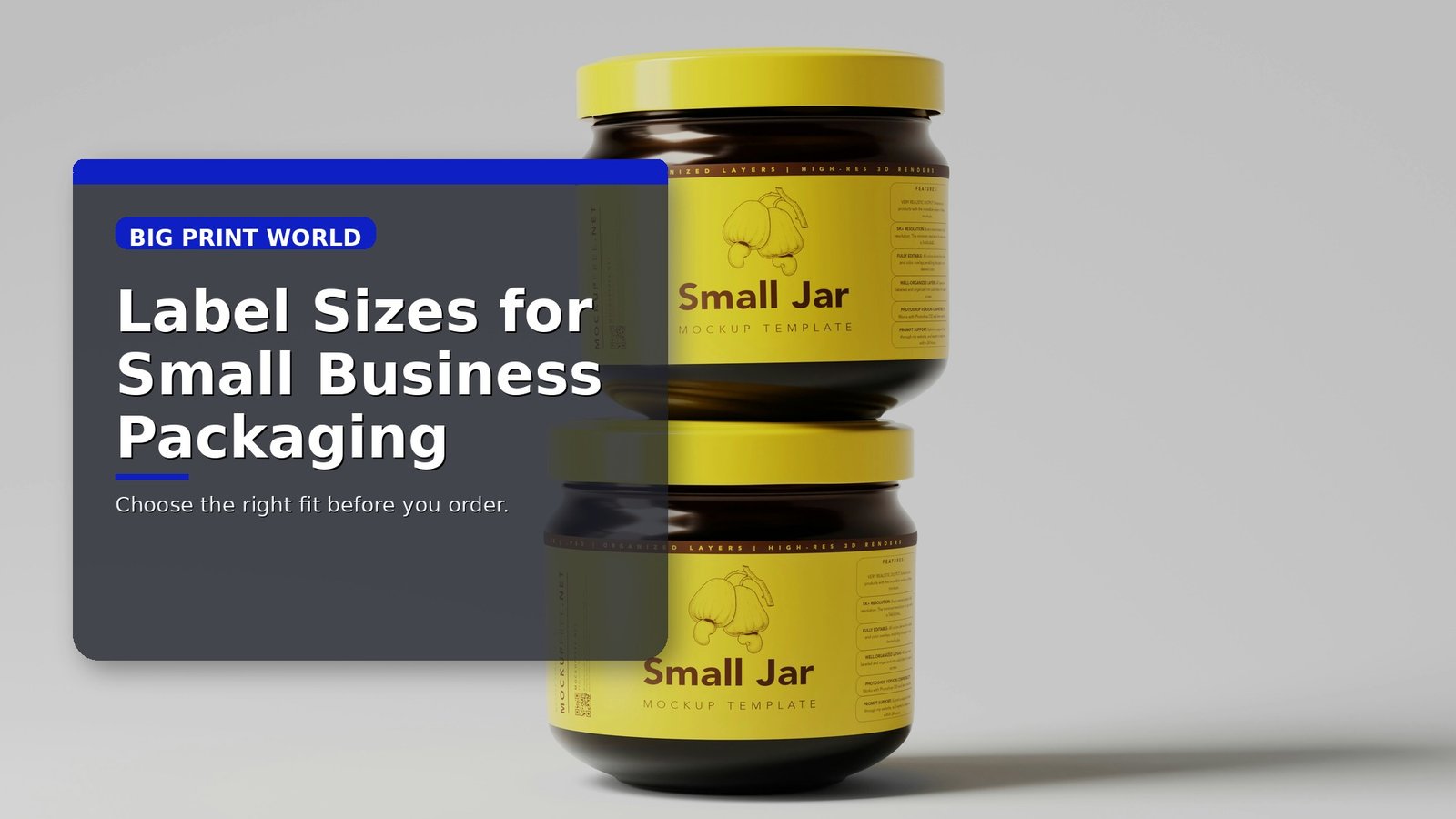
For jars, a front label often carries the product name, scent, flavor, or brand. A lid label can work as a secondary brand mark or flavor marker. Round labels are popular for lids, while rectangles often work better on the jar body.
For bottles, vertical rectangles, horizontal rectangles, and wrap labels are common choices. The curve of the bottle matters. A tall narrow bottle may need a narrow front label. A short wide bottle may need a wider label with less height.
For boxes, square and rectangular labels are usually easiest. They sit flat, read clearly, and can double as a seal when placed over a flap.
For pouches and bags, label size depends on how much the package flexes. A label on a crinkly pouch should not be too rigid or oversized. A smaller front label may look cleaner than a large label that creases every time the bag moves.
For mailers, use a label that is bold enough to read quickly but not so large that it competes with shipping labels or handling marks.
Use the Information to Decide the Size
A label with only a logo can be small. A label with product details needs more room.
Use smaller labels for:
- logo marks
- thank-you stickers
- lid labels
- package seals
- simple flavor or scent names
- handmade branding touches
Use larger labels for:
- product names
- ingredients
- usage instructions
- batch numbers
- barcodes
- warnings
- product descriptions
- care instructions
- retail packaging
A 1-inch circle may be fine for a logo seal. A 2-inch circle can work well for lids, candles, jars, and simple product labels. A 3×2 rectangle gives more room for a product name and short details. A 4×3 label starts to feel more like a full front-panel label for boxes, bags, and larger containers.
Those are not strict rules. They are starting points. The real test is whether a human can read the label without squinting or rotating the package like they are solving a puzzle.
Circle, Square, Rectangle, or Wrap Label?
Shape changes the feel of the package.
Circle labels feel friendly and simple. They work well for lids, jars, candles, bakery packaging, coffee bags, and small-batch products.
Square labels feel clean and balanced. They are useful when the design has centered artwork, a simple logo, or a compact product name.
Rectangle labels are the most flexible. They work for bottles, boxes, bags, jars, and mailers because they give text more room to breathe.
Wrap labels are best when the package needs front and back information in one continuous piece. They can look very polished on bottles and jars, but they require more careful measuring.
For product and label sticker printing options, CustomStickers.com product and label stickers is a useful reference because it shows how product labels are ordered around size, quantity, artwork, proofing, and revisions.
Make a Paper Mockup Before Ordering
This is the easiest way to avoid sizing mistakes.
Print or cut a piece of plain paper at the label size you are considering. Tape it to the package. Look at it from the front, side, and top. Hold the package the way a customer would hold it. Put it on a shelf or table next to similar products.
Ask these questions:
- Does the label look too small?
- Does the label cover too much of the package?
- Is the text readable?
- Does the label bend over a seam or ridge?
- Does the shape match the package?
- Does the design have enough margin?
- Would the label still look good if applied slightly off-center?
That last question matters. Hand-applied labels need a little forgiveness. A design that only works when placed with surgical precision may not be the best choice for a busy packing table.
Leave Room Around the Edges
Do not push text, logos, barcodes, or important details too close to the edge.
A label needs breathing room for two reasons. First, it looks better. Second, printing and cutting involve small tolerances. Safe margins help prevent important details from feeling cramped or accidentally too close to the trim.
For artwork setup, Printiverse’s Artwork & File Setup Guide is a helpful reference because it explains final size, resolution, bleed, safe area, and file setup in plain terms.
Think About Application Speed
A label can look great on one product and become annoying on the 200th product.
Small businesses should think about application, not just appearance. Round labels are easy to center on lids but can be harder to align on the front of a bottle. Long wrap labels can look polished but may slow down packing if alignment is tricky. Small seals are quick, but they may not carry enough branding on their own.
The right label size should fit both the package and the workflow.
For small batch products, a slightly simpler label that is easy to apply consistently is often better than a more ambitious label that creates wrinkles, crooked placement, or packing delays.
Common Mistakes To Avoid
Avoid choosing a label size before measuring the package.
Other common mistakes include:
- using tiny type for required details
- placing a flat label on a strong curve
- choosing a label that crosses a seam
- making the logo huge but the product name hard to read
- forgetting space for barcodes or batch codes
- using the same label size across very different packages
- skipping a real-size mockup
- ignoring how fast the label needs to be applied
A good label supports the product. It should not fight the container.
FAQs
What is the best label size for jars?
For many small jars, 2-inch circle labels, 2.5-inch circle labels, and small rectangular labels are common starting points. The right choice depends on the jar height, curve, and amount of text.
What size label should I use for candle jars?
A 2-inch or 2.5-inch circle can work well for lids, while a rectangular front label often works better for scent name, brand, and candle details.
Are circle labels or rectangle labels better?
Circle labels are great for simple branding, lids, and friendly packaging. Rectangle labels are better when you need more text, product details, or a barcode.
How do I know if my label is too small?
Print a real-size paper mockup. If the text is hard to read at normal handling distance, the label is probably too small or the design is too crowded.
Should every product use the same label size?
Not always. A consistent label system is good, but different containers may need different sizes or shapes to look clean and apply correctly.