
TLDR
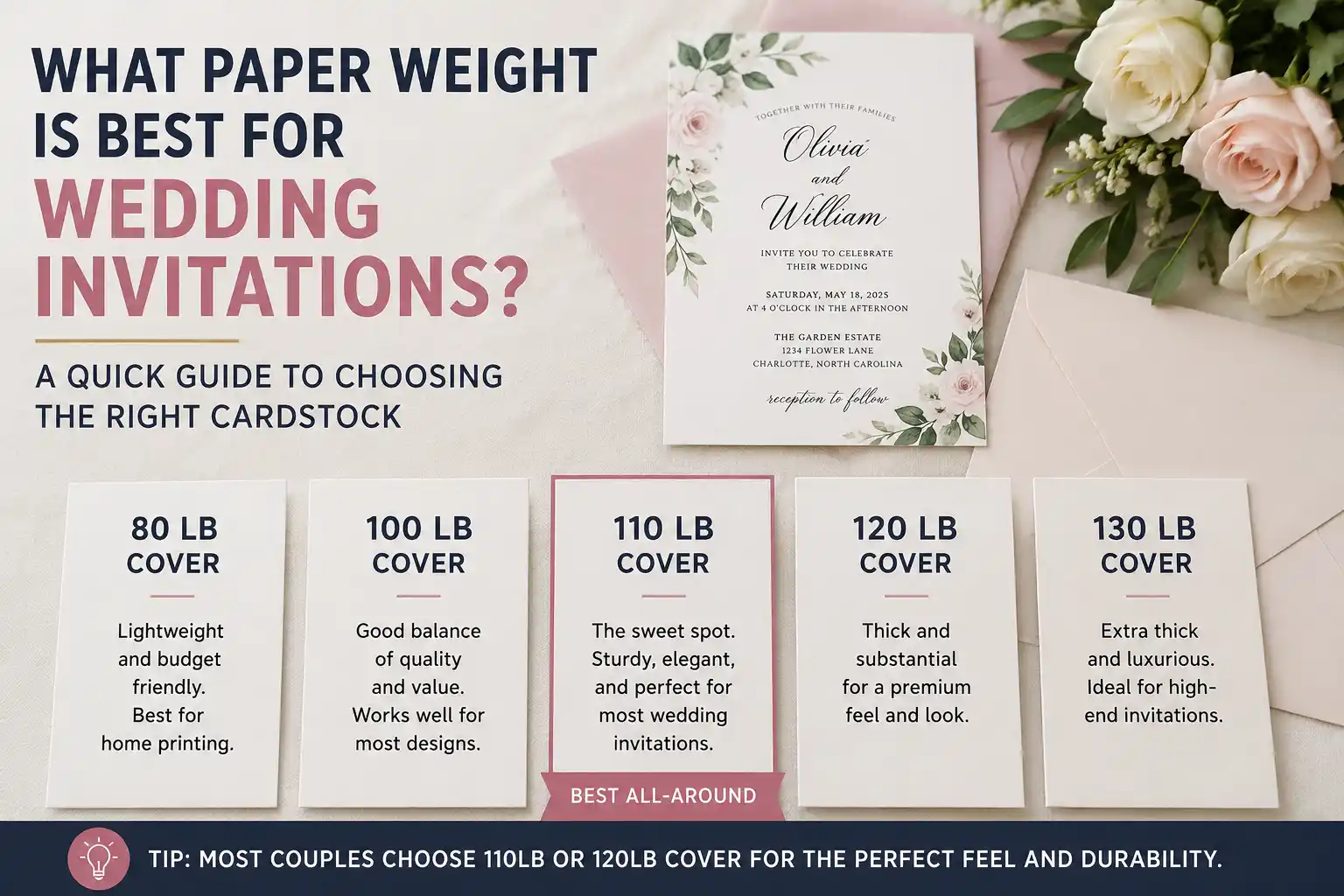
The best paper weight for wedding invitations is usually 100 lb to 130 lb cover stock, with 110 lb or 120 lb cover being the safest middle ground for most professionally printed 5 x 7 invitations. It feels substantial without getting ridiculous, and it usually works well for digital printing, foil accents, and standard mailing.
If you are printing at home, stay closer to 80 lb to 100 lb cover because many home printers get offended by thick paper. If you are ordering from a professional invitation printer, 110 lb to 130 lb cover is where the card starts to feel like a real invitation instead of a nice flyer in formalwear.
Why Paper Weight Matters More Than People Think
The best paper weight for wedding invitations is not just a technical printing detail. It affects how the invitation feels when someone pulls it out of the envelope, how well the ink sits on the surface, how cleanly the card cuts, how much the suite costs to mail, and whether the finished piece feels polished or a little limp.
That last part matters.
A wedding invitation is one of the few printed things people still expect to feel good in their hands. Nobody is gathering around the mailbox to admire a utility bill. But a wedding invitation gets opened, touched, read, shown to someone else, and sometimes saved. So the paper has to do some work.
The tricky part is that paper weight terms are confusing. You will see pounds, GSM, points, cover stock, text weight, double-thick, cotton, felt, eggshell, pearl, linen, and probably six more words that sound like they wandered in from a stationery wine tasting.
So let’s make it practical.
The Best Short Answer: Use 110 lb or 120 lb Cover Stock
For most wedding invitations, 110 lb or 120 lb cover stock is the sweet spot.
That range usually feels sturdy enough for a formal invitation, works well for professional digital printing, and does not automatically create mailing problems when paired with a standard envelope. It also gives you enough structure for a single flat 5 x 7 card without needing a backer layer.
If you want the safest recommendation, choose:
- 110 lb cover for a balanced, polished invitation
- 120 lb cover for a more premium feel
- 130 lb cover if you want the card to feel extra substantial
- 100 lb cover if you want to save money or keep postage simpler
- 80 lb to 100 lb cover if you are printing at home
That is the simple version. And honestly, for many couples, that is enough.
But if you are choosing between several paper options on an invitation site, the details below will help you avoid the two classic mistakes: going too thin and regretting it, or going too thick and accidentally turning your invitation into a tiny mailing project.
What Does “Cover Stock” Mean?
For wedding invitations, you generally want cover stock, not text weight paper.
Cover stock is the heavier paper used for cards, postcards, business cards, invitations, covers, and other pieces that need to stand on their own. Text weight paper is closer to what you would use for letterhead, book pages, programs, or inserts.
A wedding invitation printed on text weight paper can look nice in a photo, but it usually feels too soft as the main invitation card. It bends too easily. It may feel underwhelming. It can work for details cards or vellum overlays, but not usually for the main invite.
Think of it this way:
- Cover stock is for the main invitation
- Text weight is for lighter inserts, liners, wraps, or layered pieces
- Vellum is decorative, not structural
- Cardstock is the general everyday term people use for heavier cover-style paper
If you only remember one thing, remember this: the main invitation should usually be on cover stock.
Understanding Pounds, GSM, and Points
Paper weight gets confusing because not every printer describes it the same way.
Pounds
In the U.S., invitation paper is often described in pounds, such as 100 lb cover or 120 lb cover. This does not mean one sheet weighs 120 pounds. Thankfully. It refers to the weight of a standard ream in that paper category.
The annoying part is that 100 lb cover is not the same as 100 lb text. Cover and text are measured from different parent sheet sizes, so the numbers are not directly interchangeable.
For invitations, pay attention to whether the listing says cover.
GSM
GSM means grams per square meter. It is a more direct measurement because it describes the weight of a square meter of paper.
As a rough invitation-shopping guide:
- 250 GSM can feel decent but may be light for a formal main invitation
- 300 GSM is a good practical starting point
- 325 to 350 GSM feels more premium
- 400 GSM and above starts getting into extra-thick territory
Not every conversion is exact because different papers have different densities and textures. Cotton, coated, uncoated, and textured papers can feel different even at similar weights.
Points
Points, often written as pt, describe thickness. One point equals one thousandth of an inch. A 16 pt card is about 0.016 inches thick.
Point thickness is common with postcards, business cards, and some online print shops. It is useful, but it is not the same as weight. A dense paper and a fluffy textured paper can have different feels even when the thickness sounds similar.
Best Paper Weight by Invitation Type
Flat 5 x 7 Wedding Invitations
For standard flat wedding invitations, 110 lb to 120 lb cover is the best starting point.
This gives the card enough body to feel intentional without becoming awkward. It also pairs well with common finishes like matte, eggshell, felt, smooth, satin, soft-touch, and some foil options.
If the invitation is mostly text with a clean design, 110 lb cover is usually enough. If the design is more formal, minimal, or luxury-leaning, 120 lb cover often feels better.
Budget Wedding Invitations
For budget wedding invitations, 100 lb cover can work well.
It is still card stock, but it is lighter and often cheaper. It may also help keep postage more predictable if you are mailing a full suite with RSVP cards, details cards, belly bands, envelope liners, or other extras.
Do not assume cheaper means bad. A clean design on 100 lb cover can look far better than a messy design on expensive paper. Paper helps, but it does not rescue bad spacing. Paper has limits. Like the rest of us.
Luxury Wedding Invitations
For luxury wedding invitations, start around 120 lb to 130 lb cover.
This range feels more substantial and works especially well for minimalist designs, formal typography, soft neutral palettes, letterpress-inspired designs, foil accents, and premium envelopes.
If you go thicker than that, make sure you know what it does to production and mailing. Very thick cards can be beautiful, but they can also increase postage, limit print methods, and make the suite feel bulky once everything is assembled.
Letterpress Invitations
Letterpress usually works best on thick, soft paper, often cotton or cotton-blend stock.
For letterpress, the paper is not just carrying ink. It is taking an impression. That means heavier and softer stock can show the impression more clearly. Many letterpress invitations use thicker cotton stocks than standard digitally printed cards.
If you want real letterpress, choose the printer first, then choose from the paper options they recommend. Letterpress is not the place to freestyle your own paper theory at 1 a.m.
Foil Wedding Invitations
Foil invitations usually do well on smooth, sturdy cover stock.
For many foil-accented invitations, 110 lb to 130 lb cover is a strong range. Smooth papers often show foil cleaner than heavily textured stocks, though some specialty printers can foil textured paper beautifully.
If the foil is a major design feature, order a sample or proof if possible. Foil is one of those finishes where the mockup can look perfect and the final effect depends heavily on the printer, stock, and artwork.
Photo Wedding Invitations
For photo wedding invitations, use a smooth white or bright white cover stock, usually 100 lb to 120 lb cover.
A textured stock can soften a photo. That may look romantic for some images, but it can also make faces, details, and contrast look less crisp. For photo-heavy designs, smooth matte or satin stock is usually safer.
Gloss can make photos pop, but it can also feel less formal. Matte tends to feel more refined. Satin can sit in the middle.
Invitation Suites With Multiple Inserts
If you are mailing a full suite with several pieces, do not make every piece ultra-thick.
A smart setup might look like this:
- Main invitation: 110 lb or 120 lb cover
- RSVP card: 100 lb or 110 lb cover
- Details card: 100 lb cover
- Vellum wrap: lightweight decorative stock
- Belly band: lighter text or cover stock depending on style
The goal is balance. You want the main invitation to feel important, but the whole envelope still needs to mail cleanly. A suite made from five thick cards may feel premium in hand, but it can also become expensive to send.
What Paper Weight Is Best for Printing Wedding Invitations at Home?
For home printing, the best paper weight is usually 80 lb to 100 lb cover.
Some home printers can handle heavier stock, but many cannot. Even when they technically accept it, the printer may jam, smear, misfeed, bend corners, or refuse to cooperate in a way that feels deeply personal.
If you are printing at home:
- Check your printer’s maximum paper weight
- Test before buying all the paper
- Use cover stock, not text weight, for the main card
- Avoid very textured paper unless you know your printer handles it well
- Feed one sheet at a time if needed
- Let ink dry fully before stacking
- Use a proper paper cutter, not scissors
Home printing can work for casual invitations, small weddings, showers, parties, and simple designs. But if the invitation is formal, photo-heavy, dark-colored, foil-style, or large quantity, professional printing is usually the cleaner choice.
Matte, Gloss, Felt, Eggshell, or Pearlescent?
Weight is only part of the feel. Finish matters too.
Matte
Matte is the safest finish for most wedding invitations. It feels clean, modern, and readable. It also avoids the glare that can make glossy cards look more like promo postcards.
Choose matte for:
- Modern wedding invitations
- Minimal designs
- Typography-heavy layouts
- Soft colors
- Photo cards where you want less shine
Smooth
Smooth stock is a good all-purpose choice. It keeps text crisp and works well for digital printing, photos, and many foil designs.
Choose smooth for:
- Clean layouts
- Fine type
- Photo cards
- Upload-your-own designs
- Designs with thin lines
Felt or Eggshell
Felt and eggshell stocks add subtle texture. They can make invitations feel warmer and more tactile without going full handmade paper.
Choose felt or eggshell for:
- Watercolor artwork
- Botanical invitations
- Classic wedding designs
- Soft neutrals
- Romantic typography
Just be careful with tiny text. Texture can reduce sharpness a bit.
Pearlescent
Pearlescent paper has a slight shimmer. It can look elegant with pale colors, winter weddings, formal invitations, and soft metallic design elements.
Choose pearlescent for:
- Light, elegant designs
- Winter or evening weddings
- Soft floral designs
- Subtle shimmer
Avoid it if your design uses heavy dark backgrounds or very modern minimalism. Sometimes shimmer helps. Sometimes it just shows up uninvited.
Gloss
Gloss is less common for formal wedding invitations, but it can work for bright photo cards or casual celebration designs.
Choose gloss for:
- Photo-heavy invitations
- Bright color designs
- Casual events
- Save the dates where the photo is the main feature
For formal invitations, matte or smooth usually feels better.
How Paper Weight Affects Mailing
Paper weight affects postage because heavier cards and full invitation suites can push the envelope over standard letter weight or thickness limits.
A standard rectangular letter has to stay within certain size and thickness rules to qualify for regular letter pricing. Square envelopes, rigid envelopes, lumpy envelopes, wax seals, clasps, buttons, and unusually shaped mail can trigger nonmachinable handling and extra postage.
That means a very thick invitation may cost more to mail, especially if you add:
- RSVP cards
- Details cards
- Reception cards
- Envelope liners
- Vellum wraps
- Belly bands
- Wax seals
- Ribbon
- Thick handmade paper
- Square envelopes
- Rigid acrylic or wood pieces
Before mailing the full batch, assemble one complete invitation exactly as guests will receive it. Take it to the post office and ask them to weigh it and confirm the postage. This is not the glamorous part of wedding planning, but neither is getting 80 invitations returned because the postage was wrong.
Should You Choose the Thickest Paper Available?
Not automatically.
Thicker paper can feel better, but only to a point. At some point, extra thickness stops feeling elegant and starts creating practical problems.
Thick paper may:
- Cost more
- Limit printing methods
- Increase postage
- Make folded cards harder to produce cleanly
- Make a full suite too bulky
- Require special envelopes
- Feel stiff instead of refined
For a single premium invitation, 120 lb or 130 lb cover can be great. For a full suite with multiple cards, a mix of weights often makes more sense.
The main invitation should feel strongest. Supporting cards can be lighter. That gives the suite hierarchy, saves money, and keeps the envelope from turning into a tiny brick.
Best Paper Weight by Use Case
Best all-around wedding invitation paper weight
Choose 110 lb cover.
It is sturdy, practical, and safe for most digitally printed wedding invitations.
Best premium wedding invitation paper weight
Choose 120 lb to 130 lb cover.
This feels more substantial and works well for formal designs, foil accents, and minimalist stationery.
Best budget wedding invitation paper weight
Choose 100 lb cover.
It still feels like cardstock but keeps cost and mailing weight more manageable.
Best paper weight for home printing
Choose 80 lb to 100 lb cover.
Go heavier only if your printer specifications clearly allow it and your test sheets behave.
Best paper weight for full invitation suites
Use 110 lb or 120 lb cover for the main invitation, then use 100 lb or 110 lb cover for insert cards.
Best paper weight for save the dates
Use 100 lb to 120 lb cover.
Photo save the dates often look best on smooth matte or satin stock.
Best paper weight for RSVP cards
Use 100 lb to 110 lb cover.
RSVP cards do not need to be as thick as the main invitation unless the whole suite is intentionally premium.
When To Order Samples
Order samples if the invitation matters and you have time.
Samples help you compare:
- Paper weight
- Texture
- Brightness
- Finish
- Ink sharpness
- Color behavior
- Foil appearance
- Envelope quality
- Overall feel in hand
Paper descriptions can only do so much. “Premium matte” from one company may feel different from “premium matte” from another. “Soft-touch” can feel lovely or weirdly rubbery. “Pearlescent” can be subtle or a little too prom-program, depending on the stock.
A sample pack gives you actual information. Your monitor does not.
Best Printers for Different Paper Needs
If you want a balanced upload-your-own experience with solid paper and finish choices, PrintInvitations is a strong fit. It offers a proof-first workflow, multiple stock and coating choices, and good pricing for standard and premium invitation orders.
If you care most about paper samples and hard-copy proofing, CatPrint is a better paper-nerd choice. It is especially useful for custom files, designer-created invitations, and couples who want to feel the stock before committing.
If you want a simple finished-file upload process, Prints of Love is easy to recommend. It is not the deepest paper-options shop, but it is practical for Canva, Etsy, and designer files.
If you want lots of wedding templates, envelope tools, color customization, and a broader planning ecosystem, Basic Invite and Zola make sense. They are more template-and-tool driven than pure print-shop driven.
If you want luxury old-school stationery, Crane sits in a different lane entirely. Beautiful, expensive, slower, and not really the practical default for most couples.
FAQ
What is the best paper weight for wedding invitations?
The best paper weight for wedding invitations is usually 110 lb or 120 lb cover stock. This range feels substantial, prints well, and works for most standard 5 x 7 invitation cards.
Is 100 lb cardstock good for wedding invitations?
Yes, 100 lb cover stock can be good for wedding invitations, especially for budget-friendly orders, full suites with several inserts, and designs where you want to control mailing weight. It may feel less premium than 120 lb cover, but it is still a practical choice.
Is 80 lb cardstock too thin for wedding invitations?
80 lb cover can work, especially for home printing or casual invitations, but it may feel light for a formal wedding invitation. If you are ordering professionally, 100 lb cover or higher is usually better.
Is 130 lb cardstock too thick for wedding invitations?
No, 130 lb cover can be excellent for premium wedding invitations. It feels substantial and polished. The only caution is mailing. If you are sending multiple inserts, heavy envelopes, or wax seals, test postage before mailing everything.
What GSM is best for wedding invitations?
A good range is usually 300 to 350 GSM for professionally printed wedding invitations. Around 300 GSM is practical and polished, while 325 to 350 GSM feels more premium.
Should wedding invitations be matte or glossy?
Matte is usually better for formal wedding invitations because it feels softer, cleaner, and more refined. Gloss can work for photo-heavy or casual designs, but it is not the safest default for classic wedding stationery.
Can I print wedding invitations on regular printer paper?
You can, but you probably should not for the main invitation. Regular printer paper is too light and flexible. Use cover stock or cardstock for the main card.
Final Verdict
The best paper weight for wedding invitations is not the thickest paper you can find. It is the paper that fits the design, printing method, budget, and mailing plan.
For most couples, 110 lb or 120 lb cover stock is the right answer. It feels polished without being fussy. It works well for professional digital printing. It gives the invitation enough presence in hand. And it does not automatically make postage complicated.
Go lighter if you are printing at home or trying to keep a full suite affordable. Go heavier if the invitation is formal, minimal, or meant to feel premium. And if you are unsure, order samples before committing.
Paper is one of those details people do notice, even if they do not know the terminology. They may not say, “Ah yes, this appears to be a lovely 120 lb cover stock.” But they will know whether the invitation feels nice.