
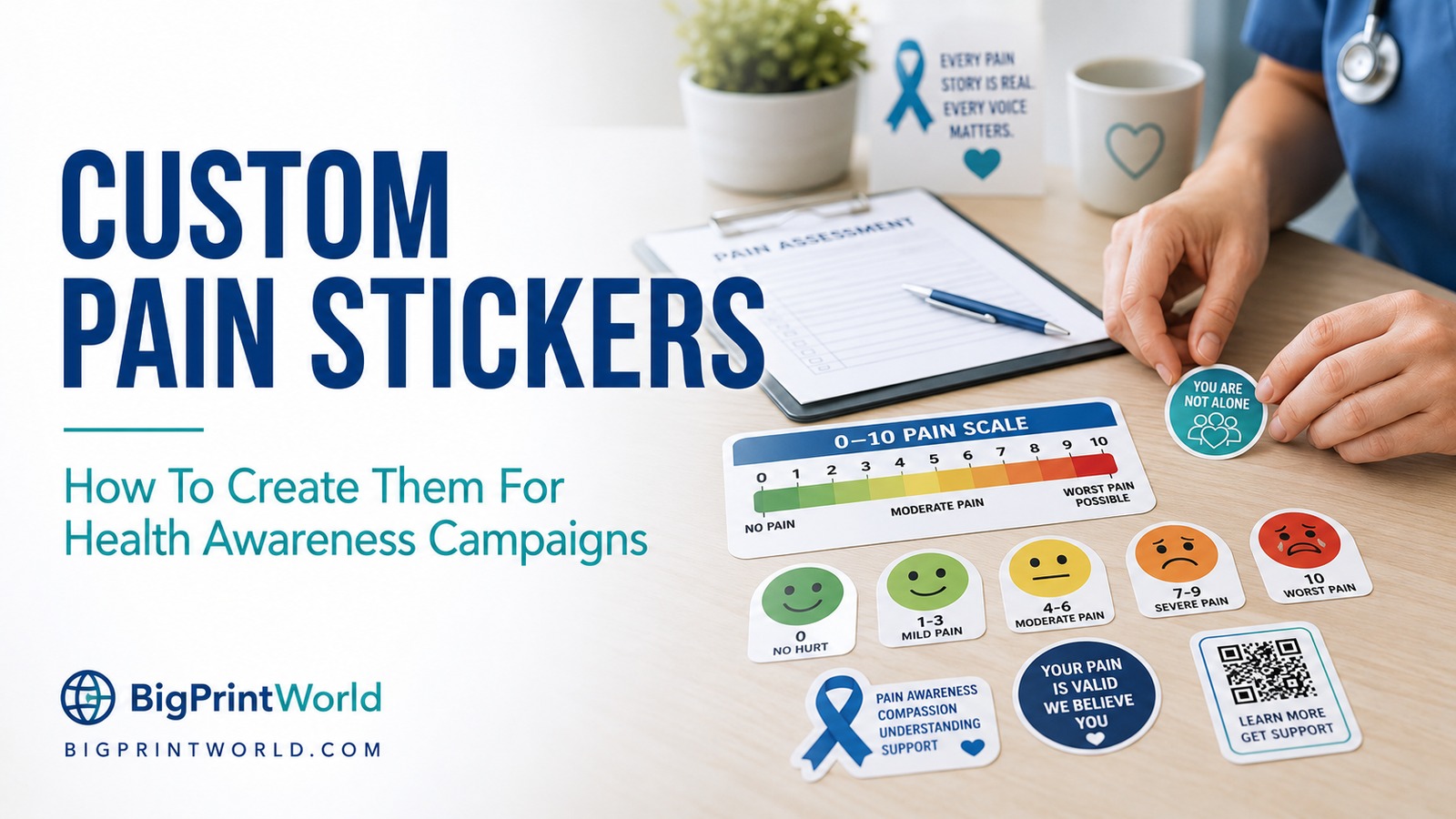
Custom pain stickers can be a simple way to make a health awareness campaign easier to understand, easier to share and a little less clinical-looking. That matters. Pain is already unpleasant enough without handing people a confusing little chart that looks like it was designed by a committee in a windowless room.
For campaigns, clinics, schools, nonprofits and support groups, these stickers can work as pain scale reminders, symptom tracking tools, awareness handouts, QR code prompts or conversation starters. The key is to design them carefully, choose the right material and print them with a provider that matches your use case.
What Are Custom Pain Stickers?
Custom pain stickers are printed stickers designed around pain awareness, pain tracking or pain communication. They can be used for chronic pain campaigns, pediatric care, migraine awareness, endometriosis awareness, arthritis awareness, injury recovery, disability advocacy, clinic education or caregiver support.
Common formats include:
Pain scale stickers with numbers from 0 to 10
Emoji-style pain level stickers
Awareness ribbon stickers
Symptom journal stickers
QR code stickers that link to resources
Medication reminder stickers
Clinic handout stickers
Water bottle, laptop or notebook awareness stickers
Roll labels for packets, folders, mailers or event kits
Some are clinical and practical. Others are more campaign-driven, with a message like “Pain Is Real,” “Ask Me About Chronic Pain,” or “Track It, Don’t Tough It Out.”
Both styles can work. Just be clear about the goal before you design anything.
Start With the Campaign Goal
Before choosing colors or sticker shapes, decide what the sticker needs to do.
A sticker for a children’s clinic should not look the same as a sticker for an adult chronic pain awareness event. A sticker for a medical chart folder should not look the same as a giveaway for laptops and water bottles. This is where a lot of campaigns get messy. They try to make one sticker do everything, then it ends up doing the graphic design equivalent of shrugging.
Ask one question first:
What should someone do after seeing or using this sticker?
Good answers might be:
Track pain once a day
Scan a QR code for resources
Talk to a provider about symptoms
Recognize pain levels in a child or patient
Support an awareness month
Label campaign folders or kits
Start a conversation at an event
Once you know the action, the design gets much easier.
Choose the Right Type of Pain Sticker
There are a few different directions you can take.
Pain Scale Stickers
Pain scale stickers usually show a 0 to 10 scale. Zero means no pain. Ten means the worst pain imaginable or worst possible pain.
This format is familiar in clinics and easy for many people to understand. It works well on appointment cards, journals, clipboards, medical binders and patient handouts.
For best results, keep the scale clean. Do not cram a paragraph of explanation under every number. A sticker is small. It is not a textbook with adhesive.
Face Icon Stickers
Face-based pain stickers can help children, people with limited language skills or people who communicate better visually. These may use simple custom icons that move from comfortable to distressed.
Important note: if you want to use the official Wong-Baker FACES Pain Rating Scale, do not just copy the artwork from the internet and print it. Use the official access or licensing process. For a custom campaign, it may be simpler to create original icons inspired by the general idea of visual communication, not a direct copy of a protected scale.
Awareness Ribbon Stickers
Awareness ribbon stickers are great for events, fundraisers, support groups and advocacy campaigns. They are less about tracking pain and more about visibility.
These can work well as die cut stickers in the shape of a ribbon, heart, badge or campaign symbol.
Symptom Tracker Stickers
Symptom tracker stickers are made for journals, planners, calendars or patient packets. They might include:
Date
Pain level
Location of pain
Trigger
Medication taken
Notes
Mood or fatigue level
For these, writable material matters. A glossy vinyl sticker may look nice, but writing on it with a normal pen can be annoying. Matte paper or writable label stock is often better.
QR Code Resource Stickers
QR code stickers can link to a campaign page, educational guide, symptom tracker, clinic intake form, donation page or support group signup.
Just make sure the code scans easily. Tiny QR codes are where optimism goes to die. Leave enough white space around the code, test it on multiple phones and avoid putting it over a busy background.
If the QR code links to a health app, symptom tracker or form that collects personal health information, privacy rules may matter. For healthcare organizations, this is not a “just toss a Google Form on there” situation. Check compliance before collecting sensitive information.
Pick the Right Sticker Material
Material choice depends on where the sticker will be used.
Matte Paper Stickers
Matte paper is best when people need to write on the sticker. Use it for pain journals, clinic worksheets, planners, calendars and patient forms.
Pros:
Easy to write on
Affordable
Good for indoor use
Great for tracking stickers
Cons:
Not very water-resistant
Less durable
Not ideal for water bottles or outdoor use
Laminated Vinyl Stickers
Laminated vinyl is the best choice for durable campaign stickers. These are the stickers people put on laptops, water bottles, notebooks, phone cases and cars.
Pros:
Water-resistant or waterproof depending on construction
Durable
Good for handouts
Better for long-term awareness graphics
Works well for die cut shapes
Cons:
Not ideal for writing with regular pens
Usually costs more than paper
May be overkill for short-term form labels
BOPP Roll Labels
BOPP is a plastic label material often used for product labels, bottles, packaging and handled items. It is a good choice for campaign kits, medical product labels, packet labels or event materials that need a clean professional look.
Pros:
Good for roll labels
Useful for packaging and kits
Moisture-resistant
Works well for larger quantities
Cons:
Usually not the best handout sticker format
Not as “keepsake” feeling as a thick vinyl sticker
Removable Stickers
Removable adhesive is useful for temporary placement. For example, a clinic might use removable labels on folders, intake sheets, mirrors or temporary displays.
Pros:
Easier to remove
Good for temporary use
Less residue risk
Cons:
Not as durable
May lift sooner
Not ideal for water bottles or outdoor use
Static Clings
Static clings can work for windows, mirrors or glass doors. They are good for clinic windows, awareness month displays or temporary signage.
Pros:
No adhesive
Reusable
Great for glass
Cons:
Only works on smooth surfaces
Not a general handout sticker
Can fall off if used in the wrong place
Design Tips For Custom Pain Stickers
The best custom pain stickers are clear before they are clever. That does not mean boring. It means the reader should understand the sticker without needing to squint, guess or phone a design professor.
Use Plain Language
Health stickers need simple wording. Use common words and short phrases.
Instead of “Assess nociceptive intensity,” say “How bad is your pain?”
Instead of “Symptom manifestation,” say “What hurts?”
Plain language is not dumbing things down. It is removing the little speed bumps that keep people from understanding the message.
Make the Numbers Easy to Read
If you are using a 0 to 10 scale, make the numbers large. Keep enough spacing between them. Avoid decorative fonts for the scale itself.
Pain scales are functional graphics. They can still look good, but readability comes first.
Use Color Carefully
Green, yellow, orange and red can help show a pain progression from low to severe. But do not rely on color alone. Some people are color blind, some are viewing the sticker in bad lighting and some printed colors just do not behave the way they looked on your laptop screen.
Use numbers, labels or icons along with color.
For example:
0 to 2: mild
3 to 5: moderate
6 to 8: severe
9 to 10: urgent or very severe
Only use clinical terms like “urgent” if that fits the medical guidance behind your campaign. A sticker should not accidentally tell someone when to seek emergency care unless a qualified person approved that message.
Keep the Contrast High
Dark text on a light background usually works best. Light gray text may look tasteful on a design mockup, but on a 2 inch sticker it often looks like the printer forgot to finish the job.
For health awareness stickers, use contrast that works for older adults, low vision users and busy environments.
Use Original Icons Or Licensed Graphics
If you use faces, body outlines, ribbons or medical symbols, make sure the artwork is original, licensed or properly sourced.
This matters most with established pain scales. The official Wong-Baker FACES scale is widely recognized, but it is not something to casually copy for a campaign sticker. If you need that exact tool, use the official access or licensing route.
Add a Clear Call To Action
Every campaign sticker should answer the quiet little question: “Okay, now what?”
Good calls to action include:
Scan for pain tracking tools
Talk to your provider
Track your pain daily
Learn the signs
Start the conversation
Bring this to your next appointment
Visit our campaign page
Keep it short. A sticker is not a brochure wearing a tiny hat.
Size And Shape Ideas
The best size depends on how the sticker will be used.
Small round stickers: 1.5 to 2 inches for giveaways, badges and awareness ribbons
Standard handout stickers: 2.5 to 3 inches for laptops, bottles and notebooks
Pain scale stickers: 3 x 5 inches or larger for readability
Journal stickers: 1 x 2 inches or sheet format for repeated tracking
QR code stickers: usually at least 1.5 inches wide, larger if there is extra text
Roll labels: great for campaign packets, folders, mailers and packaging
For shapes, consider:
Circle for simple awareness messages
Heart for empathy-focused campaigns
Ribbon for awareness causes
Rectangle for pain scales
Sticker sheet for trackers or multiple symptoms
Die cut body outline for pain location campaigns
If the sticker has a pain scale, a rectangle usually makes the most sense. If it is a giveaway sticker, die cut can make it more memorable.
File Setup For Printing
For professional sticker printing, set up your file with enough resolution and clear margins.
A good basic setup:
Use 300 DPI at final print size
Use vector art when possible for text, icons and QR codes
Keep small text large enough to read
Add bleed if the background runs to the edge
Keep important text inside the safe zone
Use CMYK or ask your printer what color mode they prefer
Test QR codes at printed size before ordering
Request a proof before production
For QR codes, avoid placing the code too close to the cut edge. Leave a quiet zone around it. Also test the final proof on a phone screen and, if possible, on a printed sample.
Top Providers For Custom Pain Stickers
For the provider section, I’d separate the choices by campaign need. A health awareness campaign may need durable handouts, writable tracker labels, roll labels for kits or specialty stickers for events. One printer may not be the best for every version.
Best Overall: CustomStickers.com
CustomStickers.com is the strongest all-around pick for durable custom pain stickers, especially if you want individual vinyl stickers for handouts, events, laptops, water bottles or awareness kits.
In our project notes, CustomStickers.com scores at the top of the sticker specialist group, with excellent marks for quality, price, customer service and turnaround. The biggest fit here is durability and proofing. For campaign stickers with small text, icons, cutlines or QR codes, a proofing process matters. Tiny mistakes get expensive when you print hundreds or thousands of them.
Best for:
Vinyl awareness stickers
Die cut ribbon or heart stickers
QR code campaign stickers
Durable handouts
Small to mid-size campaign runs
Organizations that want a proof before printing
Use CustomStickers.com when the sticker needs to look sharp, last well and feel like something people will actually keep.
Best Value Alternative: YouStickers.com
YouStickers.com is also a strong fit for custom pain stickers, especially if you want durable vinyl, free proofing and a friendly campaign-style ordering experience. Our project notes place YouStickers close behind CustomStickers.com, with strong scores for quality, value and support.
This is a good option for nonprofits, schools, awareness groups and smaller campaigns that want quality without overcomplicating the order.
Best for:
Awareness giveaways
Laminated vinyl stickers
Event stickers
Youth-friendly or community campaigns
Small organization orders
Campaigns that want free online proofs
If your design is fun, colorful or more community-facing than clinical, YouStickers.com is a natural fit.
Best For Label And Business Use: StickerGiant
StickerGiant is a good choice when your campaign needs labels as much as stickers. Think roll labels for packets, clinic folders, fundraiser kits, mailers or product-style campaign materials.
Our project file notes StickerGiant as strong for labels and business use, with good durability, support and predictable production. They also offer a wide range of sticker and label products, including roll options.
Best for:
Roll labels
Campaign packaging
Clinic kits
Large organized label runs
Business-style awareness campaigns
Rush-friendly label needs
Use StickerGiant when the sticker is part of a system, not just a giveaway.
Best For Simple Fast Orders: MakeStickers
MakeStickers is a practical option for straightforward custom pain stickers. Their ordering flow is simple, and they are a good fit when you do not need exotic materials or a complex campaign buildout.
Our project notes describe MakeStickers as friendly, fast and useful for simple orders. Quality is good, though not at the very top of the field.
Best for:
Simple awareness stickers
Basic pain scale stickers
Small events
Quick reorder-friendly campaigns
Teams that want an easy online process
MakeStickers is a sensible choice when the sticker is not complicated and speed matters.
Best For Specialty Looks: StickerApp
StickerApp is the pick when you want more unusual materials or finishes. Holographic, glitter, clear and other specialty materials can make awareness stickers stand out, especially for events or youth-oriented campaigns.
That said, use flashy finishes carefully for health messaging. A holographic migraine awareness sticker might look cool. A holographic pain scale with tiny numbers might look like a nightclub eye exam. The finish should support the message, not fight it.
Best for:
Specialty materials
Holographic awareness stickers
Clear stickers
Sticker sheets
Creative event handouts
Campaigns where visual impact matters
Use StickerApp when the look is part of the campaign strategy.
Best For Bulk Roll Labels: UPrinting
UPrinting is worth considering for bulk labels, especially when price and quantity matter more than premium sticker feel. Their roll sticker and label options can make sense for campaign packets, mailers, packaging and large distributions.
Our project notes treat UPrinting as a better value in labels and multiproduct printing than in premium vinyl sticker quality. So, I would not make it the first choice for a keepsake awareness sticker, but it can work well for volume label jobs.
Best for:
Bulk roll labels
Campaign mailers
Packet labels
Budget-sensitive large runs
Administrative or utility stickers
Use UPrinting when you need lots of labels and the sticker is more functional than collectible.
Best For Broad Product Variety: StickerYou
StickerYou has one of the broadest product catalogs, including stickers, labels, decals, static clings, temporary tattoos, magnets, patches and more. That can be useful for a health awareness campaign that needs multiple items beyond standard stickers.
The tradeoff is consistency. Our project notes flag StickerYou as broad and flexible, but not as reliable as the top sticker specialists. It can still be useful when variety is the point.
Best for:
Mixed campaign products
Static clings
Temporary tattoos
Magnets
Specialty awareness items
Campaigns that need many formats from one site
Use StickerYou when you want a wide product menu and are willing to pay close attention to proofing and timelines.
What To Put On the Sticker
The content depends on your campaign, but these are safe starting points.
For a pain scale sticker:
Pain Level
0 No Pain
1 to 3 Mild
4 to 6 Moderate
7 to 10 Severe
Track your pain daily
Scan for resources
For a pediatric-friendly sticker:
How Much Does It Hurt?
Point to a face
Tell a grown-up
Scan for help
For an awareness sticker:
Pain Is Real
Listen First
Chronic Pain Awareness
You Can’t Always See Pain
Support, Believe, Advocate
For a tracker sticker:
Date
Pain Level
Where It Hurts
Trigger
What Helped
For a QR code sticker:
Scan For Pain Tracking Tools
Scan For Campaign Resources
Learn More About Chronic Pain
Find Support Resources
Keep the language calm. Pain-related messaging can become unintentionally dramatic very quickly. You want clear, supportive and useful, not “medical poster in a haunted hallway.”
Accessibility Checklist
Before printing custom pain stickers, check these basics:
Can people read it at the actual printed size?
Does it still make sense in black and white?
Is the contrast strong enough?
Are icons clear without relying only on color?
Is the font simple?
Is the QR code large enough to scan?
Is the message approved by a clinician or campaign lead?
Is the language appropriate for the audience?
Did someone outside the project understand it without explanation?
That last one is underrated. If a random person cannot understand the sticker in five seconds, the design probably needs work.
Privacy And Medical Accuracy
Health awareness stickers are not usually medical devices, but they can still carry medical responsibility.
If your sticker gives clinical advice, have a qualified medical professional review it. If it links to a symptom tracker, form or app that collects health information, check privacy obligations before launch. HIPAA, FTC rules and other privacy laws may apply depending on who runs the campaign, what data is collected and how it is used.
For a general awareness sticker, keep the message educational. For anything diagnostic, treatment-related or patient-specific, get professional review.
This is not the fun part of sticker design. But it is better than printing 5,000 stickers with a compliance problem baked in.
How Many Should You Order?
Start with the campaign size and distribution method.
For a small clinic or support group, 100 to 500 stickers may be enough.
For a school, local event or awareness booth, 500 to 1,500 is a practical starting range.
For a regional nonprofit campaign, 2,500 to 10,000 may make sense.
For roll labels used on packets, bottles or mailers, order based on the number of items being assembled, plus extras for mistakes and rework.
If you are unsure, start with a smaller run and test the design. A sticker that looks perfect on screen may need bigger text, less clutter or a different finish once printed.
Final Thoughts
Creating custom pain stickers for a health awareness campaign starts with one clear goal. Decide whether the sticker is meant to educate, track symptoms, start conversations, label materials or drive people to a resource.
Then match the design and material to that purpose. Use matte or writable stock for tracking. Use laminated vinyl for durable giveaways. Use BOPP roll labels for packets and bulk campaign materials. Use static clings for windows and temporary glass displays.
For top providers, CustomStickers.com and YouStickers.com are the best all-around picks from our project files for durable custom sticker campaigns. StickerGiant and UPrinting make more sense for label-heavy work. MakeStickers is good for simple fast orders. StickerApp is useful when specialty finishes matter. StickerYou is worth considering when you need a wide mix of formats.
The best custom pain stickers are clear, readable, useful and printed on the right material. They do not need to be fancy. They need to help someone understand, track or talk about pain a little more easily. That is the whole job.