
TLDR
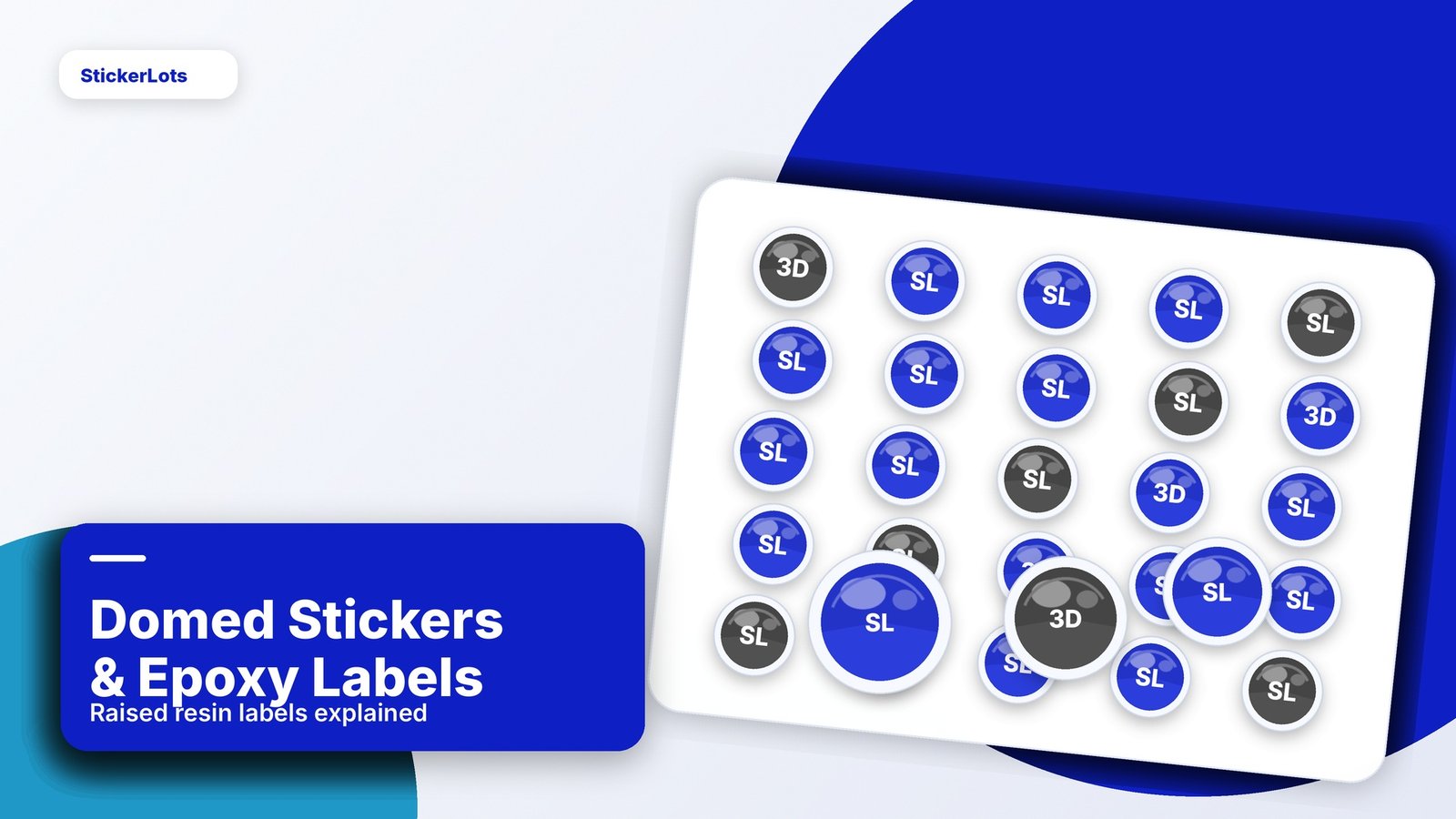
- Domed stickers are printed stickers or labels covered with a clear raised resin coating.
- They create a glossy, 3D, slightly cushioned look that makes logos and product badges feel more substantial.
- They work best for product branding, equipment labels, electronics, tools, automotive accents, and polished promotional items.
- They are not the best choice for tiny text, flexible packaging, low-cost giveaways, tight curves, or sticker packs.
- Many modern domed labels use polyurethane resin, even when people casually call them epoxy resin labels.
Domed stickers are the shiny, raised labels you often see on electronics, tools, appliances, gear, and product badges. They have that smooth little “bubble” on top that makes a logo feel thicker, glossier, and more permanent.
They are also called epoxy resin labels, resin dome labels, gel labels, 3D stickers, or domed decals. The names get used loosely, but the basic idea is the same: print the design, cut the label, then add a clear resin coating that cures into a rounded dome.
What Are Domed Stickers?
Domed stickers are pressure-sensitive stickers or labels with a clear raised coating over the printed artwork.
A typical domed sticker has three main parts:
- a printed base material, often vinyl, polyester, or another film
- adhesive on the back
- a clear resin layer on top that forms the dome
That top layer is what gives the sticker its raised, glossy, dimensional look. It acts almost like a tiny lens over the design. Colors can look deeper, logos can feel more polished, and the finished label has a tactile feel that flat stickers do not have.
In professional label production, the dome is often made from polyurethane resin. People still use the phrase epoxy resin labels because it is familiar, but polyurethane is common for domed labels because it can stay flexible and clear when properly formulated.
How Domed Stickers Differ From Flat Stickers
Flat stickers are printed, cut, and finished with a flat surface. They may have a matte laminate, gloss laminate, clear material, holographic film, or another finish, but they stay flat.
Domed stickers add physical depth.
That depth changes several things:
- the sticker feels thicker
- the surface catches light differently
- the logo looks more dimensional
- the print has a protective clear layer
- the finished piece feels more like a badge or nameplate than a standard sticker
This is why domed stickers often show up on products rather than sticker packs. They are less about handing someone a fun decal and more about making a logo, control panel, or product mark feel finished.
A flat sticker says, “Here is the design.” A domed sticker says, “This belongs on the product.”
Very fancy for something that still peels off a liner.
When Domed Stickers Make Sense
Domed stickers are best when the sticker is part of the product presentation.
They work well for:
- electronics logos
- speaker badges
- appliance labels
- power tool branding
- automotive interior accents
- bike and scooter badges
- outdoor gear labels
- machinery labels
- equipment nameplates
- premium promotional products
- small brand badges on packaging or displays
The raised resin helps a simple logo feel more finished. That can be useful when a brand wants a product to look more polished without using a metal badge, molded part, or screen printing directly onto the object.
Domed stickers are also helpful when touch matters. If someone picks up a product and their thumb lands on the label, the raised surface can make the product feel more substantial.
When Domed Stickers Are Not The Best Choice
Domed stickers are not automatically better than flat stickers. They are better for certain jobs.
Skip domed stickers when you need:
- very low-cost handouts
- sticker packs with many small designs
- labels for envelopes or mailers
- stickers that need to bend sharply
- labels that wrap around tight curves
- tiny text or very fine line art
- QR codes or barcodes where glare could interfere
- labels for rough or heavily textured surfaces
- packaging that will be stacked tightly
- a subtle matte finish
The dome adds thickness, shine, and cost. Those are benefits when you want a badge-like finish. They are drawbacks when you need something thin, flexible, cheap, or easy to mail in bulk.
For everyday durable flat stickers, a standard vinyl sticker may be the better choice. A source like www.CustomStickers.com is a better fit when you want classic custom stickers, sticker sheets, or flat laminated vinyl stickers instead of a raised resin label.
Domed Stickers vs Epoxy Resin Labels
The terms domed stickers and epoxy resin labels often get used interchangeably, but they are not always technically identical.
“Domed sticker” describes the shape and finished look. It means the sticker has a raised clear dome over the design.
“Epoxy resin label” describes the material people assume is used to create that dome. In some cases, epoxy may be used. In many modern professional applications, the dome may be polyurethane instead.
That difference matters because resin quality affects clarity, flexibility, yellowing, scratch resistance, and outdoor performance. For a serious product label, ask the printer what resin is used instead of relying on the generic phrase “epoxy.”
A good question to ask is:
“Are these domed stickers made with epoxy or polyurethane resin, and are they recommended for the surface and environment where we plan to use them?”
That one sentence can prevent a lot of guessing.
Design Tips For Better Domed Stickers
Domed stickers look best when the design is simple, bold, and easy to read.
Good domed sticker designs usually have:
- clean logo shapes
- strong contrast
- simple type
- rounded corners
- enough margin around the artwork
- a shape that lets the resin settle evenly
- a clear edge that contains the dome cleanly
Avoid designs with tiny text, fragile lines, complicated cut shapes, or important details right at the edge. The dome creates a curved surface, so small details can become harder to see from certain angles.
Rounded rectangles, circles, ovals, and simple custom shapes are usually safer than spiky or very complex outlines. The resin needs to flow cleanly and stop at the edge. If the shape is too intricate, the finished result may not look as smooth.
Surface Choice Matters
Domed stickers usually work best on smooth, clean, rigid surfaces.
Good surfaces include:
- smooth plastic
- coated metal
- glass
- finished electronics housings
- flat product panels
- smooth painted surfaces
More difficult surfaces include:
- textured plastic
- fabric
- raw wood
- rubbery materials
- powder-coated surfaces with heavy texture
- flexible pouches
- tight curved bottles
Adhesive choice also matters. A domed label on a slightly curved hard surface may work fine if the sticker is small and the adhesive is right. A large domed sticker on a flexible pouch is usually asking too much.
When in doubt, test a sample on the actual product surface. Not a similar surface. The actual surface. Sticker testing loves tiny differences.
What To Ask Before Ordering Domed Stickers
Before placing a domed sticker order, ask a few practical questions:
- What resin is used for the dome?
- Is the resin recommended for indoor use, outdoor use, or both?
- What base material will be printed?
- What adhesive is recommended for the surface?
- How thick will the finished dome be?
- Can the shape support clean resin flow?
- Are there minimum size requirements?
- Will the sticker work on a curved surface?
- Is a sample available before a full order?
- How should the surface be cleaned before application?
These questions are especially important for product labels, equipment badges, automotive accessories, or anything exposed to sunlight, heat, moisture, cleaning chemicals, or abrasion.
Domed Stickers vs Other Specialty Stickers
Domed stickers are one specialty option, but they are not the only way to make a design stand out.
Consider:
- gloss stickers for shine without thickness
- matte stickers for a softer, less reflective look
- holographic stickers for color-shifting effects
- glitter stickers for sparkle
- clear stickers for a no-background look
- metallic stickers for a badge-like finish without resin
If you are mostly deciding between flat finishes, StickerLots has a helpful guide to matte vs gloss stickers. Domed stickers are a bigger jump than matte versus gloss because they change the physical feel, not just the surface finish.
The Simple Recommendation
Use domed stickers when the label is part of the product’s perceived quality.
They are a strong choice for logos, badges, equipment labels, and product marks that should feel polished and durable. They are less ideal for casual giveaways, large sticker packs, very small artwork, or labels that need to bend.
The best domed sticker designs are simple, bold, and placed on smooth rigid surfaces. When the surface, resin, adhesive, and design all match the job, domed stickers can look surprisingly sharp for such a small detail.
FAQs
What are domed stickers made of?
Domed stickers usually have a printed adhesive base with a clear resin coating on top. Many professional domed labels use polyurethane resin, though people often call the category epoxy resin labels.
Are domed stickers waterproof?
Many domed stickers are designed to resist moisture, but performance depends on the base material, adhesive, resin, edge seal, and application surface. For outdoor or wet use, ask the printer for the recommended material and test a sample.
Are domed stickers good for laptops and water bottles?
They can work on some smooth surfaces, but they are usually thicker than normal laptop or water bottle stickers. For everyday personal stickers, flat vinyl stickers are usually more practical.
Can domed stickers be any shape?
They can be made in many shapes, but simple shapes usually work best. Circles, ovals, rounded rectangles, and smooth custom outlines allow the resin to form a cleaner dome.
Do domed stickers yellow over time?
Low-quality resin or the wrong resin for the environment may yellow, harden, or lose clarity. Ask whether the resin is designed for UV exposure if the sticker will be used outdoors or near sunlight.
Are domed stickers expensive?
They usually cost more than flat stickers because they require an additional resin application and curing process. They make the most sense when the raised finish adds real value to the product or brand presentation.